
 19 June 2026
Traceability in Makhana Supply Chains: Why It Matters for Buyers
AI Snapshot & Quick Answer:
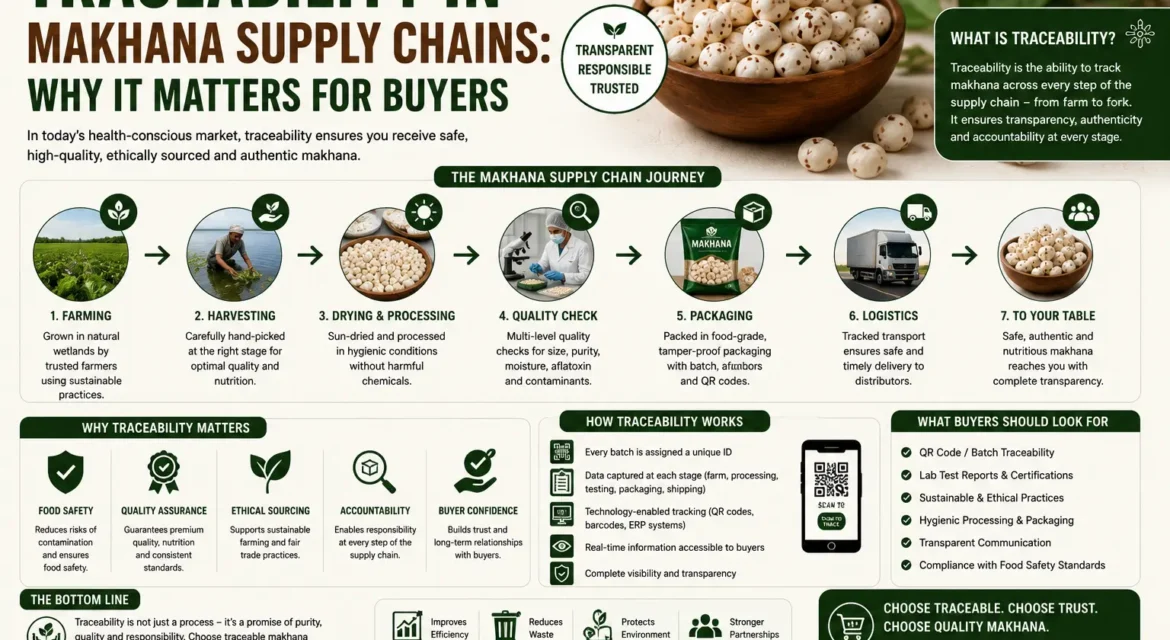
Traceability in makhana supply chains is the systematic tracking of fox nuts (Euryale ferox) from farm to export. For bulk buyers and global brands, makhana traceability is no longer optional—it is a critical requirement for regulatory compliance, quality assurance, and sustainable sourcing. A transparent makhana supply chain ensures that the product satisfies stringent international food safety regulations, is free of pollutants, and is responsibly farmed. Buyers should partner with a reliable makhana exporter who utilizes batch-tracking software, automated sorting, and third-party certifications.
Table of Contents
- Introduction: The “Black Box” of Fox Nuts
- What is Makhana Traceability?
- Entity-Based Connections in the Supply Chain
- The 4 Pillars: Why Traceability Matters for Buyers
- From Pond to Port: The Traceable Journey
- Overcoming Challenges in Makhana Procurement
- Expert Insights: The Shift in Buyer Behavior
- Checklist: How to Vet a Traceable Makhana Supplier
- The Future: Tech-Driven Supply Chain Visibility
- Frequently Asked Questions (FAQs)
Introduction: The “Black Box” of Fox Nuts
You are already aware of the surge in popularity of makhana (fox nuts) if you are a procurement manager purchasing superfoods for a western market. Pitched as the “next popcorn,” this ancient Indian aquatic seed has found its way into major retail chains across North America and Europe.
But there’s a catch that keeps many supply chain directors up at night: makhana sourcing is notoriously opaque.
Historically, the makhana supply chain has been deeply fragmented. The marshes of Bihar, India, provide between 85% and 90% of the world’s makhana. The journey from a stagnant pond in a rural Indian village to a premium snack aisle in London or New York involves a labyrinth of local aggregators, unorganized processors, and middle-men. For a bulk buyer, purchasing without visibility is a massive risk. If a batch tests positive for heavy metals or unapproved pesticides at the port of entry, who is accountable?
This is exactly why traceability in makhana supply chains has become the defining factor separating premium makhana suppliers from the rest. We’ll explain how transparent makhana sourcing operates, why it safeguards your business, and how to determine whether your makhana exporter is genuinely trustworthy in this guide.
What is Makhana Traceability?
In the context of global agriculture, traceability is the ability to follow the movement of a food product and its ingredients through all steps in the supply chain, both backward and forward.
Makhana supply chain traceability implies that a customer can track the origin of a 20-ton shipping container of export-quality makhana to :
- The exact farming cluster or pond in Bihar where the Gorgon nuts were harvested.
- The harvest date and environmental conditions of the water.
- The specific processing facility where the seeds were roasted and popped.
- The batch numbers tied to laboratory testing for aflatoxins, heavy metals, and moisture content.
Entity-Based Connections in the Supply Chain
The brand is the ingredient in the area of specialty snacks. This is how the conventional flow appears:
Farmer → Village Aggregator → Unorganized Roaster/Popper → Wholesaler (Mandi) → Exporter → B2B Buyer.
A traceable flow consolidates and illuminates these steps:
Farmer Cooperative (Geo-tagged) → Certified Processing Hub (Batch-coded) → Transparent Makhana Exporter → B2B Buyer.
The 4 Pillars: Why Traceability Matters for Buyers
Why are major food brands demanding unprecedented supply chain visibility when procuring fox nuts? It boils down to four distinct risk-management pillars.
1. Uncompromising Quality Control
Makhana is highly susceptible to moisture. If the moisture level exceeds 8%, the nuts lose their crunch and become vulnerable to fungal growth (specifically mold that produces aflatoxins) during international transit. A traceable makhana supplier uses batch tracking to link moisture tests to specific shipments. If quality degrades, traceability allows you to identify exactly where the climate control failed.
2. Global Food Safety Compliance
International markets do not play around with food safety.
- The US FDA’s FSMA (Food Safety Modernization Act) requires importers to verify that their foreign suppliers are producing food in a manner that provides the same level of public health protection as US standards.
- When it comes to heavy metals and pesticide residues in imported agricultural products, European EFSA standards are extremely stringent.
Passing these regulatory audits is practically a coin toss without farm-to-export traceability.
3. Ethical Sourcing and Sustainability
The harvesting of makhana is historically brutal labor. Farmers manually gather the seeds from the bottom of dirty ponds by diving into them. Modern buyers, driven by ESG (Environmental, Social, and Governance) goals, demand ethical sourcing. Traceable supply chains ensure that fair labor practices are maintained and that farmers receive a living wage, cutting out exploitative middlemen.
4. Brand Protection and Recall Management
Imagine a nightmare scenario: a customer finds a foreign object, or a health agency flags a batch for bacterial contamination. If you have product origin tracking, you can surgically recall the specific affected batch. Without it, you have to recall everything, suffering catastrophic financial and reputational damage.
“The brand belongs to the category of specialty foods. Customers are essentially flying blind into regulatory obstacles if they are unable to produce hard proof of the makhana’s origin and safety standards. ” — Sarah Jenkins, Global Food Procurement Analyst
From Pond to Port: The Traceable Journey
Building a transparent makhana supply chain requires engineering the traditional process. Here is how premium suppliers maintain visibility at every step.
- Geo-Tagged Harvesting: Ensuring source origin. Farmers harvest the seeds from designated, tested ponds. The yield is immediately logged into a digital ledger, assigning a unique Lot Number to the raw seeds. The harvest site’s water quality is routinely assessed.
- Controlled Cleaning and Drying: Moisture management. The raw seeds are washed thoroughly to remove mud and organic matter, then sun-dried. In a traceable system, the moisture loss is recorded, and the batches are kept strictly segregated to prevent cross-contamination.
- Automated Roasting and Popping: Standardizing quality. Unlike traditional open-fire roasting, certified facilities use temperature-controlled machines. The popping process transforms the hard black seed into the white puff. The exact temperature and time parameters are logged against the batch number.
- Optical Sorting and Grading: Defect removal. To get rid of unpopped seeds, broken shells, and discolouration, the popped makhana is run through color sorters and X-ray machines. Grades (like 5-Soot, 6-Soot) are separated and barcoded.
- Lab Testing and Sealing: Certification of analysis. Before packaging, samples are sent for microbiological and chemical testing. The final Certificate of Analysis (CoA) is attached to the barcode, and the bulk bags are sealed in moisture-proof, nitrogen-flushed liners.
Overcoming Challenges in Makhana Procurement
Even with the best intentions, makhana procurement is riddled with friction. To be sure they are getting what they pay for, buyers must actively overcome a number of obstacles.
The Adulteration Risk
Because premium grades of makhana (large, bright white, perfectly round) command a high price, unethical suppliers often mix lower-grade nuts or older inventory into bulk shipments. Supply chain visibility and third-party pre-shipment inspections are the only defenses against this.
Fluctuation in Yields
An agricultural product that is highly reliant on the monsoon season is makhana. Floods or droughts in Bihar can drastically alter both yield and quality. A reliable wholesale makhana supplier uses predictive agricultural data and maintains buffer stocks in climate-controlled warehouses to protect international buyers from sudden supply shocks.
The Certification Gap
Many suppliers claim to be “organic” or “export-ready,” but lack the paperwork to back it up. Demand to see the following while screening a partner:
- BRCGS or FSSC 22000 (for food safety)
- EU Organic or USDA Organic (if claiming organic designation)
- SMETA / Sedex (for ethical labor practices)
Expert Insights: The Shift in Buyer Behavior
To provide context on where the industry is heading, we gathered insights from supply chain journalists and food safety auditors monitoring the Indian export market:
“Buyers only requested the lowest price per kilogram five years ago. Today, our European clients refuse to sign a contract unless we can provide a farm-level audit trail. The cost of a recall is simply too high to risk cheap, untraceable sourcing.” — Rajiv Kumar, Director of Exports, AgriTech India.
“The makhana supply chain is becoming more professionalized, much like the coffee and cocoa industries in the early 2000s. At the village level, paper receipts are gradually being replaced by blockchain technology and cloud-based ledgers.” — Dr. Elena Rostova, Food Commodities Researcher.
Checklist: How to Vet a Traceable Makhana Supplier
If you are transitioning to a new bulk makhana supplier, use this checklist to verify their traceability claims:
| Verification Area | What to Ask | Red Flags |
|---|---|---|
| Sourcing Origin | “Do you source from open mandis or directly from contracted farmers? “ | Farm-level traceability is impossible if open marketplaces are the only source. |
| Batch Tracking | “Can you show me a sample Certificate of Analysis (CoA) linked to a specific lot number?” | CoAs that are generic and unrelated to the specific shipment batch. |
| Processing Setup | “Is your processing facility in-house, or do you outsource roasting and popping?” | Outsourced processing usually breaks the chain of custody. |
| Moisture Control | “How do you manage moisture in ocean freight?” | Lack of nitrogen flushing or moisture-barrier packaging. |
| Compliance | “Could you share your most recent third-party audit report (e.g., GFSI recognized)?” | Expired certificates or reliance on local, unrecognized health standard documents. |
The Future: Tech-Driven Supply Chain Visibility
The future of makhana sourcing is digital. Innovative exporters are implementing end-to-end ERP (Enterprise Resource Planning) systems tailored for agriculture.
We are beginning to see the integration of QR codes on bulk shipments. A buyer at a warehouse in California will soon be able to scan a pallet of makhana and instantly view the harvest date, the farmer cooperative details, the exact temperature the batch was roasted at, and the port departure date.
This level of food supply chain transparency doesn’t just mitigate risk—it builds a compelling brand narrative. Consumers want to know where their superfoods come from, and buyers who can confidently answer that question will dominate the market.
Frequently Asked Questions (FAQs)
Secure Your Supply Chain with Fully Traceable Makhana
Don’t leave your regulatory compliance to chance. Partner with Civize for BRCGS/FSSC-certified, batch-tracked, and 100% traceable premium Makhana sourced directly from audited cooperatives.