
 12 August 2026
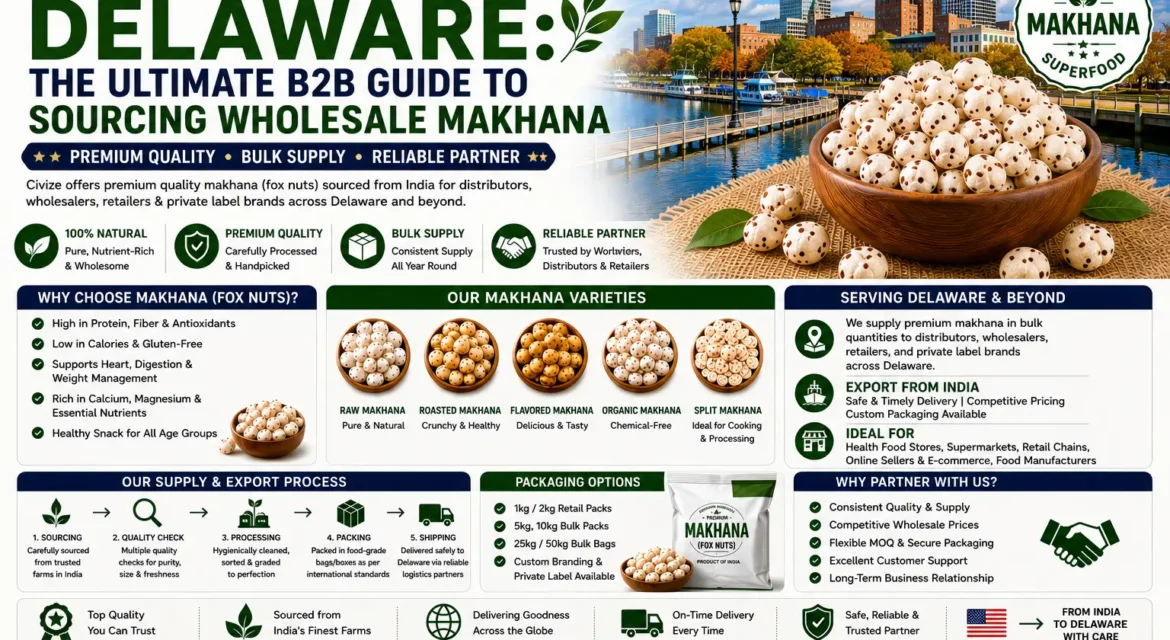
Fox Nut Distributor Delaware: The Ultimate B2B Guide to Sourcing Wholesale Makhana
The global snacking landscape is undergoing a massive transformation. Across the United States, consumers are aggressively pivoting away from highly processed, seed-oil-drenched potato chips and corn puffs. In their place, a new superfood has emerged on the shelves of premium grocers and massive retail chains alike: the Fox Nut, also known as Phool Makhana.
Contact Civize Today to Discuss Bulk PricingIf you are a procurement manager, food manufacturer, or retail buyer searching for a reliable Fox Nut Distributor in Delaware, your search ends here. Civize is a premier global export company specializing in the wholesale supply of export-grade Phool Makhana. We bridge the gap between the rural aquatic farms of Bihar, India (which produces 90% of the global supply) and the strategic distribution hubs of Delaware, ensuring strict FDA compliance, rigorous moisture control, and precise grading.
This comprehensive guide serves as your ultimate resource for understanding the wholesale makhana market, navigating B2B procurement challenges, and leveraging Civize as your dedicated Delaware supplier.
The Rise of Fox Nuts (Makhana) in the US Snack Market
To understand the explosive demand for wholesale fox nuts, we must first look at what makes this ancient seed a modern snacking holy grail.
What is a Fox Nut (Phool Makhana)?
Entity Definition: The Fox Nut is the edible seed of the Euryale ferox plant, a species of water lily. Cultivated primarily in the stagnant wetlands of Bihar, India, the hard black seeds are harvested, sun-dried, roasted, and manually popped into the fluffy, white, popcorn-like snack known as Phool Makhana.
The Nutritional Profile Driving Consumer Demand
Historically used in Ayurvedic medicine and Indian religious fasting, makhana has crossed over into mainstream Western diets because it perfectly aligns with modern health trends:
- Plant-Based Protein: A natural source of vegan protein.
- Gluten-Free and Grain-Free: Safe for celiac and paleo demographics.
- Low Glycemic Index: Ideal for diabetic and pre-diabetic consumers, preventing sudden sugar spikes.
- Rich in Antioxidants: Contains kaempferol, which combats inflammation and free radicals.
- Digestive Health: High dietary fiber content promotes gut health.
“The US snack market is no longer satisfied with ‘less bad’ options. Consumers want functional foods that deliver active health benefits without sacrificing crunch. Makhana is unique because its neutral flavor profile acts as a perfect canvas for both savory Western seasonings and sweet coatings, making it the most versatile raw material in the better-for-you category today.” — Food Science & Snack Innovation Analyst
Why Delaware is a Strategic Hub for Makhana Distribution
When importing agricultural commodities into the USA, logistics dictate profitability. Delaware is not just a corporate haven; it is a logistical powerhouse for food distribution.
- Tax Advantages: Delaware’s business-friendly tax structures allow wholesale distributors and FMCG brands to optimize their B2B transactions and inventory holding costs.
- Proximity to East Coast Markets: Situated perfectly within the Mid-Atlantic region, a warehouse in Delaware provides overnight trucking access to massive metropolitan markets including New York, Philadelphia, Baltimore, and Washington D.C.
- Port Access: Easy access to the Port of Wilmington and nearby Port of New York/New Jersey ensures that inbound ocean freight containers of makhana can be quickly offloaded, cleared through customs, and transported to local distribution centers with minimal drayage costs.
For companies seeking a Fox Nut Supplier in Delaware, partnering with Civize ensures your supply chain is fortified from the farm to the East Coast.
Sourcing Challenges in the Makhana Supply Chain
Sourcing fox nuts internationally isn’t as simple as placing a bulk order on a B2B marketplace. The makhana supply chain is notoriously fragmented, presenting several high-risk challenges for uninformed buyers.
1. Manual Processing and Quality Inconsistency
The popping of makhana is a highly labor-intensive, artisanal process. Farmers dive into ponds to harvest seeds, which are then roasted over high flames and popped manually with wooden mallets. Because this isn’t an automated factory process, the risk of broken pieces, un-popped hard seeds (godi), and uneven coloring is incredibly high.
2. The Blending Problem
Many unscrupulous bulk makhana suppliers mix lower-grade nuts with premium batches to pad their margins. A buyer might inspect a sample of perfectly round 6-suta makhana, only to receive a container filled with 20% broken pieces and smaller grades.
3. Moisture and Infestation Risks
During the 30-to-40-day ocean transit from India to the US East Coast, temperature fluctuations can cause condensation inside the shipping container. If the makhana is not adequately dried (moisture > 8%) and improperly packaged, the entire shipment can arrive rancid, chewy, or infested with weevils.
The Civize Solution: A QA-Tested Supply Chain
As a premier Fox Nut Exporter Delaware buyers can trust, Civize bypasses the fragmented local middleman markets (mandis). We procure directly from verified farmer cooperatives in Bihar.
Here is how we mitigate risk for our B2B partners:
- Optical Sorting: We run raw pops through advanced optical sorting (Sortex) machines to guarantee uniformity in size and color.
- Strict Moisture Control: Every batch is tested to ensure moisture content is strictly below 8%, preserving the crucial crunch.
- Zero Tolerance for Godi: We guarantee zero un-popped seeds in our premium export grades, protecting your end-consumers from dental hazards.
Compare Wholesale Supply Chain Models
To understand the financial and operational impact of different sourcing strategies, explore the interactive supply chain comparison widget below:
Key Takeaway: Every middleman in the traditional supply chain adds a 5-10% markup and increases the risk of product degradation due to poor storage. Direct sourcing is the only way to ensure both competitive pricing and premium quality.
Civize Makhana Specifications and Grades (The B2B Standard)
When looking to buy fox nuts online in bulk, “premium” is a meaningless buzzword. Makhana is traded using exact, quantifiable grading standards in the professional B2B export market. Makhana is graded by its size (diameter) and its color, using a traditional measurement unit called the “Suta”.
If you are a Makhana Distributor Delaware USA, you must align the grade you purchase with your end-product strategy.
The “Suta” Grading System
| Grade | Size (Diameter) | Best Use Case | Characteristics |
|---|---|---|---|
| 4-Suta | 12mm – 15mm | Powdered makhana, baby food, heavily coated snacks | Smaller, denser nuts. Highly cost-effective where visual size does not impact the final product’s appeal. |
| 5-Suta | 15mm – 18mm | Standard retail flavored snacks | The industry standard. provides a great mix of price, crunch, and size. |
| 6-Suta & 7-Suta | 18mm – 22mm | Luxury health food brands, boutique retail | The highest export quality. Big, flawlessly round, snow-white fox nuts with very little red seed-coat. |
Civize Quality Assurance Parameters
Regardless of the grade you select, every container shipped to our Delaware partners adheres to strict limits:
- Moisture Content: < 8%
- Broken/Damaged Nuts: < 2% by weight
- Un-popped Seeds (Godi): 0%
- Color: Bright white (A-Grade) to off-white, customizable to client specifications.
Product Offerings: Raw, Roasted, and Private Label
As a comprehensive Fox Nut Wholesaler Delaware businesses rely on, Civize offers flexible sourcing models tailored to your position in the food manufacturing funnel.
Bulk Raw Phool Makhana
Ideal for commodity traders or US-based snack manufacturers who possess their own commercial roasting and flavoring facilities.
- Packaging: We ship in bulk PP (Polypropylene) bags or specialized moisture-barrier gunny bags. Makhana is incredibly voluminous; a standard bag typically holds 8kg to 10kg.
- Strategic Advantage: Buying raw offers the lowest landed cost per kilogram, allowing you to tightly control the proprietary flavoring and coating processes in your local Delaware facility.
Private Label: Roasted & Flavored Makhana
For retail chains, boutique grocers, and FMCG brands looking for a ready-to-market product without the overhead of processing facilities, Civize provides end-to-end white labeling.
Roasting makhana is a delicate art.The delicate nut burns if the temperature is too high, and the center stays unpleasantly chewy if it is too low.
- Roasting Technology: Civize utilizes commercial hot-air continuous roasters to ensure a perfect, uniform crunch across massive batches.
- Roasting Mediums: Dry roasted (air popped), Olive Oil roasted, or traditional Indian Cow Ghee roasted.
- Western Flavor Profiles: We cater to the US palate with custom dustings, including Himalayan Pink Salt, Vegan White Cheddar, Truffle, Peri-Peri, and Jalapeño.
Strategic Logistics: Importing to the USA
Successfully operating as a Fox Nut Distributor in Delaware requires mastering the complexities of international freight and US border compliance.
Regulatory Compliance and FDA Standards
Entering US ports requires rigorous documentation. Civize ensures that all our export operations adhere strictly to US FDA regulations and the Food Safety Modernization Act (FSMA) guidelines. To ensure a seamless, easy entry into East Coast ports, we carry out comprehensive third-party lab testing for heavy metals, pesticide residues (MRL compliance), and microbiological variables (Salmonella, E. coli).
The Reality of Volumetric Freight
Procurement managers must understand that makhana is incredibly light but takes up massive physical volume. Compared to dense commodities like cashews, peanuts, or almonds, a typical 40-foot High Cube (HC) shipping container can hold far less weight in makhana.
As a result, the landing CIF (Cost, Insurance, and Freight) price is significantly impacted by ocean freight costs. When ocean freight rates spike, the price per kilogram of landed makhana in Delaware will rise accordingly, even if the raw commodity price in India remains stable. Civize works closely with logistics partners to optimize container packing, maximizing the weight-to-volume ratio without crushing the fragile product.
Pricing Dynamics: Understanding Wholesale Makhana Costs
The wholesale price of makhana fluctuates based on several core variables:
- Monsoon Impact: Because makhana is an aquatic crop, excessive flooding or drought during the Bihar monsoon season can severely impact crop yields, driving up raw material costs.
- Suta Grade Variation: 6-suta export-quality nuts command a significant premium over 4-suta commercial grades.
- Freight & Logistics: As noted, volumetric shipping costs are a major component of the final price
“Procurement teams need to lock in their makhana contracts immediately post-harvest (September/October) to secure the best pricing. Buying in the spot market during the US summer months often means paying a premium due to dwindling high-grade inventory in India.” — Global Commodities Trading Expert
How to Choose a Fox Nut Supplier in Delaware (Buyer’s Checklist)
If you are evaluating partners for wholesale makhana supply, use this checklist to separate reliable exporters from risky middlemen:
- Do they own the grading process? Ask for their Suta specifications and tolerance levels for broken pieces.
- How do they control moisture? Ensure they guarantee moisture levels below 8% and use moisture-barrier packaging.
- Are they FDA compliant? Request recent lab reports for heavy metals and pesticides.
- Do they offer Sortex quality? Manual sorting is prone to human error; optical sorting is mandatory for consistent US retail quality.
- Can they scale? Ensure the supplier has the capacity to fill 40ft HC containers consistently without dropping quality.
Partner with Civize for Delaware Distribution
The US market’s appetite for clean-label, functional snacks is only accelerating. By securing a reliable, high-quality supply of Phool Makhana, your brand can capture a lucrative share of the “better-for-you” snack aisle.
As a premier Fox Nut Distributor Delaware counts on, Civize provides the quality assurance, logistical expertise, and scalable volume necessary to fuel your growth. Bypass the fragmented supply chain and source directly from the experts. Contact Civize Today to Discuss Bulk PricingFrequently Asked Questions (FAQs)
A: MOQs vary depending on the product type (raw bulk vs. private label retail packaging) and shipping method (LCL vs. FCL). Contact the Civize export team directly for precise MOQ requirements tailored to Delaware distribution.
A: When stored correctly in a cool, dry warehouse (like those in Delaware) away from direct sunlight and humidity, raw makhana packaged in moisture-barrier bags can maintain its quality for 12 to 18 months.
A: Yes, Civize is capable of supplying organic certified makhana that complies with strict international standards, highly sought after by premium European and US health food brands.
A: Chewy makhana is almost always the result of high moisture content (above 8%). This occurs either because the nuts were not properly dried before packaging or because the supplier used substandard packaging that allowed humidity to penetrate during ocean freight.
A: Makhana is naturally free from common allergens like gluten, soy, and dairy (when raw or vegan-flavored). However, buyers should always verify cross-contamination protocols if the supplier’s roasting facility handles tree nuts or dairy (like ghee).