
 23 June 2026
The 2026 Guide to Sourcing Bulk Makhana: Export Grades & Suta Sizing
The Definitive 2026 Guide to Sourcing Bulk Makhana: Export Grades, Pricing & Logistics
Table of Contents
- Executive Summary: Why Sourcing Strategy Matters
- The 2026 Global Makhana Market Overview
- Decoding the “Suta” System: Export Grading Standards
- Quality Assurance: Technical Specifications and NABL Standards
- Application-Based Sourcing: Matching Grade to Industry
- Expert Insights
- Global Logistics & Supply Chain Framework
- Why Partner with Civize?
- Frequently Asked Questions (FAQs)
1. Executive Summary: Why Sourcing Strategy Matters
Makhana (Euryale ferox), also known as fox nuts or gorgon nuts, is an aquatic cash crop primarily cultivated in Bihar, India, which accounts for nearly 90% of global production. For B2B bulk procurement, makhana is graded using the “Suta” system, where 1 Suta equals approximately 3.17 mm. Premium export grades include 5 Suta+ (15–24 mm) and 6 Suta+ (19–24 mm), characterized by near-zero breakage and superior popping expansion. Procurement officers must balance Suta size, moisture content (strictly under 10%), and logistical efficiency to secure competitive wholesale pricing.
If you’re a snack manufacturer or international distributor trying to navigate the complex world of bulk makhana procurement, you’ve probably felt the sting of inconsistent quality. You order a container of premium fox nuts, and what arrives is a mixed bag of broken kernels, high moisture content, and sizes that don’t match your spec sheet.
At Civize, we know that in the B2B commodities trade, precision isn’t just a buzzword—it’s your bottom line. Whether you’re manufacturing flavored roasted makhana for European supermarkets or repackaging raw superfoods for the US market, this guide serves as your authoritative blueprint for securing premium bulk makhana in 2026.
2. The 2026 Global Makhana Market Overview
The fox nut isn’t just a regional Indian snack anymore; it has exploded onto the global superfood stage. Positioned as a vegan, gluten-free, and high-protein alternative to traditional popcorn and potato chips, the macro-economic data surrounding makhana is staggering.
Industry Growth Metrics
The global Fox Nuts (Makhana) market is projected to reach approximately $231.8 to $309 Million by 2035, expanding at a Compound Annual Growth Rate (CAGR) of over 8%. India’s domestic market alone is valued at roughly $1.46 billion in 2025 and is projected to hit $2.23 billion by 2030.
- Production Dominance: India produces roughly 312,000 metric tons of makhana annually. A staggering 85% to 90% of this originates from the Mithilanchal region of Bihar.
- Consumer Shift: Modern snacking trends are the primary catalyst. Current data reveals that 69% of consumers are actively seeking high-protein snacks, and 57% are shifting toward low-calorie, plant-based options.
- Export Hotspots: The United States, United Arab Emirates, and the United Kingdom remain the dominant import destinations, demanding strict adherence to phytosanitary and size grading standards.
The Problem with the Current Supply Chain
Despite booming demand, the supply chain remains fragmented. Over 52% of producers struggle with logistics challenges, and inconsistent raw material availability plagues the middle market. Without standardized protocols, post-harvest losses due to poor roasting or drying can exceed 10-15%. This fragmentation is precisely why partnering with a verified bulk exporter like Civize—who integrates quality control from pond to port—is a critical business imperative.
3. Decoding the “Suta” System: Export Grading Standards
To the uninitiated, Indian makhana markets can be impenetrable. The local sizing metric is the “Suta”, a traditional measurement system that dictates price, quality, and end-use.
The Golden Rule of Suta: 1 Suta = ~3.17 mm in diameter.
Unlike Western metrics where grading is often categorized simply as “Small, Medium, Large,” the Suta system defines the exact sieve size the popped kernel can pass through. Let’s break down the commercial grades:
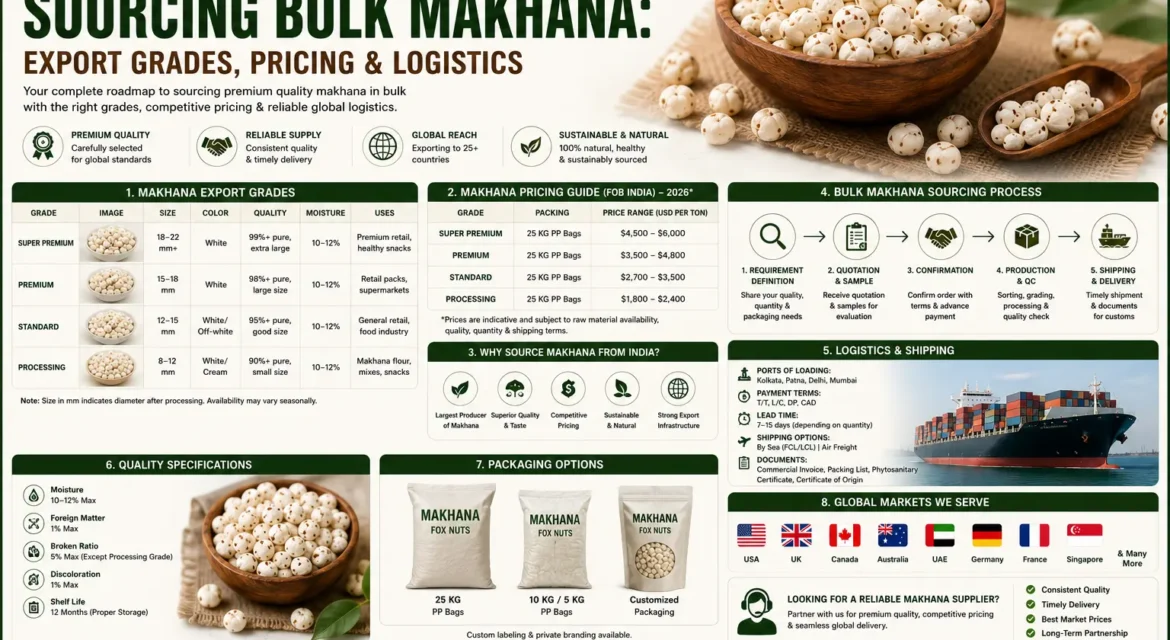
The Complete 2026 Suta Sizing Matrix
| Commercial Grade | Approx. Sieve Size (mm) | Characteristics | Pricing Tier |
|---|---|---|---|
| 3 Suta (Murrah) | 9 mm – 12 mm | High density, limited popping expansion, highly economical. | Economy / Low |
| 4 Suta | 12 mm – 14 mm | Small but uniform, moderate popping yield, creamish-white. | Mid-Range |
| 4.5 Suta+ | 14 mm – 24 mm | Solid mix of small/medium, better popping ratio, fewer splits. | Value-Plus |
| 5 Suta | 15 mm – 20 mm | Consistent popping, bright white, the industry baseline. | Premium Base |
| 5 Suta+ | 15 mm – 24 mm | Large size, excellent expansion, low breakage (~2%). | Premium Export |
| 6 Suta+ | 19 mm – 24 mm | Extra-large, rare, near-zero breakage, highest visual appeal. | Luxury / Elite |
Why 5 Suta+ and 6 Suta+ Dominate Export
When you’re paying thousands of dollars for container freight, you don’t ship empty calories or dust. The 5 Suta+ and 6 Suta+ grades are the gold standards for international export.
- 6 Suta+: Yields about 140-170 pieces per 100g. It commands the highest margins and is reserved for luxury gifting, premium retail brands, and gourmet supermarkets.
- 5 Suta+: Yields about 180-220 pieces per 100g. It is the “workhorse” of the export market, offering an optimal balance of premium visual appearance and cost-effectiveness for flavored snack manufacturers.
4. Quality Assurance: Technical Specifications and NABL Standards
Size is just one factor to consider. To meet EU, FDA, and Middle Eastern import regulations, bulk makhana must pass rigorous biochemical and physical assessments. At Civize, we adhere to strict NABL-accredited testing frameworks.
Core Physical Specifications
- Moisture Content: Must be strictly under 10% (target 9% for 6 Suta+). High moisture leads to fungal growth during sea transit and kills the “crunch” factor necessary for secondary processing.
- Broken Kernels: Broken pieces must make up less than 1.5% to 2% of the whole volume for premium export grades (5+ and 6+).
- Foreign Matter: Dust, unpopped black seeds, or agricultural debris must be below 2%.
- Color Profiling: Bright, natural white. Yellowing indicates improper roasting or age.
Microbiological & Chemical Compliance
International borders don’t care how big your makhana is if it fails health screening. Export-ready consignments must clear:
- Aflatoxin Screening: Strict adherence to limits for aflatoxin screening (< 15 ppb for many places).
- Pesticide Residues: To guarantee chemical-free manufacturing, several residues are screened.
- Heavy Metals: Testing for lead, cadmium, mercury, and arsenic well within WHO guidelines.
- Bacteriology: Total plate count, E.coli, and Salmonella screening.
5. Application-Based Sourcing: Matching Grade to Industry
Buying the most expensive grade isn’t always the smart business move. Your sourcing strategy must align seamlessly with your manufacturing end-use.
A. The Snack Manufacturer (Flavored & Packaged)
If your business roasts and flavors makhana (e.g., Peri-Peri, Sour Cream, Truffle) for retail pouches:
Optimal Grade: 5 Suta+ or 4.5 Suta+
Why: You need uniformity for automated packaging and consistent surface area for flavor adherence. 6 Suta+ is too expensive for heavily coated snacks where size variation is masked by flavoring.
B. The Premium / Gourmet Retailer
If you are packaging raw, unflavored superfoods in clear, windowed packaging for boutique health stores:
Optimal Grade: 6 Suta+
Why: Visuals dictate price. Consumers paying a premium expect large, flawless, snow-white kernels. The near-zero breakage rate protects brand equity.
C. The Food Processing / Industrial Grinding Sector
If you are manufacturing makhana flour, baby food blends, Ayurvedic powders, or thickeners:
Optimal Grade: 3 Suta (Murrah) or 4 Suta
Why: Aesthetics are completely irrelevant since the product will be milled. You are buying strictly for density and nutritional yield per kilogram, making 3 Suta the most cost-effective choice.
6. Expert Insights & Market Data
For journalists, researchers, and B2B analysts looking for quotable data, the shifting dynamics of the global makhana trade offer fascinating insights into agro-economics.
“The Western market is inherently biased toward visual perfection. We frequently see US and UK buyers default to requesting 6 Suta+ makhana, assuming biggest always means best. However, for manufacturers producing coated or heavily seasoned snacks, opting for a 5 Suta+ grade can reduce raw material costs by up to 18% without any discernible loss in the consumer’s eating experience.”
— Lead Export Strategist, Civize
“One of the greatest bottlenecks in the global fox nut supply chain isn’t cultivation—it’s post-harvest moisture control. A lack of standardized drying protocols in rural processing hubs can lead to 10-15% crop loss. Global market stability in 2026 will be determined by exporters that invest in state-of-the-art, climate-controlled warehousing.”
— Global Commodities Analyst
Key Journalist Takeaways:
- Nutritional Equivalence: A 3 Suta kernel and a 6 Suta kernel possess identical nutritional profiles; the price disparity is driven entirely by visual appeal and popping ratio.
- Market Concentration: While demand is global, the geopolitical risk is concentrated—if Bihar, India experiences a massive weather anomaly, over 85% of the world’s makhana supply is instantly compromised.
7. Global Logistics & Supply Chain Framework
Sourcing the makhana is only step one. Getting a 40ft High Cube container from the landlocked fields of Bihar to a port in Rotterdam or Jebel Ali requires specialized logistical architecture.
Packaging for Sea Freight
Makhana is incredibly hygroscopic (it absorbs moisture from the air). Improper packaging will result in a container full of soggy, unsellable paste.
- Standard Export Packing: Bulk makhana is typically packed in high-density polyethylene (HDPE) bags lined with moisture-barrier film.
- Volumetric Weight: Makhana is extremely light but voluminous. A standard 20ft container can hold approximately 3.5 to 4.5 Metric Tons, while a 40ft HC container maxes out around 8 to 9.5 Metric Tons, depending on the Suta size. (Larger Suta = more empty space = lower total weight per container).
Certifications & Export Documentation
To prevent customs delays, ensure your supplier provides:
- Phytosanitary Certificate: Issued by the Plant Quarantine Organization of India.
- Certificate of Origin (COO): Crucial for securing favorable tariff rates under specific bilateral trade agreements.
- FSSAI Export Certificate.
- Fumigation Certificate: Proving the container was treated for pests prior to loading.
8. Why Partner with Civize for Bulk Makhana?
At Civize, we don’t just act as middlemen; we engineer the supply chain. From the moment the gorgon nuts are harvested from the ponds to the moment the container seals are broken at your warehouse, we provide:
- Uncompromising Suta Accuracy: We utilize advanced multi-stage rotary sieves. When you order 14mm-24mm 5 Suta+, that is exactly what arrives.
- Agile Volume Capacity: Whether you need a 2-ton LCL (Less than Container Load) for a pilot snack launch or recurring 40ft HC shipments for enterprise manufacturing, our procurement networks are highly scalable.
- Total Transparency: We provide comprehensive lab analysis reports prior to dispatch. You will never second-guess the moisture content or aflatoxin levels of your raw materials.
9. Frequently Asked Questions (FAQs)
Ready to Secure Your Premium Bulk Makhana Supply?
Stop risking your manufacturing lines on inconsistent sizing and high-moisture consignments. Partner with Civize today for accurately graded, NABL-tested, and export-ready Makhana.