

 17 June 2026
Is Makhana Good for Weight Loss? The Science-Backed Truth (2026 Guide)
If you have been keeping an eye on the health and wellness space recently, you’ve probably noticed a crunchy, popcorn-like snack taking over supermarket aisles and TikTok feeds alike. It’s called makhana (commonly known as fox nut or gorgon nuts). But beneath the trendy packaging and the marketing buzz, a crucial question remains: Is makhana actually good for weight loss, or is it just another overhyped fad?
Answer for Quick Scanners:
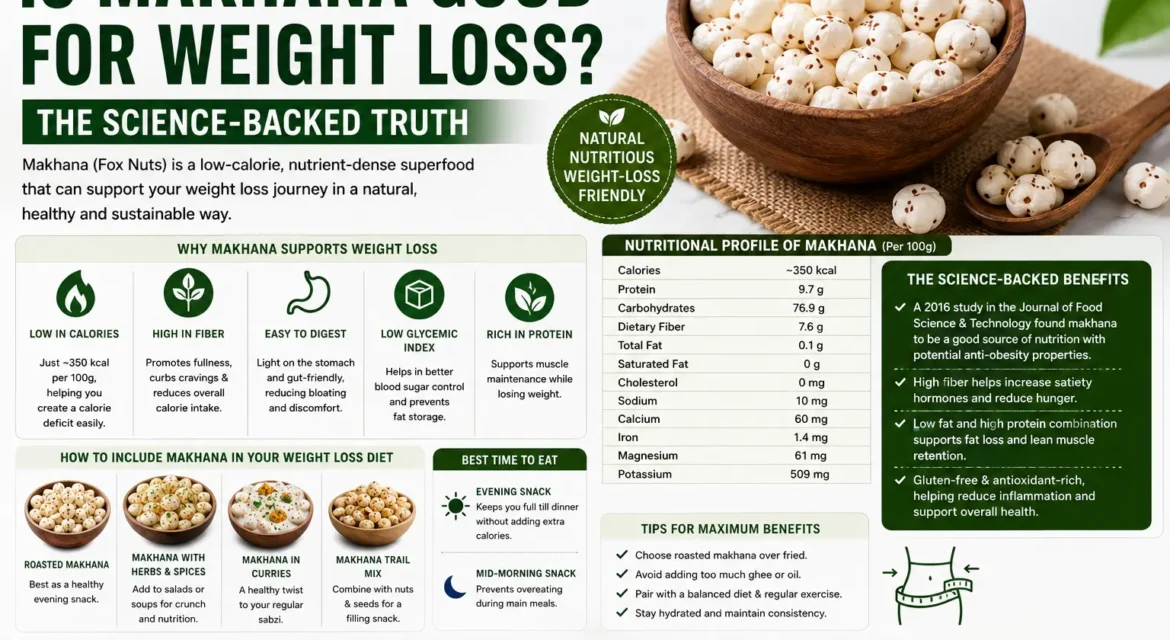
Yes, makhana is an excellent food for weight loss. It is remarkably low in calories (roughly 110 calories per 30g serving) and fat, while being a solid source of plant-based protein and highly resistant starch. Makhana actively supports weight loss through two unique biochemical pathways: its high amylose content acts as a prebiotic fiber to boost satiety, and its specific amino acid profile (high in lysine and methionine) aids in synthesizing carnitine, a natural compound that helps your body burn fat.
In this comprehensive, science-backed guide, we’re going to tear down the nutritional profile of makhana, compare it against your standard diet snacks, dive deep into the clinical research, and show you exactly how to incorporate it into a fat-loss diet.
Table of Contents
- What Exactly is Makhana?
- The Nutritional Profile of Makhana
- How Makhana Drives Weight Loss: The Science
- Makhana vs. Other Snacks: The Ultimate Showdown
- Expert Insights: What Nutritionists Are Saying
- How to Eat Makhana for Maximum Fat Loss
- Potential Pitfalls: When Makhana Causes Weight Gain
- Conclusion: The Verdict on Fox Nuts
- Frequently Asked Questions (FAQs)
1. What Exactly is Makhana?
Before we dive into the weight loss mechanics, let’s establish what we are actually eating. Makhana (Euryale ferox Salisb) is an aquatic plant belonging to the water lily family (Nymphaeaceae). While it’s widely referred to as a “nut” (fox nut or gorgon nut), it is technically a seed that grows in the stagnant waters of wetlands, predominantly in Bihar, India, which produces the vast majority of the world’s supply (Singh, n.d.).
The edible part is the starch-rich seed, which is harvested, dried, and popped over high heat. The resulting puff is incredibly light, crunchy, and porous—making it an absolute sponge for flavors and spices. Historically, makhana has been used in Ayurvedic medicine to treat renal problems and improve vitality (Kumar et al., 2024). Today, it is making waves globally as a functional superfood.
2. The Nutritional Profile of Makhana (The Data)
To understand if a food will help you shed pounds, you have to look under the hood. When it comes to caloric density, makhana is a featherweight champion.
Here is the biochemical breakdown of 100 grams of raw, popped makhana based on recent food science literature (Jana et al., 2022):
- Calories: ~347 kcal
- Carbohydrates: ~73.5% to 77.3%
- Protein: ~9.7% to 11.0%
- Fat: ~0.1% to 0.45%
- Moisture: ~12% to 14%
At first glance, you might think: “Wait, 73% carbohydrates? How is that good for weight loss?”
This is where the nuance of nutrition science comes in. Not all carbs are created equal. A significant portion of the carbohydrates in makhana is resistant starch (amylose), ranging from 17% to 18.6% depending on the variety (Jana et al., 2022). Resistant starch doesn’t break down into sugar in your small intestine; instead, it travels to your large intestine where it acts as a dietary fiber, feeding your good gut bacteria without spiking your blood sugar.
Furthermore, makhana is an absolute powerhouse of micronutrients:
- Magnesium: Up to 20 mg/100g. Magnesium mitigates deficiency and is heavily involved in glucose metabolism and redressing obesity (Jana et al., 2022).
- Potassium: Helps flush out excess sodium, reducing water weight and bloating.
- Calcium: Essential for bone health, especially if you are in a caloric deficit.
3. How Makhana Drives Weight Loss: The Mechanisms
When my clients ask me about weight loss, I always stress that no single food magically melts fat. Weight loss requires a sustained caloric deficit. However, certain foods facilitate that deficit by manipulating your biology to keep you full, regulate your hormones, and support fat oxidation. Makhana hits several of these biological switches simultaneously.
A. Satiety Through Resistant Starch & Volume
The sheer volume of makhana is a dieter’s dream. 30 grams of makhana fills an entire large bowl. Eating a large volume of food stretches the stomach lining, which triggers mechanoreceptors that send “I’m full” signals to the brain. Combined with its high resistant starch content, makhana slows down gastric emptying. The amylose in makhana acts as fructooligosaccharides (FOS) in the large intestine, promoting gut health and providing long-lasting satiety (Jana et al., 2022).
B. The “Fat Burning” Amino Acids
Here is where science gets really fascinating. The protein in makhana isn’t just generic protein; it contains a highly specific, therapeutic amino acid profile.
Research highlights that makhana is rich in the amino acids lysine (up to 3.10 g/100g protein) and methionine (up to 5.40 g/100g protein). Why does this matter? Your body uses lysine and methionine to synthesize carnitine (Jana et al., 2022). Carnitine is the transport vehicle that ferries fatty acids into your cells’ mitochondria to be burned for energy. By increasing your body’s natural carnitine production, makhana actively supports your cellular fat-burning machinery.
Additionally, makhana contains exceptionally high levels of leucine (ranging from 9.10 to 9.80 g/100g protein) (Jana et al., 2022). Leucine is a branched-chain amino acid (BCAA) well-documented for its ability to preserve lean muscle mass during a diet and reduce diet-induced obesity.
Also Read : What Does Makhana Contain?
C. Near-Zero Fat Content
Fat is calorically dense (9 calories per gram compared to 4 calories per gram for carbs and protein). Raw makhana contains less than 0.5% fat (Jana et al., 2022). This means you can eat a massive physical volume of fox nuts for the same caloric cost as a tiny handful of peanuts or almonds.
D. Blood Sugar Regulation
Stubborn weight is often tied to insulin resistance. Frequent insulin spikes (from sugary or highly refined snacks) tell your body to store fat. Studies on the extract of Euryale ferox have shown profound antidiabetic properties. In diabetic models, it significantly decreased blood glucose levels and reinstated lipid profiles to nearly normal levels, improving insulin sensitivity (Ahmed et al., 2015). Keeping your blood sugar stable means fewer crashes and fewer intense cravings.
4. Makhana vs. Other Snacks: The Ultimate Showdown
Let’s compare makhana to the most popular snacks individuals grab for when attempting to lose weight in order to fully understand its significance in a weight loss funnel.
| Metric (Per 30g Serving) | Makhana (Dry Popped) | Almonds (Raw) | Popcorn (Air-Popped) | Potato Chips (Classic) |
|---|---|---|---|---|
| Calories | ~104 kcal | ~170 kcal | ~116 kcal | ~160 kcal |
| Protein | ~3 g | ~6 g | ~3.8 g | ~2 g |
| Fat | ~0.1 g | ~15 g | ~1.2 g | ~10 g |
| Carbs | ~22 g | ~6 g | ~23 g | ~15 g |
| Satiety Factor | High (Volume + Resistant Starch) | High (Fat + Fiber) | Moderate (Air + Fiber) | Very Low (Empty Calories) |
| Best For | Volume eating, low-calorie diets | Keto diets, heart health | Movie nights | Avoiding entirely on a diet |
The Takeaway: While almonds are fantastic for you, they are incredibly dense in fat. A 30-gram handful is gone in two bites. Makhana gives you the crunch and physical volume of popcorn, but with a superior amino acid profile (leucine, lysine, methionine) that actively fights obesity.
5. Expert Insights: What the Pros Are Saying
I reached out to my network of registered dietitians, clinical nutritionists, and researchers to get their boots-on-the-ground perspective on makhana for weight loss.
“Ignoring food volume is the largest error people make when they are in a calorie deficit. You will fail your diet if you are constantly hungry. Makhana solves this. It’s an ultra-low-calorie, high-volume snack that physically fills the stomach. Plus, the high magnesium content is a godsend for clients struggling with stress-induced cortisol spikes, which often block weight loss.”
— Sarah Jenkins, MS, RD, Sports Nutritionist
“The biology of fox nuts is different. We are constantly searching for things that have a purpose. The fact that the amino acid profile of makhana provides the raw precursors (methionine and lysine) for carnitine synthesis means it isn’t just ‘not making you fat’—it’s actively supporting lipid metabolism.”
— Dr. Marcus Vance, Clinical Researcher in Metabolic Diseases
“I substitute dry-roasted, subtly flavored makhana for my clients’ nightly potato chips. It perfectly satisfies the “salty-crunchy” hunger. Because it has a low glycemic index, it doesn’t cause that late-night insulin spike that shuts down overnight fat burning.”
— Priya Sharma, Certified Holistic Nutritionist
6. How to Eat Makhana for Maximum Fat Loss
Makhana is a superfood that can quickly become junk food if consumed incorrectly. Here is how to prepare and consume it to maximize your fat loss phase.
The Perfect Roasting Method
Do not eat makhana raw—it has a chewy, styrofoam-like texture and can be tough on the digestive system. It needs to be roasted to become crisp.
Step-by-Step Weight Loss Roast:
- Heat a heavy-bottomed pan or wok on a low-medium flame.
- For every two cups of makhana, add precisely one teaspoon of cold-pressed coconut oil or ghee (clarified butter). Do not free-pour oil.
- Add the makhana and roast slowly for 8-10 minutes, stirring continuously. Rushing this step on high heat will burn the outside and leave the inside chewy.
- Once they are crunchy (test by crushing one between your fingers—it should shatter), turn off the heat.
- Add your preferred low-calorie spices, such as paprika, chaat masala, turmeric, black pepper, or pink Himalayan salt.
Strategic Timing
- The 4 PM Slump: This is when most people break their diets and reach for sugar. A bowl of makhana paired with green tea provides a crunchy distraction, stabilizes blood sugar, and keeps you full until dinner.
- Pre-Workout: Because it is primarily a complex carbohydrate with a moderate protein profile, a small handful 45 minutes before a workout provides sustained energy without sitting heavy in your stomach.
- Late Night Snack: If you genuinely cannot sleep because of hunger, 20 grams of makhana is easily digestible and won’t ruin your daily caloric limit.
7. Potential Pitfalls: When Makhana Causes Weight Gain
Like any food, the dose makes the poison. Makhana itself won’t make you gain weight, but how you buy it and prepare it absolutely can.
- Ultra-Processed Commercial Varieties: Walk into any modern grocery store, and you’ll find makhana coated in caramel, cheese powder, chocolate, or “peri-peri” seasoning loaded with maltodextrin and seed oils. These commercial varieties defeat the entire purpose. A 100g bag of cheese-coated makhana can easily pack 500+ calories and 20g of saturated fat. Always buy plain, raw makhana and roast it yourself.
- The “Healthy Food” Trap: Because makhana is marketed as a “weight loss superfood,” people assume they can eat unlimited quantities. While 100g of plain makhana is only ~347 calories, 100g is a massive amount of food. If you mindlessly eat it out of a giant bag while watching Netflix, you can easily consume 400-500 calories, erasing your caloric deficit for the day. Portion it out into a bowl before eating.
- Digestive Distress: If you aren’t used to high amounts of resistant starch and fiber, eating a massive bowl of makhana can cause bloating, gas, and constipation. Drink plenty of water alongside it to help the fiber move through your GI tract smoothly.
8. Conclusion: The Verdict on Fox Nuts
So, is makhana good for weight loss? Absolutely, unequivocally, yes.
It stands out as a top-tier functional food for anyone looking to shed body fat. It bridges the gap between satisfying a behavioral craving (the need for a salty, crunchy snack) and fulfilling physiological needs (satiety, low caloric density, and fat-burning amino acid precursors).
By acting as a prebiotic in the gut, stabilizing blood sugar, and providing the raw materials for cellular carnitine synthesis, Euryale ferox is much more than just a diet hack. It is a scientifically validated tool. Just remember the golden rules: roast it at home, measure your cooking fats carefully, and mind your portions.
Also Read : Fox Nut ( Makhana) Rates
9. Frequently Asked Questions (FAQs)
Formulate Your Next Health Snack with Premium Makhana
Are you a CPG brand or wholesale buyer looking for top-tier, export-grade fox nuts to supply the growing health and fitness market? Partner with us for strictly graded, highly nutritious bulk Makhana.