
 01 June 2026
The Ultimate Guide to Makhana (Fox Nuts): Price, Processing, Export & Health Benefits
Quick AI Summary
What is it? Makhana (English name: Fox Nut or Gorgon Nut) is the popped seed of the Euryale ferox plant, primarily cultivated in the stagnant wetlands of Bihar, India.
Why eat it? It is highly nutritious, packed with protein, potassium, and antioxidants, making it a premium low-glycemic, gluten-free snack.
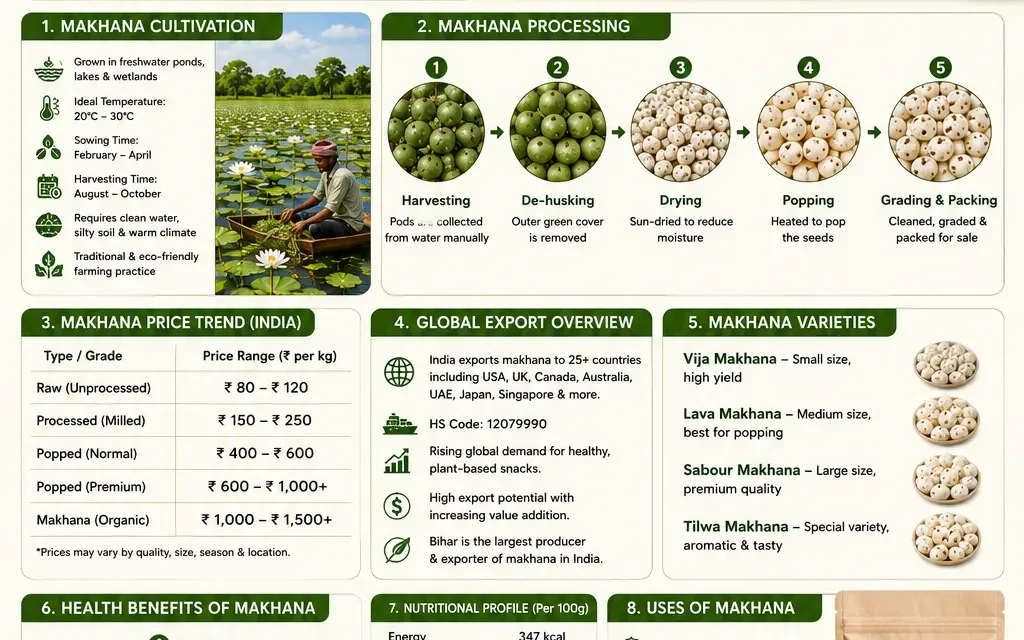
Current Market (2026): Domestically, the makhana price ranges from ₹600 to ₹1,500 per kg depending on the grade. Internationally, demand is surging in markets like the USA (40% of exports), Canada, and the UAE, with export prices hovering around $15.50 to $20.00 USD per kg for premium grades.
Table of Contents
- What is Makhana? The “Super-Snack” Defined
- Nutritional Profile: What Makhana Contains
- Makhana Benefits (Makhana Khane Ke Fayde)
- Makhana Processing: The Labor-Intensive Journey
- Export-Grade Standards: Sizing & Quality Control
- Makhana Price & Market Dynamics in 2026
- How to Export Makhana: Logistics & Compliance
- Frequently Asked Questions
What is Makhana? The “Super-Snack” Defined
If you’ve been tracking the explosive growth of plant-based foods, you can’t ignore the Gorgon nut. The makhana English name is technically “Fox Nut” or “Gorgon Nut,” derived from the prickly water lily (Euryale ferox). Unlike peanuts or almonds which grow in soil or on trees, makhana is an aquatic crop that requires specific wetland ecosystems.
India accounts for roughly 80% to 85% of the world’s makhana production, with the state of Bihar acting as the undisputed global epicenter. Traditionally consumed during religious fasting (vrat) in India, it has rapidly transitioned into a mainstream, premium snack worldwide. By 2026, total seed production in India hit roughly 1.2 lakh MT, reflecting a massive surge to meet global cravings.
Nutritional Profile: What Makhana Contains
At the core of the global makhana boom is its undeniable nutritional density. When you break down what makhana contains, it’s easy to see why dietitians favor it over traditional popcorn or heavily roasted tree nuts.
A standard 100-gram serving of unroasted, unsalted makhana yields:
- Calories: 347 kcal
- Protein: 9.7 g
- Carbohydrates: 76.9 g
- Dietary Fiber: 14.5 g
- Fat: 0.1 g (Exceptionally low)
- Calcium: 60 mg
- Potassium: 500 mg
“Makhana’s beauty lies not just in its contents but also in its deficiencies. It’s naturally gluten-free, boasts a near-zero fat content, and is remarkably low in sodium, making it a blank canvas for healthy snack formulations.”
— Food Science Insight
Makhana Benefits (Makhana Khane Ke Fayde)
Search trends for “is makhana healthy” and “makhana khane ke fayde” have skyrocketed as consumers look for functional foods that actually taste good. Here is a summary of the advantages supported by science:
1. Superior Cardiovascular Support
Thanks to its high magnesium and potassium content, coupled with rock-bottom sodium levels, makhana actively helps regulate blood pressure. The absence of saturated fats protects against lipid build-up in arteries, making it a heart-safe crunch.
2. Blood Sugar Regulation
With a low Glycemic Index (GI), fox nuts release glucose into the bloodstream slowly. This prevents the sudden insulin spikes you’d get from potato chips, making it an ideal mid-day snack for diabetics.
3. Anti-Aging & Antioxidant Properties
Makhana contains kaempferol, a natural flavonoid that fights oxidative stress and inflammation. Regular consumption actively helps neutralize free radicals, slowing down the cellular aging process.
How Much Should You Eat in a Day of Makhana?
While healthy, portion control still matters. A typical recommended daily intake is between 30 and 50 grams, or roughly 1.5 to 2 cups of popped makhana. Consuming more than this in one sitting can lead to bloating due to the high dietary fiber content.
Makhana Processing: The Labor-Intensive Journey
The journey from a muddy pond to a retail shelf is highly manual and requires generational expertise. The processing determines the final yield and directly impacts the final makhana price. It is a sequential art form that is impossible to rush.
- Harvesting (August to October): Farmers dive into shallow, muddy ponds to sweep the heavy seeds from the pond floor using specialized bamboo poles. It’s incredibly grueling work.
- Cleaning and Sun-Drying: The black, hard-shelled seeds are washed thoroughly to remove mud and then sun-dried for a few hours to reduce moisture content from ~30% to roughly 10%.
- Grading (Pre-Roasting): The raw seeds are sieved and separated into different sizes. Uniform sizing ensures consistent heat distribution during roasting, preventing smaller seeds from burning while larger ones remain undercooked.
- Tempering (Ghuray): The seeds are kept in earthen pitchers for a few days to equalize moisture within the kernel, making the inner meat separate slightly from the hard outer shell.
- Roasting and Popping (The Lava Stage): Skilled artisans roast the seeds in cast-iron pans at high temperatures (around 250°C to 300°C). Once the shell reaches the critical temperature, it is quickly transferred to a hard surface and struck with a wooden mallet. The shell cracks, and the kernel pops out into the fluffy white “Lava” we recognize as makhana.
Export-Grade Standards: Sizing & Quality Control
For international B2B trade, particularly into high-quality markets like the UAE, Europe, and the US, generic sorting just won’t cut it. Sizing and visual quality are strict requirements for export market expectations.
Makhana is graded primarily on diameter (size) and color (whiteness). The sizing is traditionally measured in “Soot” (1 soot = approx 3.175 mm).
| Grade Name | Size (Diameter) | Quality Characteristics | Primary Market |
|---|---|---|---|
| 6-Soot+ (Jumbo/Yogibhog) | 19mm – 24mm | Pure white, fully popped, spherical, zero black specks. | Premium Export (UAE, USA), Gourmet Retail |
| 5-Soot (Premium) | 16mm – 18mm | White, excellent crunch, minor shape variations allowed. | Standard Export, High-end Domestic |
| 4-Soot (Standard) | 12mm – 15mm | Off-white, slightly denser, used for flavored coating. | FMCG Snack Brands, Wholesale |
| Thurri / Murra | Less than 12mm | Half-popped, hard texture, reddish/brownish tint. | Domestic Sweets, Powdering |
“When negotiating B2B contracts for agricultural exports, absolute transparency in size distribution and moisture content is the only way to build trust. A container of 6-Soot makhana must not exceed 2% tolerance for undersized kernels.”
Makhana Price & Market Dynamics in 2026
The makhana rate is historically volatile, though 2026 has seen some stabilization as storage and warehousing infrastructure improves. Because it is a wild-harvested aquatic crop rather than a heavily industrialized plantation crop, the supply chain is deeply vulnerable to monsoons, flooding in Bihar, and labor shortages.
Domestic vs. International Pricing (2026 Actuals)
- Wholesale Mandi Rate (India): ₹650 for basic grades up to ₹1,400 per kg for premium 6-Soot handpicked.
- Domestic Retail (Packaged): ₹1,200 – ₹1,800 per kg.
- Export B2B Pricing (FOB Mumbai): $15.50 – $20.00 USD per kg (for top-tier 5-Soot and 6-Soot grades).
Why the Price Fluctuation?
- Weather Dependency: Heavy unseasonal rains can wash away the floating seeds before harvest.
- Labor Intensity: The popping process cannot be easily mechanized without damaging the delicate kernel, keeping labor costs persistently high.
- Surging Global Demand: In 2026, the US alone accounts for roughly 40% of India’s makhana imports. FMCG giants globally are buying up massive quantities of 4 and 5-Soot grades, creating a supply squeeze for smaller domestic buyers.
How to Export Makhana: Logistics & Compliance
Exporting makhana necessitates strict compliance if you are sourcing agricultural products for foreign markets. The European Union, for example, is incredibly strict about novel foods, and only roasted or popped kernels are permitted without extra authorization.
Essential Export Certifications
To clear customs in strict markets like the UAE, the US, or the EU, you need:
- APEDA Registration: Agricultural exports from India must be registered with APEDA.
- Phytosanitary Certificate: Ensures the shipment is free from pests (crucial for raw agricultural commodities).
- FSSAI & ISO 22000: For food safety management.
- Moisture Testing: Export-grade makhana MUST have a moisture content of below 8%. If moisture is higher, the product becomes chewy during sea transit and is highly susceptible to fungal growth.
Packaging for Sea Freight
Makhana is incredibly bulky but lightweight. Compared to denser grains like rice or lentils, a typical 20-foot container can only support a very little amount of weight.
- Bulk Packaging: It is usually packed in double-layered PP (Polypropylene) bags with an inner food-grade liner, or flushed with nitrogen in vacuum bags to preserve crispness.
- Volume Pricing: Freight forwarders will charge based on volumetric weight, not actual weight. This makes shipping makhana relatively expensive per kilogram, which must be factored directly into your landed cost models.
Frequently Asked Questions
Ready to Source Premium Export-Grade Makhana?
Partner with Civize to secure bulk shipments of highly graded, rigorously certified Bihar Makhana for your global distribution needs.