

 08 June 2026
Makhana Rate 2026: Wholesale & Retail Fox Nut Price Guide
By an Agri-Commodities Market Analyst with 10 years of experience tracking wetland crops.
Makhana (Euryale ferox Salisb.), globally recognized as fox nut or gorgon nut, isn’t just a traditional fasting snack anymore; it is the beating heart of India’s wetland economy and a rising star in the global superfood aisle. If you’ve been tracking the makhana rate recently, you know it’s a rollercoaster. Prices swing wildly based on rain patterns in Bihar, international health food trends, and the intricacies of traditional grading methods.
Whether you’re a retail consumer wondering why that small packet of peri-peri flavored makhana costs a small fortune, a B2B wholesaler looking for accurate farm-gate prices in Darbhanga, or an international buyer eyeing the gluten-free market, you need accurate, context-rich data.
In this comprehensive guide, we strip away the noise. We are not only looking for a fixed “price per kg.”” Using peer-reviewed agricultural economics, professional views, and current market sentiment, we are examining the entire value chain, from Mithila’s murky ponds to the shelves of upmarket supermarkets.
1. Current Makhana Rate (2026 Market Averages)
Let’s get right to the numbers. The price of makhana is primarily determined by its diameter, which is traditionally measured in “soots.” One soot is equivalent to about 3.175 millimeters. High-quality makhana pops are pearl white, larger in size, and weigh less; a low-weight bag is universally recognized as an indication of high-quality “lava” (the popped kernel) in both domestic and international markets (Jana, 2021).
Here is the current rate breakdown as of mid-2026.
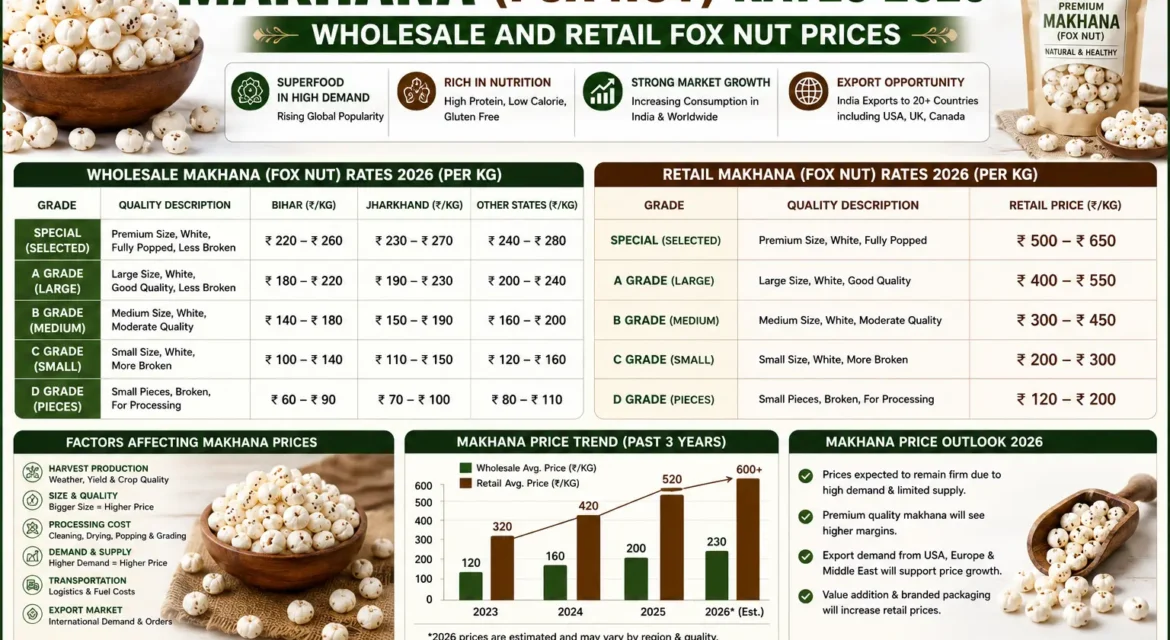
Wholesale Makhana Prices (Per KG)
Wholesale rates refer to the farm-gate or local mandi (market) prices in primary production hubs like Darbhanga, Madhubani, and Purnia in Bihar.
| Grade (Size) | Visual Quality | Wholesale Price (INR/kg) | Wholesale Price (USD/kg) |
|---|---|---|---|
| 4 Soot (12mm) | Mixed color, smaller, denser | ₹350 – ₹450 | $4.20 – $5.40 |
| 5 Soot (15mm) | Mostly white, medium fluff | ₹500 – ₹650 | $6.00 – $7.80 |
| 6 Soot (19mm+) | Pearl white, extremely light (Lava) | ₹750 – ₹950 | $9.00 – $11.40 |
| Phool/Hand-picked | Flawless round, premium export | ₹1,000 – ₹1,200 | $12.00 – $14.40 |
(Note: Prices fluctuate based on the harvest cycle, which typically begins with germination in February and peaks during the August/September harvest).
Retail Makhana Prices (Per KG)
Once makhana leaves the wholesaler, it undergoes further grading, mechanical roasting, flavoring, and nitrogen-flush packaging. The retail markup is significant. Historically, farmers receive about 55% of the final retail price for loose makhana, but this share declines to 50% or less for branded products because the heavy value addition happens downstream (Minten et al., 2010).
- Loose Retail (Unbranded): ₹800 – ₹1,200 per kg.
- Branded Plain Makhana: ₹1,200 to ₹1,600 per kg (usually offered in stand-up pouches weighing 100g or 250g).
- Flavored/Roasted Makhana: ₹1,800 – ₹2,500+ per kg (sold in premium 50g/100g snack bags).
2. The Economics of Fox Nuts: Unpacking the Value Chain
Why does a product that costs ₹450 at the farm gate cost ₹1,800 at your local supermarket? The makhana value chain is notoriously complex, dominated by intermediaries, immense manual labor, and massive processing shrinkage.
The Processing Bottleneck
Makhana doesn’t grow as a fluffy white ball. Branded Plain Makhana: ₹1,200 to ₹1,600 per kg (usually offered in stand-up pouches weighing 100g or 250g). The seeds must be collected by highly skilled divers who hold their breath to sweep the pond floor, sun-dried, graded by sieves, and then roasted and popped manually.
- Seed to Pop Ratio: You don’t get 1 kg of pop from 1 kg of seed. The yield is incredibly low. Only 35–40 kg of popped makhana (lava) are typically produced from 100 kg of raw makhana seeds.
- Labor Costs: Popping requires precise heat control. The seeds are roasted in earthen pots and immediately struck with a wooden mallet to break the shell and pop the kernel. This traditional skill commands high daily wages.
- Volume vs. Weight Economics: Makhana is incredibly bulky. A standard truck that can carry 10 tons of wheat might only fit 2 to 3 tons of makhana. Therefore, transportation costs per kilogram are disproportionately high compared to other agricultural commodities.
Margin Distribution in the Channel
Research into the price spread of makhana reveals exactly who takes home the profits. Marketing of makhana is heavily dominated by a few large wholesalers who purchase popped makhana in bulk, stock it in massive warehouses, and dictate prices due to the lack of organized farmer cooperatives (Singh, 2020).
“The irony of the makhana profession is that the hardest physical labor—diving into unclean ponds to pick seeds—provides the lowest income. Meanwhile, the simple downstream act of sealing the pop into a beautifully branded, nitrogen-flushed bag doubles its market value.”
3. Factors Influencing the Makhana Rate
If you want to predict the price of fox nuts and optimize your procurement, you need to understand the macro and micro variables that move the needle.
Seasonal Supply Dynamics
Makhana is harvested once a year.
- Harvest Glut: Prices dip between September and November when the new crop floods the local mandis.
- Off-Season Premium: Prices peak between April and July as inventory dwindles. Surprisingly, few farmers store makhana to benefit from these higher off-season prices, mostly because they lack proper warehousing and need immediate cash flow to pay off debts (Minten et al., 2010).
Weather and Wetland Health
Euryale ferox thrives in stagnant, shallow water (4-6 ft deep). Excessive monsoon flooding washes away the mature seeds before they can be harvested, while severe droughts dry up the ponds prematurely. Climate volatility directly impacts the yield per hectare, causing massive year-over-year price volatility.
4. Why Most Makhana Price Guides Fail
If you search for “makhana rate today” on standard commodity tracking websites, you’ll usually get a single, flat number (e.g., “₹600/kg”). Here is why relying on those generic aggregator numbers will burn your business:
- They Ignore the ‘Soot’ System: Quoting a flat rate for makhana is like quoting a flat rate for diamonds without mentioning the cut or carat. 4-soot and 6-soot makhana serve entirely different markets. 4-soot goes to powder manufacturers and local sweet shops; 6-soot goes to premium export brands and modern retail shelves.
- They Confuse Seed Price with Pop Price: Some poorly researched portals scrape the price of raw makhana seeds (which sell for roughly ₹150-₹250/kg) and present it as the wholesale price for popped makhana, completely confusing buyers.
- They Miss the Moisture Content Trap: Freshly popped makhana has higher moisture. Unscrupulous traders sometimes sell “heavy” makhana that loses 10% to 15% of its weight once it properly dries out in your warehouse. You aren’t paying for makhana; you’re paying for water.
5. The Global Export Market: A Sleeping Giant
Currently, India dominates global makhana production, accounting for an estimated 90% of the world’s supply, with the state of Bihar alone contributing 85-90% of that output. Yet, astonishingly, only around 1% to 2% of India’s total makhana produce is exported internationally (Wardhan et al., 2025).
“The global snack market is pivoting hard toward plant-based, gluten-free alternatives. Makhana is perfectly positioned to replace popcorn and processed potato chips in the US and EU markets. The only hurdle right now is standardized quality control and meeting the strict pesticide residue limits required by the FDA.” — Rajesh K., Agri-Export Consultant, New Delhi.
6. Frequently Asked Questions (FAQs)
Ready to Source Export-Grade Makhana?
Don’t let price volatility disrupt your supply chain. Partner with Civize for direct-from-origin, strictly graded, and quality-assured Makhana supply.