

 10 June 2026
What Does Makhana Contain? The Complete Nutritional Profile and Science-2026 Guide
Quick Answer:
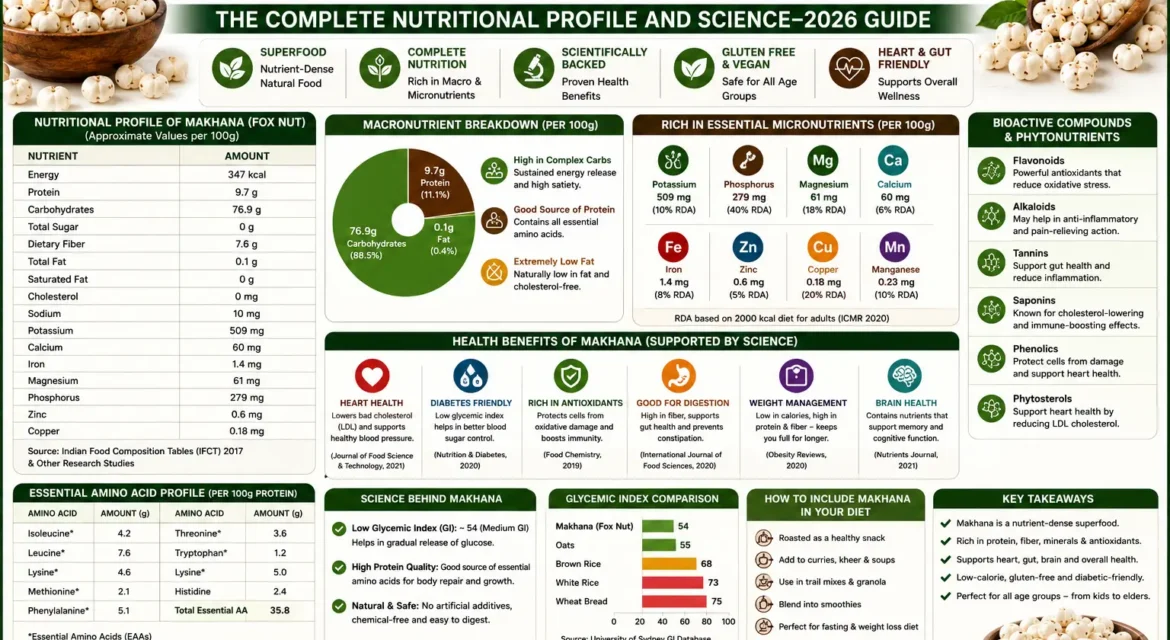
Makhana (Euryale ferox), also known as fox nuts, contains a highly nutritious blend of macronutrients and micronutrients. Per 100 grams, popped makhana contains approximately 362 calories, 9.7g of protein, 76g of complex carbohydrates, 14.5g of fiber/moisture, and less than 0.5g of fat. Biochemically, makhana contains 16 essential amino acids, powerful antioxidants like kaempferol, and a specific type of resistant starch (RS3) that gives it a very low glycemic index, making it ideal for weight management and diabetic diets.
Table of Contents
The Nutritional Foundation: What Actually is in a Fox Nut?
When people ask what makhana contains, they’re usually looking for the macronutrient split. As a staple in traditional Ayurvedic medicine for over two millennia, the seeds of the Euryale ferox plant (a type of water lily native to eastern Asia and heavily cultivated in India) are nothing short of a nutritional powerhouse.
But let’s ditch the fluff and look at the hard data.
Macronutrients (Per 100g of Popped Makhana)
- Calories: ~328 – 362 kcal
- Protein: 9.7g – 11.5g
- Carbohydrates: 76g – 84.9g
- Dietary Fiber: 7.6g – 14.5g
- Total Fat: 0.1g – 0.5g
Author’s Note: If you’re building a diet plan or formulating a packaged CPG snack, that near-zero fat content is your golden ticket. You get the crunch of popcorn or potato chips without the heavy lipid load, giving you massive leeway to flavor the product with healthy fats (like cold-pressed olive oil or ghee) without blowing up the caloric density.
Micronutrient Density
| Mineral / Vitamin | Density per 100g | Why It Matters |
|---|---|---|
| Magnesium | 20.0 mg | Crucial for over 300 enzymatic reactions; aids in muscle recovery and mitigates obesity. |
| Calcium | ~60 mg | Essential for bone density and cardiovascular function. |
| Potassium | High | Helps regulate blood pressure and flush out excess sodium. |
| Iron | 1.4 mg | Supports oxygen transport; makhana is a great adjunct for preventing anemia. |
| Thiamine (B1) | Present | Essential for carbohydrate metabolism and optimizing magnesium absorption. |
The Biochemical Edge: Why Euryale Ferox Stands Out
Any nutritionist can read a calorie label. But to truly understand what makhana contains, we have to look under the hood at its biochemical architecture.
The Essential Amino Acid Index (EAAI)
Makhana contains an incredibly high Essential Amino Acid Index (EAAI) ranging from 89% to 93%. For context, this plant protein is biologically comparable to fish. It contains 16 different amino acids, particularly rich in Arginine, Glutamine, Methionine, Cysteine, and Tyrosine.
Type 3 Resistant Starch (RS3)
A significant portion of the carbohydrates in makhana (roughly 17% to 20%) is amylose, which functions as a Type 3 Resistant Starch (RS3). It resists digestion in the small intestine, acting as a prebiotic in the colon. This mechanism is exactly why makhana boasts such a low glycemic index.
Flavonoids and Antioxidants: The Kaempferol Connection
What makes makhana anti-aging? It’s largely due to a specific flavonoid called kaempferol, which fights oxidative stress and inflammation.
Quality Matters: How Grading Affects Nutritional Value
If you are sourcing makhana for export or premium retail, understanding these grades is non-negotiable:
- Lava Grade (>12 mm): The premium, fully popped “Phool” makhana. It has the highest expansion ratio, yielding the best crunch and optimal balance of nutrients.
- Olhua (11–12 mm): Medium-sized, great for adding to processed health snacks or grinding into flours.
- Murra / Thurri (<11 mm): Often harder, partially popped seeds.
Quotable Expert Insights
“The true power of makhana isn’t just what it contains, but what it doesn’t absorb. The high concentration of Type 3 resistant starch means that despite being 76% carbohydrates, the actual glycemic load on the bloodstream is remarkably low.”
“A premium Lava-grade makhana should snap cleanly. If moisture exceeds 10%, not only do you lose that signature crunch, but you accelerate the degradation of its natural polyphenols.”
Comparison: Makhana vs. Other Superfoods
| Feature | Makhana | Almonds | Popcorn |
|---|---|---|---|
| Calories (per 100g) | ~350 | ~579 | ~387 |
| Fat Content | < 0.5g | 49g | 4.5g |
| Protein | 9.7g | 21g | 13g |
| Glycemic Index | Low | Low | Medium |
Health Benefits Driven by Composition
- Cardiovascular Protection: Zero cholesterol and high potassium help regulate blood pressure.
- Anti-Obesity Mechanics: Magnesium and FOS help regulate lipid metabolism.
- Anti-Aging: Antioxidants and amino acids promote collagen synthesis and cellular repair.
Frequently Asked Questions (FAQs)
Scale Your Health Brand with Premium Bihar Makhana
Looking for strictly graded, nutrient-dense Makhana for your CPG line or export operations? Partner with a supplier that guarantees the nutritional integrity of every batch.