
 08 July 2026
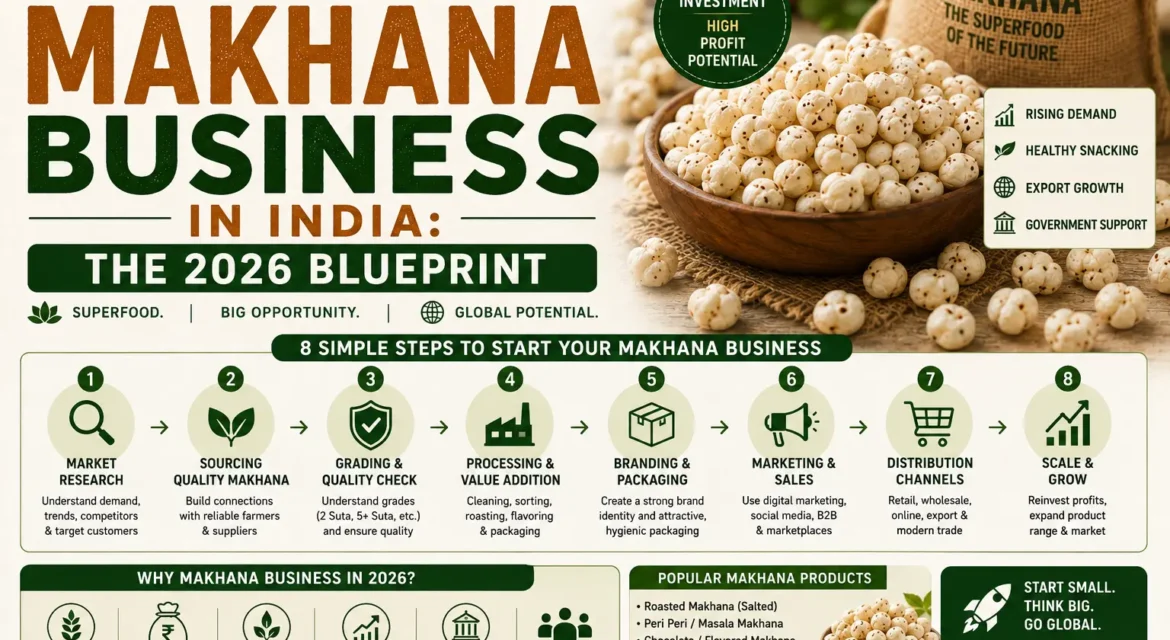
How to Start a Makhana Business in India: The 2026 Blueprint
Once confined to traditional Indian fasting rituals, Makhana (fox nut or gorgon nut) has exploded onto the global stage as a premium, plant-based superfood. As we navigate through 2026, the Indian makhana market isn’t just growing; it’s undergoing a structural transformation. Driven by international demand for gluten-free, low-glycemic snacks, India now commands over 90% of the world’s makhana production, with exports surging past $30 million annually.
Be it is a small scale roasting unit, a D2C flavored snack brand or a large B2B export business, this book will give you the right technical roadmap, financial modelling and export grading criteria to be successful.
1. The 2026 Market Opportunity
Before investing capital, it’s critical to understand the macroeconomic forces driving the makhana boom. According to 2026 market intelligence, the India Makhana Market was valued at INR 9.29 Billion in 2025 and is aggressively projected to reach INR 19.95 Billion by 2034, registering an 8.85% CAGR.
Why Start a Makhana Business Now?
- Export Dominance: India exported over 25,130 metric tons in the 2024–2025 cycle, establishing absolute dominance over competitors like China and Pakistan.
- High Profit Margins: Raw makhana procured at ₹250–₹400/kg can be processed, flavored, and sold at ₹800–₹1,200/kg in retail or exported at premium rates up to $25/kg.
- Global Health Shifts: A 2025 Farmley report highlights that 55% of Indian consumers prioritize preservative-free snacks. In the US and EU, makhana perfectly aligns with keto, vegan, and diabetic-friendly dietary trends.
“The Makhana business has transitioned from unorganized trade to precise food engineering.” “Success today is not just about roasting, it’s about controlling moisture to a precise degree and understanding international grading standards.” ” — Dr. R.K. Singh, Agro-Commodities Trade Analyst
2. Choosing Your Makhana Business Model
The model you chose determines both your initial investment and operational complexity. Do not aim to dominate the entire supply chain on the first day.
Model A: Wholesale & Bulk Trading
You sit between the farmers in Bihar and the processors or retailers.
- Core Activity: Sourcing raw or popped makhana in bulk, maintaining quality in storage, and distributing to B2B buyers.
- Investment: ₹5 Lakh – ₹20 Lakh.
- Ideal For: Entrepreneurs with strong logistics and networking skills.
Model B: Processing & Flavouring (D2C Brand)
You buy plain, popped makhana and add value through roasting and seasoning.
- Core Activity: Roasting, flavoring (e.g., peri-peri, cheese, Himalayan salt), and consumer packaging.
- Investment: ₹10 Lakh – ₹30 Lakh.
- Ideal For: Marketers and branding experts targeting urban millennials and Gen Z.
Model C: Export Operations
You source export-grade makhana, manage compliance, and ship internationally.
- Core Activity: Quality control (grading, sorting), obtaining FSSAI/APEDA certifications, and securing international buyers.
- Investment: ₹25 Lakh – ₹1 Crore+.
- Ideal For: Established businesses with capital and international trade knowledge.
3. Step-by-Step: Setting Up Your Manufacturing Unit
If you are setting up a processing or flavoring unit, order and execution are critical to maintaining food safety standards.
- Source the Raw Material:Bihar accounts for 85%+ of global yield. Establish direct relationships with farmers or mandis in Darbhanga, Purnia, or Katihar. Aim for organic certification if targeting the US/EU markets. Ensure moisture levels are strictly below 5% to guarantee a 6-month shelf life.
- Sorting and Cleaning: Use a mechanical Makhana Sorting Machine to remove broken pieces, stones, and foreign matter. Purity is the first gate to premium pricing.
- Popping and Roasting:The critical crunch factor. Raw seeds are roasted at controlled high temperatures using a rotary roaster. This step removes residual moisture and delivers the signature crunch.
- Flavoring and Seasoning: For value-added products, lightly coat the makhana in edible oil (or ghee) to act as a binder, then tumble it in a seasoning drum with natural spices. Synthetic flavors are heavily scrutinized by FSSAI.
- Cooling and Packaging: Makhana must cool completely to prevent moisture condensation. Pack immediately in nitrogen-flushed, vacuum-sealed stand-up pouches to avoid breakage and rancidity.
4. Mastering Export Quality: The Suta Grading System
If you plan to export to high-paying markets like the USA, Canada, or the UAE, you cannot use generic terms like “medium” or “large.” International B2B buyers procure makhana strictly based on the traditional Suta measurement system, which dictates millimeter diameters.
Failing to meet exact technical grading standards will result in high rejection rates at customs.
| Grade Name | Exact Diameter | International Market Fit | Est. FOB Price (USD/kg) |
|---|---|---|---|
| 4 Suta | 12 – 15 mm | Middle East, Southeast Asia (Budget/Wholesale) | $8 – $11 |
| 5 Suta | 15 – 18 mm | UK, Canada, Australia (Premium retail) | $11 – $15 |
| 6 Suta | 18 – 21 mm | USA, EU (Premium retail & Organic channels) | $15 – $20 |
| 7 Suta (Jumbo) | > 21 mm | USA luxury, GCC premium | $18 – $25 |
“The majority of new exporters fail because their shipments are not visually standardized. A US buyer anticipating a consignment of six Suta (18-21mm) will reject a container containing four Suta grades. Uniformity is your most valuable currency.” — Anita Desai, Supply Chain Director, Global Agro-Exports
5. Required Licenses and Compliance
Navigating the regulatory landscape in India is non-negotiable for food businesses.
- FSSAI License: Mandatory.Basic Registration ( 12 lakh turnover) State License (12L – 20Cr) Central License (> 20Cr)
- GST Registration: Required once your turnover crosses ₹20 Lakhs (or ₹10 Lakhs in special category states).
- Udyam (MSME) Registration: Udyam (MSME) Registration is important to get government subsidies, cheaper lending rates (around 8%) and benefits of the PM-FME scheme.
- Import Export Code (IEC) & APEDA Registration: Absolutely mandatory if you plan to export agricultural products.
6. Financial Modeling: Investment & Margins
Is the makhana business actually profitable in 2026? Let’s break down a mid-scale export scenario shipping a Full Container Load (FCL) to the USA.
Per Metric Ton (MT) Export Cost Breakdown:
- Raw Procurement: ₹7,00,000
- Processing & Grading: ₹80,000
- Export Packaging (Nitrogen-flush): ₹40,000
- FSSAI/Quality Testing: ₹15,000
- Sea Freight (FCL to USA): ₹90,000 (~$1,100)
- Customs, Insurance & Commisions: ₹65,000
- Total Cost per MT: ~₹9,90,000
Revenue & Margin:
- Export Revenue (At $18/kg for 6 Suta): ₹15,00,000
- Gross Profit: ₹5,10,000 per MT (Approx. 34% margin)
“The real profit isn’t in buying cheap; it’s in limiting your rejection rates. Invest in top-tier sorting machinery up front. It pays for itself in the first three container shipments.” — Vikram Patel, Founder of AgroTech Solutions
8. Frequently Asked Questions
Ready to Build Your Makhana Empire?
Skip the middleman and secure your supply chain. Partner with Civize for strictly graded, premium Makhana exports tailored to global markets. Scale your business with quality you can trust.