

 29 May 2026
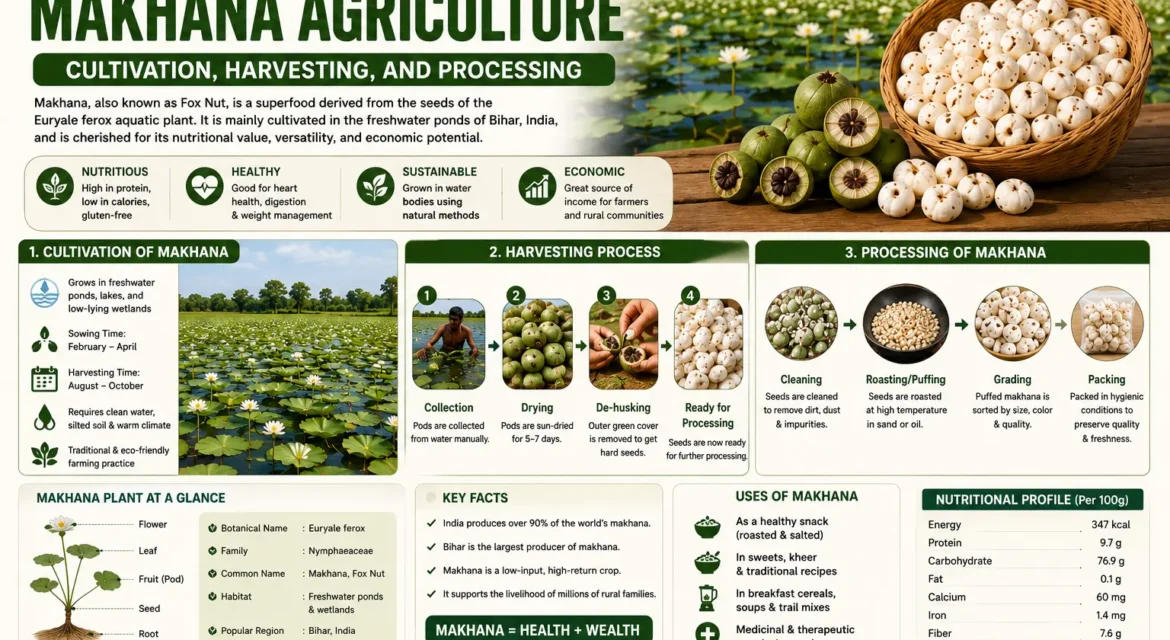
The Ultimate Guide to Makhana Agriculture: Cultivation, Harvesting, and Processing
If you’ve walked down the snack aisle of any premium grocery store recently, you’ve probably noticed the explosion of a new “superfood.” Packaged in sleek, nitrogen-flushed bags and dusted with everything from Himalayan pink salt to peri-peri seasoning, makhana (fox nut) has taken the global health food market by storm.
But long before it becomes a $5-per-bag guilt-free snack in New York or London, makhana begins its life in the muddy, stagnant ponds of eastern India. Having spent considerable time with the traditional Mallah fishing communities in the Mithilanchal wetlands, I can tell you firsthand: makhana farming isn’t just agriculture. It’s an incredibly demanding, labor-intensive art form that tests human endurance.
In this comprehensive guide, we’ll strip away the marketing gloss and dive deep into makhana agriculture. We’ll cover how makhana grows, the grueling harvest process, the highly specific processing stages that turn a rock-hard black seed into a fluffy white cloud, and the sweeping economic shifts transforming Bihar’s rural landscape.
Whether you’re an agritech entrepreneur, a supply chain manager, or simply curious about where your food comes from, here is the unvarnished reality of makhana production.
What is Makhana? The Botanical Blueprint
Makhana, scientifically known as Euryale ferox Salisb., belongs to the water lily family (Nymphaeaceae). It is an aquatic plant native to South and East Asia, thriving in stagnant, perennial water bodies. While the world calls it “fox nut” or “gorgon nut,” it isn’t actually a nut at all—it’s the starchy, popped seed of an aquatic plant.
The plant itself is fiercely prehistoric in appearance. As temperatures rise in the spring, the plant spreads across the water’s surface, deploying massive, circular, floating leaves that can reach up to a meter in diameter. The entire plant—leaves, stems, and flowers—is covered in sharp, defensive thorns. Underneath these protective leaves, the plant develops spiky, fleshy fruits that resemble small pomegranates. Each fruit contains 20 to 40 pea-sized seeds encased in a gelatinous aril.
Nutritional Profile: Why the World is Obsessed
The exploding demand for makhana boils down to its macroscopic nutrient density. According to the Indian Council of Agricultural Research (ICAR), a 100g serving of dry, raw makhana contains:
- Protein: 9.7–14.5 g (High quality, plant-based)
- Carbohydrates: 65–76 g
- Fat: 0.1–0.5 g (Virtually fat-free)
- Glycemic Index: Low (≈ 45–50)
- Gluten: Zero
It’s an easily digestible, gluten-free, low-fat carbohydrate source that absorbs flavors brilliantly. In an era where consumers are turning away from deep-fried potato chips, makhana is the holy grail of snack manufacturing.
The Epicenter: Makhana Production in Bihar
You cannot discuss makhana & makhana rate farming without talking about Bihar, India.
Bihar accounts for an astonishing 85% to 90% of India’s total makhana production, which in turn accounts for the vast majority of the global supply. The Mithilanchal and Kosi regions—districts like Darbhanga, Madhubani, Purnia, Katihar, and Araria—are the undisputed makhana capitals of the world.
Why Bihar? It comes down to a perfect geographical lottery:
- Water Surplus: The region is drained by hundreds of Himalayan river channels that recharge natural oxbow lakes, swamps, and ponds year after year.
- Stagnant Water: Makhana requires stagnant water up to 4–6 feet deep. The natural topography of the Indo-Gangetic plains provides thousands of hectares of these depressions.
- Generational Skill: The traditional Mallah (fishing) communities, specifically sub-groups like the Kols, Chaains, and Vanpars, possess centuries of inherited, highly specialized knowledge required to harvest and pop the seeds.
The Economic Awakening and The Makhana Board
For decades, makhana was a regional staple, used in religious rituals (as an offering to deities) and local curries. The farmers saw a fraction of a penny for their grueling work.
Today, the narrative has flipped. With export demand skyrocketing, makhana has become a highly lucrative cash crop. Acknowledging this immense potential, the Indian government’s Union Budget 2025–26 officially announced the creation of a dedicated National Makhana Board headquartered in Bihar. This board is tasked with funding infrastructure, modernizing processing units to reduce post-harvest losses, and aggressive global marketing.
Agro-Climatic Requirements: How Does Makhana Grow?
Makhana is incredibly resilient to extreme weather—making it a championed “climate-smart” crop—but it demands a very specific micro-environment to yield commercial quantities.
Soil and Water Constraints
The plant needs clayey or loamy soil rich in organic matter at the bottom of the pond to support deep root anchorage. The water depth should ideally be maintained at 1.2 to 1.5 meters (around 4 to 5 feet) throughout the 8 to 10-month cropping season.
Temperature and Sunlight
Makhana is a photosensitive, tropical to subtropical crop. It requires:
- Air Temperature: 20°C to 35°C for optimal vegetative growth.
- Humidity: 50% to 90%.
- Rainfall: 100 to 250 cm annually to naturally replenish the ponds.
Ecological Benefits
Interestingly, makhana cultivation acts as a natural fertilizer for the ecosystem. ICAR studies have shown that the makhana cropping system adds approximately 8.0 tonnes per hectare per year of dry biomass back into the soil. This decomposing matter significantly enriches the pond bed with Nitrogen (approx. 34 kg/ha) and Phosphorus (56 kg/ha), paving the way for integrated fish farming or subsequent crop rotations in shallower fields.
The Makhana Agriculture Lifecycle
There are two primary methods of makhana cultivation: the traditional pond system and the modern field-based system. We’ll focus on the prevailing pond-based agriculture.
- Pond Preparation (December – January): Farmers clean the ponds, removing invasive aquatic weeds like water hyacinth. In traditional systems, no tilling is possible. In newer, shallow-trench field systems, the soil is ploughed and organic manure is incorporated before flooding the field with 1 to 2 feet of water.
- Sowing and Nursery Management: Historically, farmers simply broadcasted seeds into the pond. However, modern agronomy advocates for a nursery method. Seeds are germinated in a small, controlled nursery bed for 30–45 days. Once the seedlings develop a few floating leaves, they are transplanted into the main pond with a spacing of about 1.2 x 1.2 meters to prevent overcrowding.
- Vegetative Growth (February – May): As the water warms, the plant exhibits rapid vegetative growth. Massive, thorny leaves blanket the water surface. During this phase, farmers must meticulously thin out excess leaves to ensure adequate sunlight penetrates the water, which is vital for the eventual development of the fruit.
- Fruiting and Maturation (June – July): Bright purple flowers emerge, blooming briefly before retreating underwater where the fruit develops. By mid-summer, the spongy fruits swell. When they reach full maturity, the fruits burst open underwater, scattering the heavy, black seeds across the muddy floor of the pond.
The Makhana Harvest: A Test of Endurance
If you want to understand why makhana commands a premium price, you must understand the harvest. There is no machine that can harvest makhana from a traditional pond. It is an entirely manual, physically punishing process.
Between August and October, when the seeds have settled into the thick, anaerobic sludge at the bottom of the pond, the harvest begins.
Skilled farmers, primarily from the Mallah community, wade or dive into the deep water. They hold their breath, dive to the bottom, and use their bare hands or specialized bamboo contraptions (called a Khonnghi or Deli) to sweep the muddy floor. They drag the mud toward them, sifting out the small, hard, black seeds from the muck, snails, and rotting plant matter.
They do this for hours on end, submerged in muddy water, navigating around the decaying, razor-sharp thorns of the dying makhana plants. It is a testament to human resilience, but it also highlights the urgent need for ergonomic interventions and modernized, shallow-field cultivation where harvesting doesn’t require deep diving.
Post-Harvest Processing: The Crucible of Fire
Once the raw, black seeds are pulled from the mud, the clock starts ticking. The seeds have a moisture content of roughly 37%, and if left unattended, they will rot.
Transforming these rock-hard black pebbles into the fluffy white kernels we recognize is one of the most complex, multi-stage, thermally-sensitive traditional processing methods in global agriculture.
- Cleaning and Washing: The seeds are brought ashore and immediately threshed underfoot to remove the rotting gelatinous air. They are then washed vigorously in clean water to remove all traces of mud, snails, and debris.
- Sun Drying: The clean, wet seeds are spread out on large mats under the hot sun for several hours. The goal is to drop the moisture content from ~37% down to roughly 25%. This slight drying hardens the black seed coat, preparing it for the intense heat to come.
- Size Grading: Crucial for even roasting. Because popping requires precise timing based on seed mass, the seeds are passed through a series of sieves (up to 10 different sizes). Small seeds roast faster than large ones; mixing them would result in burnt small seeds and un-popped large ones.
- First Roasting (Pre-heating): 250°C to 300°C. The graded seeds are thrown into a heavy cast-iron pan set over a fiercely hot mud stove. They are roasted rapidly for 5 to 6 minutes, bringing their moisture content down to about 21%.
- Tempering: The resting phase. The hot, roasted seeds are stored in bamboo baskets and left at room temperature for 23 to 24 hours. This is the secret to popping: during tempering, the moisture inside the seed migrates, loosening the starchy kernel from the hard, outer black shell.
- Second Roasting: The next day, small handfuls of tempered seeds are thrown back into a blazing hot pan (around 280°C to 335°C). They are roasted for exactly 1.5 to 2 minutes until the internal moisture turns to pressurized steam.
- Popping: Must be done within seconds. This is the most critical and dangerous step. The roasting-hot seeds are scooped out and immediately placed on a wooden platform (Aphara). An experienced worker strikes the seed with a wooden mallet (Thaapi). The blunt force cracks the hard shell, and the pressurized steam inside explosively expands the starchy kernel, turning it inside out into a fluffy white ball. If there is a delay of even 5 seconds, the seed cools, the pressure drops, and it will not pop.
The Toll of Traditional Processing
The traditional popping method is incredibly hazardous. The workers’ hands are constantly exposed to flying shrapnel from the hard shells and the searing heat of the 300°C seeds. Burns, calluses, and chronic pain are standard occupational hazards.
Mechanization: The ICAR-CIPHET Revolution
Recognizing the drudgery and human cost of traditional processing, the Central Institute of Post-Harvest Engineering and Technology (ICAR-CIPHET) in Ludhiana developed a fully mechanized makhana roasting and popping system.
This technological leap replaces the manual cast-iron pans and wooden mallets with a continuous, closed-barrel roasting system using electrically heated thermic oil.
- Time Saved: It reduces the total processing time from 3 days down to just 20 hours.
- Safety: Zero human intervention between roasting and popping eliminates hand burns.
- Economics: Mechanized popping yields a higher percentage of unbroken, premium-grade Lawa (the highest grade of makhana), which fetches at least ₹50 more per kilogram in the market.
With a fixed capital investment of around ₹15 lakhs, entrepreneurs in Bihar and beyond are establishing these processing units. The shift from manual to mechanized processing is the crucial bottleneck that is finally opening up, allowing the industry to scale to meet global demand.
Grading, Flavoring, and Packaging
Once popped, the makhana isn’t ready for the supermarket just yet.
- Polishing & Grading: The popped kernels are rubbed against bamboo baskets to remove any lingering red flakes of the inner seed coat, resulting in a pristine creamy-white appearance. They are then graded.
- Grade 1 (Lawa/Rasgulla): Fully inflated, circular, more than 15mm diameter. Used for premium snacks.
- Grade 2 (Murra): Smaller, slightly irregular, with light reddish spots.
- Grade 3 (Thurri): Flattened, unpopped or half-popped. Often ground into powder for baby food or ready-to-eat puddings (Makhana Kheer).
- Flavoring: Raw makhana is a blank canvas. In modern FMCG (Fast-Moving Consumer Goods) facilities, the makhana is sent through rotary coating drums. A light spray of olive oil or ghee acts as a binding agent, followed by precise dusting of spices—from traditional Pudina (mint) to modern Truffle and Cheese.
- Packaging: Makhana needs to be fully chilled before being packed in laminated, sealed pouches because it is extremely hygroscopic—it quickly absorbs moisture from the air and loses its crunch. High-end products use nitrogen flushing to remove oxygen, which keeps the oils from getting rancid and increases their shelf life by up to a year.
Expert Insights: The Future of Makhana
To provide a 360-degree view of the industry, we synthesized insights from agronomists, economic researchers, and supply chain experts monitoring the makhana boom:
“The shift from deep-water pond culture to shallow-field culture is the largest agricultural transformation we see. Crop rotation increases the usefulness of farmers’ land and significantly lessens harvesting drudgery. Makhana is typically followed by wheat or mustard.”
— Dr. S. K. Singh, Agronomist specializing in wetland ecosystems.
“Makhana is a unique convergence in global agriculture since it is a crop that meets the highest standards of contemporary consumer health trends and is very adaptive to climate unpredictability. It is gluten-free, vegan, and protein-dense. The ceiling for export growth hasn’t even been spotted yet.”
— A. Sharma, FMCG Market Analyst.
“The true bottleneck has always been processing. By introducing thermic-oil mechanized popping, we aren’t just increasing throughput; we are saving the hands and health of thousands of traditional workers, allowing them to shift to supervisory and quality control roles.”
— Research Director, Post-Harvest Engineering.
“The National Makhana Board in Bihar received funding from the Union Budget, which provided the necessary regulatory framework for this sector. It shifts makhana from an ‘unorganized forest-produce’ mindset to a formalized, export-ready agricultural sector with standardized GI (Geographical Indication) protections.”
— R. Verma, Agricultural Economist.
Conclusion: The Lotus Rises
Makhana agriculture is a profound story of transformation. It is a crop born in mud and thorns, harvested through immense physical sacrifice, and processed through literal fire. But it is also a delicate, super-nutritious food that is transforming the economics of eastern India.
As mechanization scales and the newly formed Makhana Board standardizes export quality, the next five years will dictate who captures the lion’s share of this market. For the farmers of Mithilanchal, the era of treating makhana as a local curiosity is over; the global stage is officially open.
Frequently Asked Questions
Ready to Source Premium Indian Makhana?
Connect with a trusted B2B exporter to secure highly graded, mechanization-processed Makhana straight from the heart of Bihar. Enhance your FMCG snack line with the finest quality available.