

 31 August 2026
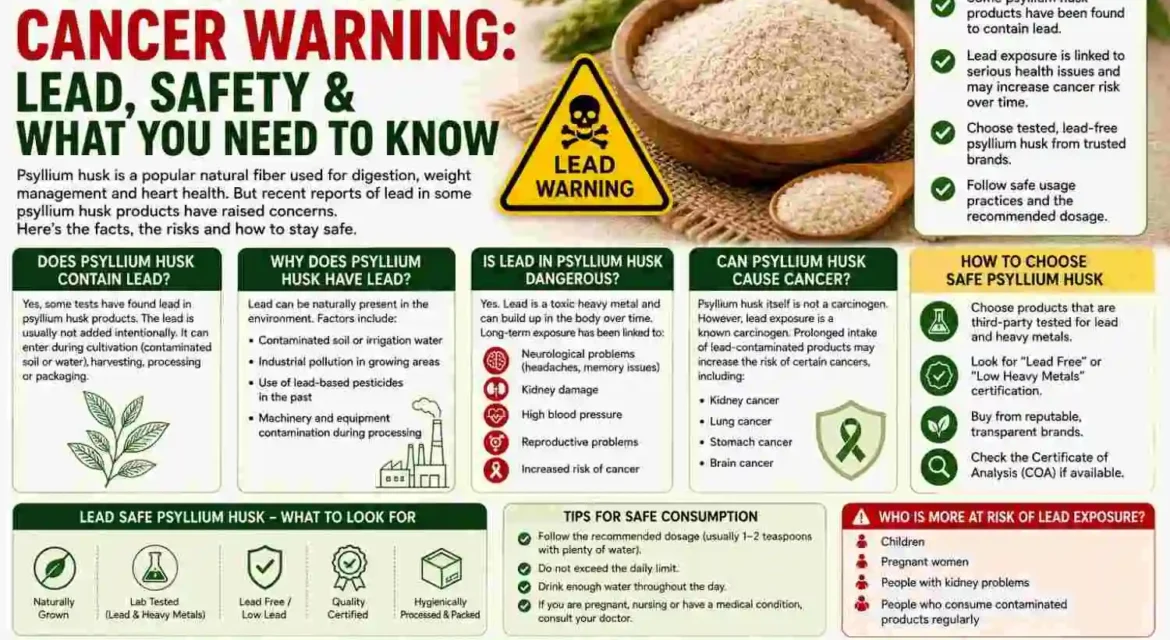
Psyllium Husk Cancer Warning: Lead, Safety & What You Need to Know
Searches for “psyllium husk cancer warning”, “lead in psyllium husk”, and “does psyllium husk have lead” have raised questions about the safety and quality of psyllium products.
The concern generally relates to lead and other heavy metals, rather than psyllium itself being established as a cancer-causing ingredient. Lead is a toxic environmental contaminant that can enter agricultural products through soil, water, processing, or other environmental sources. Consumer Reports notes that heavy metals such as lead, arsenic, and cadmium can occur naturally in soil and can make their way into agricultural products.
This makes quality control and testing important when purchasing psyllium husk, particularly for products intended for regular consumption.
Table of Contents
- Does Psyllium Husk Have Lead?
- Why Does Psyllium Husk Have Lead?
- Why Is There Lead in Psyllium Husk?
- Lead in Psyllium Husk: Should You Be Concerned?
- Psyllium Husk Cancer Risk: Is Psyllium Carcinogenic?
- What Does “Lead-Free Psyllium” Mean?
- Lead-Free Psyllium Husk and Psyllium Powder
- What Is Low Lead Psyllium Husk?
- Metamucil Lead: Does Metamucil Contain Lead?
- Does Metamucil Have Lead or a Lead Warning?
- How Is Lead in Psyllium Tested?
- How to Choose High-Quality Psyllium Husk
- Frequently Asked Questions
- Conclusion
1. Does Psyllium Husk Have Lead?
The answer to “does psyllium husk have lead?” is not a simple yes or no for every product.
Psyllium is an agricultural product, and like other crops, it can potentially be exposed to environmental contaminants such as heavy metals. Lead can occur in soil and may enter agricultural products through environmental pathways.
However, this does not mean that all psyllium husk contains concerning levels of lead.
The actual level depends on factors such as:
- Growing conditions
- Soil composition
- Water quality
- Agricultural practices
- Processing
- Cleaning
- Storage
- Testing and quality control
For this reason, buyers should look at the specifications and testing documentation for the specific psyllium product or batch rather than assuming that all psyllium has the same lead content.
Is Lead Naturally Added to Psyllium?
No. Lead is not an ingredient that manufacturers intentionally add to psyllium husk.
If lead is detected, it is generally considered an environmental or processing contaminant rather than a functional ingredient.
2. Why Does Psyllium Husk Have Lead?
People often search “why does psyllium husk have lead” or “why is there lead in psyllium husk?”
The answer is primarily related to the fact that psyllium is a plant-derived agricultural ingredient.
Plants grow in soil and interact with water and the surrounding environment. If heavy metals are present in the growing environment, trace amounts can potentially enter agricultural materials.
Consumer Reports explains that heavy metals such as lead, arsenic, and cadmium can occur in soil and can enter foods and other agricultural products.
Possible sources include:
- Naturally occurring minerals in soil
- Historical environmental contamination
- Irrigation water
- Agricultural inputs
- Processing environments
- Transportation or storage contamination
The presence of a detectable trace amount therefore needs to be interpreted using the applicable safety standard and the actual amount detected.
3. Why Is There Lead in Psyllium Husk?
The question “why is there lead in psyllium husk” is closely related to agricultural sourcing and contamination control.
Psyllium is derived from Plantago ovata, so the quality of the raw agricultural material matters. Good manufacturing practices can help reduce contamination risks through appropriate sourcing, cleaning, processing, testing, and quality-control procedures.
For commercial buyers, this is why supplier selection is important.
A reputable supplier should be able to provide relevant information about:
- Raw-material origin
- Processing
- Product specifications
- Heavy-metal testing
- Batch identification
- Certificate of Analysis (COA)
- Applicable food-safety requirements
4. Lead in Psyllium Husk: Should You Be Concerned?
Lead exposure is a legitimate food-safety concern because lead is toxic. The important question is how much lead is present and whether the amount meets the applicable safety requirements.
Consumer Reports has highlighted that heavy-metal levels can vary substantially between products and that testing is useful for identifying products with lower levels of contamination.
This means consumers should avoid making assumptions such as:
“All psyllium contains dangerous lead.”
or:
“All psyllium is automatically lead-free.”
Neither conclusion is appropriate without product-specific testing.
Why Testing Matters
Laboratory testing can determine the concentration of lead in a particular sample.
For commercial psyllium buyers, a Certificate of Analysis can provide useful information about the tested batch and its relevant specifications.
5. Psyllium Husk Cancer Risk: Is Psyllium Carcinogenic?
The phrase “psyllium husk cancer risk” can sound alarming, but it is important to distinguish between lead contamination and psyllium itself.
Psyllium is a plant-derived dietary fiber. The FDA’s current information on selected dietary-supplement ingredients recognizes psyllium husk and lists a qualified health claim concerning psyllium husk and reduced risk of type 2 diabetes.
A concern about possible heavy-metal contamination should therefore not automatically be interpreted as evidence that psyllium itself causes cancer.
Where Does the Cancer Concern Come From?
The concern is generally related to long-term exposure to certain toxic substances, including lead, rather than psyllium being inherently carcinogenic.
Lead exposure is a public-health concern, which is why controlling heavy metals in food and dietary ingredients is important.
Therefore:
- Psyllium husk ≠ lead.
- Possible lead contamination ≠ proof that psyllium causes cancer.
The relevant safety question is whether a particular product contains contaminants above applicable limits.
6. What Does “Lead-Free Psyllium” Mean?
The phrase lead-free psyllium is commonly used by buyers who want to minimize exposure to heavy-metal contaminants.
However, consumers should use caution when using the term “lead-free.”
In analytical testing, laboratories may report results based on the detection or quantification limits of the test method. A product described commercially as lead free may therefore mean that lead was not detected above the method’s reporting limit rather than that the material contains absolutely zero lead atoms.
What Should Buyers Look For?
Instead of relying only on marketing language, check for:
- Lead test results
- Certificate of Analysis
- Testing laboratory
- Batch number
- Testing date
- Applicable specification or limit
- Heavy-metal testing methodology where provided
For commercial purchasing, documentation is more useful than an unsupported “lead-free” claim.
7. Lead-Free Psyllium Husk and Psyllium Powder
Both whole psyllium husk and psyllium husk powder can be evaluated for heavy metals.
If you are looking for lead-free psyllium husk or lead-free psyllium husk powder, ask the supplier for appropriate laboratory documentation.
Whole Psyllium Husk
Whole husk is less finely processed and is commonly sold as a dietary-fiber ingredient.
Psyllium Husk Powder
Powder is produced by processing or grinding psyllium husk into a smaller particle size.
The physical form does not by itself determine whether a product contains lead.
Instead, heavy-metal levels should be confirmed through appropriate testing.
8. What Is Low Lead Psyllium Husk?
Low lead psyllium husk generally refers to psyllium that has been tested and found to contain a low concentration of lead relative to the applicable specification or benchmark.
The term itself does not establish a universal numerical threshold.
Different countries, applications, and regulatory frameworks may have different requirements. Therefore, commercial buyers should identify the requirements that apply to their target market.
Low Lead vs Lead Free
It is not appropriate to treat these terms as interchangeable.
Low lead psyllium husk means the measured level is low.
Lead-free psyllium is a stronger marketing term that should be supported by an appropriate test result and an understanding of the laboratory’s detection limits.
For a professional purchase, request the actual test report whenever possible.
9. Metamucil Lead: Does Metamucil Contain Lead?
Searches for “does Metamucil contain lead”, “Metamucil lead”, and “does Metamucil have lead” are often driven by general concerns about heavy metals in dietary supplements.
Metamucil’s current product information identifies psyllium as its plant-based fiber ingredient. Its official product information provides directions, ingredient information, and safety instructions for its products.
However, it would be inaccurate to make a blanket statement that every Metamucil product is either completely free of lead or contains a specific amount of lead without product-specific laboratory evidence.
Why Product-Specific Information Matters
Metamucil has multiple formulations, including powders and capsules. Product composition can differ between formulations and markets.
Therefore, if you are investigating Metamucil lead, identify:
- The exact product
- Product formulation
- Country or market
- Batch or lot
- Available laboratory or manufacturer information
This is more reliable than applying a general claim to every Metamucil product.
10. Does Metamucil Have Lead or a Lead Warning?
The phrase “Metamucil lead warning” can refer to concerns about heavy-metal contamination or regulatory warnings associated with specific products or jurisdictions.
A warning should not be assumed to apply universally to every Metamucil product.
The official Metamucil product pages currently provide safety information such as taking the product with sufficient liquid, allergy information, and medication-separation guidance.
If you see a specific warning on a product package, review the exact wording and the jurisdiction in which the product is sold.
What About a California Prop 65 Warning?
A California Proposition 65 warning, if present on a product, does not automatically mean that the product causes cancer or that it is unsafe when used as directed.
California’s warning system has its own legal requirements and exposure-based thresholds. Therefore, consumers should distinguish a regulatory warning from a finding that a product contains a dangerous amount of lead.
For any specific product, the package and current manufacturer information should be checked.
11. How Is Lead in Psyllium Tested?
Heavy-metal testing is generally performed using laboratory analytical methods designed to detect and quantify elements such as lead.
For commercial psyllium, buyers may request testing for:
- Lead
- Arsenic
- Cadmium
- Mercury
The exact testing requirements depend on the intended application and destination market.
Certificate of Analysis
A Certificate of Analysis (COA) may include results for heavy metals and other quality parameters.
When reviewing a COA, check:
- Product name
- Batch number
- Test date
- Parameter tested
- Result
- Unit of measurement
- Specification or limit
- Testing laboratory
This allows buyers to evaluate the actual batch rather than relying solely on marketing claims.
12. How to Choose High-Quality Psyllium Husk
If concerns about lead in psyllium husk are influencing your purchasing decision, consider the following checklist.
1. Choose a Transparent Supplier
Look for suppliers that can provide clear product specifications and testing information.
2. Request Heavy-Metal Testing
Ask whether the product is tested for lead, arsenic, cadmium, and other relevant contaminants.
3. Request a COA
For commercial orders, request a COA for the relevant batch whenever appropriate.
4. Check the Product Origin
Understanding the agricultural and processing source can help with supplier due diligence.
5. Review Applicable Standards
A result should be interpreted against the appropriate regulatory or customer specification rather than an arbitrary number.
6. Compare Suppliers
Do not select a supplier based only on the phrase lead-free psyllium. Compare documentation, quality systems, specifications, testing, and supply consistency.
Source FDA-Compliant Wholesale Psyllium
Ensure the safety and quality of your supply chain. Partner with Civize for meticulously tested, export-grade bulk psyllium husk backed by complete Certificates of Analysis.
13. Frequently Asked Questions
Does psyllium husk contain lead?
Psyllium, like other agricultural products, can potentially contain trace amounts of environmental contaminants such as lead. The actual level varies by product and batch, so product-specific testing is the appropriate way to evaluate it.
Does psyllium husk have lead?
It can contain trace levels depending on agricultural and environmental conditions, but this does not mean that every psyllium product contains a concerning level of lead.
Why does psyllium husk have lead?
Psyllium is a plant-derived agricultural product. Lead can enter agricultural materials through environmental sources such as soil or water. Appropriate sourcing, processing, and testing can help control contamination.
Why is there lead in psyllium husk?
The presence of lead, when detected, is generally related to environmental contamination rather than lead being an intended ingredient of psyllium.
What is lead-free psyllium?
Lead-free psyllium is a commercial term generally used for psyllium that has not shown detectable lead above the relevant analytical reporting or detection threshold. Buyers should request laboratory documentation rather than relying solely on the claim.
Is lead-free psyllium husk completely free of lead?
Not necessarily. “Lead-free” may refer to lead being below a laboratory’s detection or reporting limit. Check the actual test report and methodology where available.
What is low lead psyllium husk?
It refers to psyllium with a low measured lead concentration relative to an applicable specification or benchmark. The exact acceptable level depends on the relevant market and intended use.
Is lead-free psyllium husk powder available?
Psyllium husk powder can be tested for heavy metals, including lead. If a supplier markets it as lead-free psyllium husk powder, ask for supporting laboratory results.
Does Metamucil contain lead?
You should not assume that every Metamucil product contains or does not contain a specific amount of lead without product-specific testing. Metamucil’s official product information identifies psyllium as its plant-based fiber ingredient.
Does Metamucil have lead?
The answer depends on the specific product, formulation, batch, and applicable testing. A blanket claim about all Metamucil products would require product-specific evidence.
Is there a Metamucil lead warning?
Any warning should be evaluated based on the exact product, label, market, and jurisdiction. Do not assume that a warning associated with one product or jurisdiction applies to every Metamucil product.
Does psyllium husk cause cancer?
There is an important distinction between psyllium itself and potential contamination by substances such as lead. Concerns about heavy metals should not be presented as evidence that psyllium itself is a known carcinogen. FDA currently recognizes psyllium husk as a dietary ingredient and has information concerning qualified health claims for psyllium husk.
14. Conclusion
The phrase “psyllium husk cancer warning” can be misleading if it suggests that psyllium itself is a known cause of cancer. The more relevant issue for buyers is contaminant control, particularly testing for heavy metals such as lead.
So, does psyllium husk have lead? It can potentially contain trace environmental contaminants because it is an agricultural product, but the presence and concentration should be determined through product-specific testing rather than assumptions.
If you are looking for lead-free psyllium, lead-free psyllium husk, or low lead psyllium husk, prioritize suppliers that provide reliable specifications, batch-level testing, and Certificates of Analysis.
The same principle applies when investigating Metamucil lead, does Metamucil contain lead, or does Metamucil have lead. Product-specific information is more reliable than broad claims about an entire brand.
For consumers and commercial buyers alike, the best approach is simple: check the product, check the test results, and check the applicable safety requirements.