
 17 August 2026
Psyllium Husk Purity: How to Identify Pure, Natural Psyllium Fiber
Psyllium husk is a natural dietary fiber obtained from the outer coating of Plantago ovata seeds. It is widely used in food, nutrition, pharmaceutical, and dietary-fiber products because of its high soluble-fiber content and excellent water-absorbing properties.
For consumers, wholesalers, manufacturers, and importers, psyllium husk purity is one of the most important factors to consider before purchasing. Pure psyllium should have consistent color, texture, cleanliness, moisture levels, and fiber content, with minimal foreign matter or contamination.
Whether you are looking for psyllium hulls, psyllium seed husk fiber, natural psyllium fiber, or ground psyllium powder, psyllium capsules understanding quality and purity can help you choose the right product.
Request a Wholesale Quote Today
Table of Contents
- What Is Psyllium Husk?
- What Is Psyllium Husk Purity?
- Types of Psyllium Husk and Fiber
- How to Identify Pure Psyllium Husk
- Natural Psyllium Fiber: What to Look For
- Psyllium Husk Nutritional Profile
- Psyllium Husk Quality Standards and Testing
- Where to Get Psyllium Husk
- Psyllium Husk for Sale: What Buyers Should Check
- How Much Is Psyllium Husk?
- How to Choose High-Purity Psyllium Husk
- Frequently Asked Questions
1. What Is Psyllium Husk?
Psyllium husk is the thin outer layer of the seeds of Plantago ovata, a plant primarily cultivated in regions of India. The husk contains a high proportion of soluble dietary fiber and is commonly processed into whole husk, flakes, or powder.
The terms psyllium hulls and psyllium husk are generally used to describe the outer seed covering. After harvesting and cleaning, the husk can be separated from the seed and processed according to the intended application.
Psyllium Seed Husk Fiber
Psyllium seed husk fiber is valued for its high dietary-fiber content and ability to absorb water. When mixed with liquid, psyllium expands and forms a gel-like consistency.
This property makes psyllium useful in a variety of food and nutritional applications.
Why Is Psyllium Considered a Natural Fiber?
Natural psyllium fiber comes from the husk of the Plantago ovata seed. High-quality psyllium products generally contain the cleaned and processed husk without unnecessary fillers.
For buyers looking for psyllium natural products, checking the ingredient list, specifications, processing information, and supplier documentation is important.
2. What Is Psyllium Husk Purity?
Psyllium husk purity refers to the quality and cleanliness of psyllium husk and the extent to which the product is free from unwanted materials.
A high-quality psyllium product should have:
- Consistent appearance and color
- Clean and uniform texture
- Low foreign-matter content
- Controlled moisture
- Appropriate microbiological quality
- Consistent fiber content
- Proper packaging and storage
- Reliable quality documentation
Purity becomes particularly important when psyllium is purchased in bulk for food manufacturing, dietary-fiber products, nutraceutical applications, or export.
Why Psyllium Purity Matters
Lower-quality raw material may contain unwanted plant material, excessive moisture, foreign particles, or other impurities. These factors can affect product consistency, shelf life, processing performance, and customer acceptance.
For commercial buyers, purity should therefore be evaluated alongside specifications, certificates, testing reports, packaging, and supplier reliability.
3. Types of Psyllium Husk and Fiber
Psyllium can be supplied in several physical forms depending on the application.
Whole Psyllium Husk
Whole psyllium husk consists of the separated outer husk with minimal grinding. It typically has a light, flaky appearance and can be used directly in food and fiber applications.
Psyllium Flakes
Psyllium flakes are larger pieces of processed husk. They can be suitable for applications where a less finely milled form is preferred.
Ground Psyllium Husk
Ground psyllium husk is produced by mechanically reducing the particle size of psyllium husk.
Grinding can make the material easier to incorporate into certain food formulations, although the appropriate particle size depends on the application.
Ground Psyllium Powder
Ground psyllium powder is a finely processed form of psyllium husk. Particle size, flowability, color, moisture, and fiber content can vary depending on processing conditions.
Husk Powder
The term husk powder is commonly used for finely milled psyllium husk. Buyers should always check the product specification rather than relying only on the name because particle size and composition can differ between suppliers.
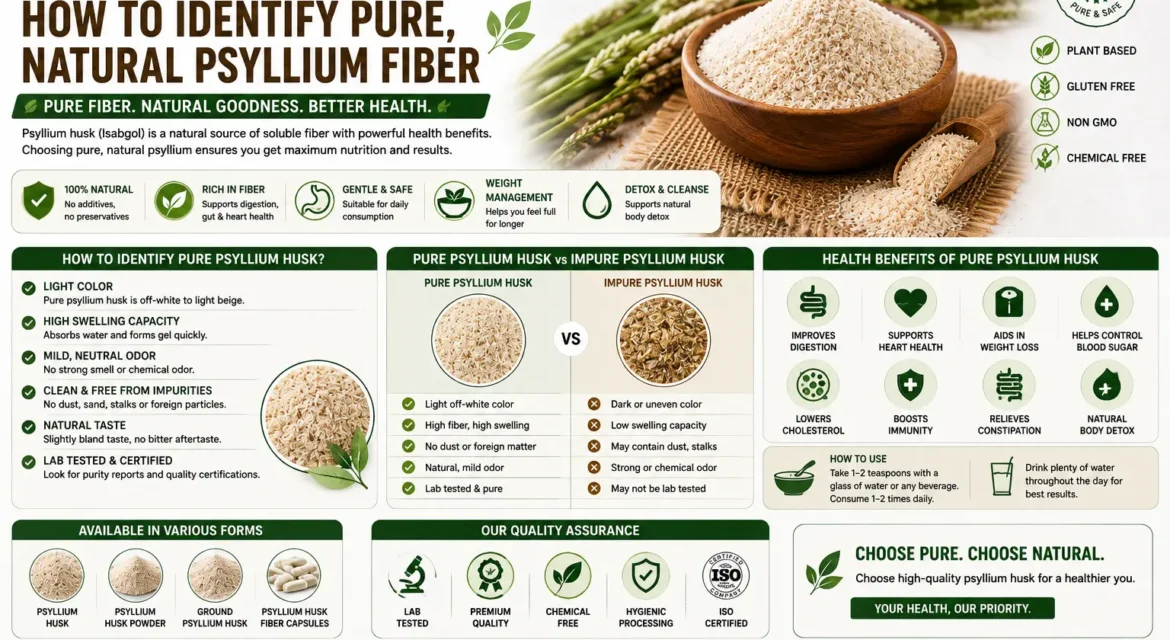
4. How to Identify Pure Psyllium Husk
Identifying high-quality psyllium requires more than simply looking at its color. Commercial buyers should evaluate several characteristics.
Color and Appearance
High-quality psyllium husk generally has a clean, consistent appearance. Significant discoloration, excessive dark particles, or visible foreign material can indicate quality issues and should be investigated.
Texture and Particle Size
The texture depends on whether you are purchasing whole husk, flakes, or ground psyllium.
For powdered products, consistent particle size can be important for manufacturing and formulation.
Odor and Taste
Psyllium should have a characteristic mild odor without obvious signs of spoilage, unusual odors, or contamination.
Moisture
Moisture is an important quality parameter because excessive moisture can negatively affect storage stability and product quality.
Foreign Matter
A high-quality product should be properly cleaned and processed to minimize foreign matter. Commercial buyers should request appropriate testing documentation where required.
5. Natural Psyllium Fiber: What to Look For
If you are specifically looking for natural psyllium fiber, focus on the product’s source, processing, composition, and ingredient declaration.
A reliable supplier should be able to provide information such as:
- Botanical source
- Product form
- Fiber specification
- Moisture specification
- Microbiological parameters
- Foreign-matter limits
- Packaging information
- Batch or lot identification
- Relevant certificates and test reports
Natural Psyllium vs Psyllium-Based Blends
Not every product marketed as a fiber product is necessarily pure psyllium. Some products may contain additional ingredients.
Therefore, buyers looking for psyllium natural products should carefully review the ingredient declaration and technical specification.
6. Psyllium Husk Nutritional Profile
Psyllium is primarily known as a source of dietary fiber rather than as a significant source of vitamins.
Psyllium Husk Fiber
The nutritional value of psyllium is largely associated with its soluble fiber content. The exact nutritional composition can vary depending on the product and processing method.
Psyllium Husk Vitamins
People sometimes search for psyllium husk vitamins, but psyllium should not generally be considered a major vitamin source. Its main nutritional feature is its dietary-fiber content.
For accurate nutritional information, consumers and commercial buyers should refer to the manufacturer’s nutrition panel or laboratory-tested specification.
7. Psyllium Husk Quality Standards and Testing
For commercial applications, visual inspection alone is not enough to establish psyllium husk purity.
Depending on the intended market and application, testing may include:
Fiber Content
Fiber testing helps establish whether the product meets the specified nutritional or technical requirements.
Moisture Testing
Moisture analysis helps assess the product’s condition and storage stability.
Microbiological Testing
Microbiological testing may be required for food and nutritional applications to verify that the product meets applicable safety specifications.
Foreign Matter
Testing and inspection can help identify unwanted plant material or other foreign particles.
Supplier Documentation
Importers and manufacturers may also request:
- Certificate of Analysis (COA)
- Specification sheet
- Batch information
- Certificate of origin
- Food-safety documentation
- Relevant certifications
The exact requirements depend on the destination market and intended application.
8. Where to Get Psyllium Husk
If you are searching for where to get psyllium husk, the right source depends on whether you need a small retail quantity or bulk commercial supply.
Consumers may find psyllium through pharmacies, health-food retailers, supermarkets, and online stores.
Commercial buyers looking for psyllium husk for sale should consider specialized suppliers, processors, manufacturers, exporters, and bulk distributors.
Where Can I Find Psyllium?
When searching for where can I find psyllium, consider the product form you need first.
For example, you may be looking for:
- Whole psyllium husk
- Psyllium flakes
- Ground psyllium
- Ground psyllium powder
- Psyllium seed husk fiber
The right form depends on your intended use.
Psyllium Husk Nearby
Searches such as psyllium husk nearby or psyllium husk powder nearby are useful when you need the product quickly from a local retailer.
However, if you are purchasing for manufacturing or resale, comparing bulk suppliers may provide better consistency and commercial specifications.
9. Psyllium Husk for Sale: What Buyers Should Check
When comparing psyllium husk for sale, price should not be the only consideration.
Commercial buyers should evaluate:
Product Specification
Check the exact product form, fiber content, moisture, particle size, purity, and other applicable parameters.
Source and Processing
Ask where the psyllium originates and how it is cleaned, processed, packed, and stored.
Packaging
Proper packaging helps protect psyllium from moisture, contamination, and handling issues during transportation and storage.
Testing and Documentation
A reliable supplier should be able to provide relevant technical documents and batch information when required.
MOQ and Supply Capacity
Importers and wholesalers should also consider minimum order quantity, production capacity, lead time, and export experience.
10. How Much Is Psyllium Husk?
One of the most common purchasing questions is how much is psyllium husk?
There is no single fixed price because psyllium pricing depends on several factors, including:
- Product form
- Purity and specification
- Particle size
- Order quantity
- Origin
- Packaging
- Processing
- Market conditions
- Destination country
- Shipping and logistics costs
Bulk commercial pricing can be significantly different from retail pricing.
For this reason, buyers should compare quotations based on the same specifications rather than comparing price per kilogram alone.
11. How to Choose High-Purity Psyllium Husk
Whether you are a consumer, wholesaler, manufacturer, or importer, use the following factors when selecting psyllium.
1. Confirm the Product Form
Determine whether you need whole husk, psyllium hulls, flakes, ground husk, or ground psyllium powder.
2. Check the Specification
Review fiber content, moisture, particle size, appearance, and other relevant quality parameters.
3. Verify Purity
Ask for appropriate documentation supporting the stated psyllium husk purity.
4. Check Packaging and Storage
Psyllium should be stored and packed appropriately to protect it from moisture and contamination.
5. Compare Suppliers
For commercial purchases, compare suppliers based on quality consistency, documentation, MOQ, supply capability, pricing, and delivery terms.
6. Request a Sample
For larger orders, a sample can help buyers evaluate appearance, texture, particle size, and suitability before placing a bulk order.
Source Premium, High-Purity Psyllium Husk
Ensure your product quality with FDA-compliant, rigorously tested, and perfectly graded wholesale psyllium. Partner with Civize for reliable B2B supply.
12. Frequently Asked Questions About Psyllium Husk Purity
The best form depends on the intended application. Purity should be evaluated through product specifications, testing, and supplier documentation rather than simply choosing whole husk or powder.
Look for consistent appearance, suitable moisture, low foreign matter, appropriate fiber specifications, and reliable quality documentation.
Ground psyllium is psyllium husk that has been processed to reduce its particle size. The exact characteristics depend on the grinding process and specification.
Psyllium husk powder is a finely processed form of psyllium husk. It is commonly used where a smaller and more uniform particle size is required.
Yes. Psyllium flakes are larger pieces of husk, while psyllium powder has a much finer particle size.
You can purchase psyllium through retail stores, pharmacies, online sellers, bulk distributors, processors, and exporters. Commercial buyers should select suppliers based on specifications, quality documentation, and supply capability.
You can search local pharmacies, health-food stores, supermarkets, and specialty retailers. For bulk requirements, commercial psyllium suppliers and exporters may be more appropriate.
The price depends on quality, product form, order volume, origin, processing, packaging, and shipping requirements. Bulk buyers should request a quotation based on their exact specification.
Conclusion
Choosing high-quality psyllium husk starts with understanding purity, product form, processing, and supplier quality. Whether you need psyllium hulls, psyllium seed husk fiber, natural psyllium fiber, ground psyllium, or ground psyllium powder, the product should be evaluated according to clear specifications rather than price alone.
For consumers, checking the ingredient declaration and product information is a good starting point. For wholesalers, manufacturers, and importers, it is equally important to review technical specifications, testing documentation, packaging, and supplier reliability.
By understanding these factors, buyers can make a more informed decision when looking for psyllium husk for sale, comparing psyllium husk purity, or determining where to get psyllium husk for their specific requirements.