
 24 July 2026
How to Succeed as a Flavoured Makhana Importer: The 2026 Sourcing Guide
If you are looking to become a flavoured makhana importer you are entering one of the most lucrative and rapidly expanding segments of the global healthy snack market. The global Fox Nuts (makhana) market was valued at approximately USD 138 million in early 2026 and is on track to reach USD 309 million by 2035.
However, transitioning from importing raw agricultural commodities to processed, flavoured, and retail-ready varieties introduces significant regulatory, logistical, and compliance hurdles. From the latest 2025 APEDA HS code changes to stringent US FDA FSVP requirements and strict EU pesticide limits, the margin for error is shrinking rapidly.
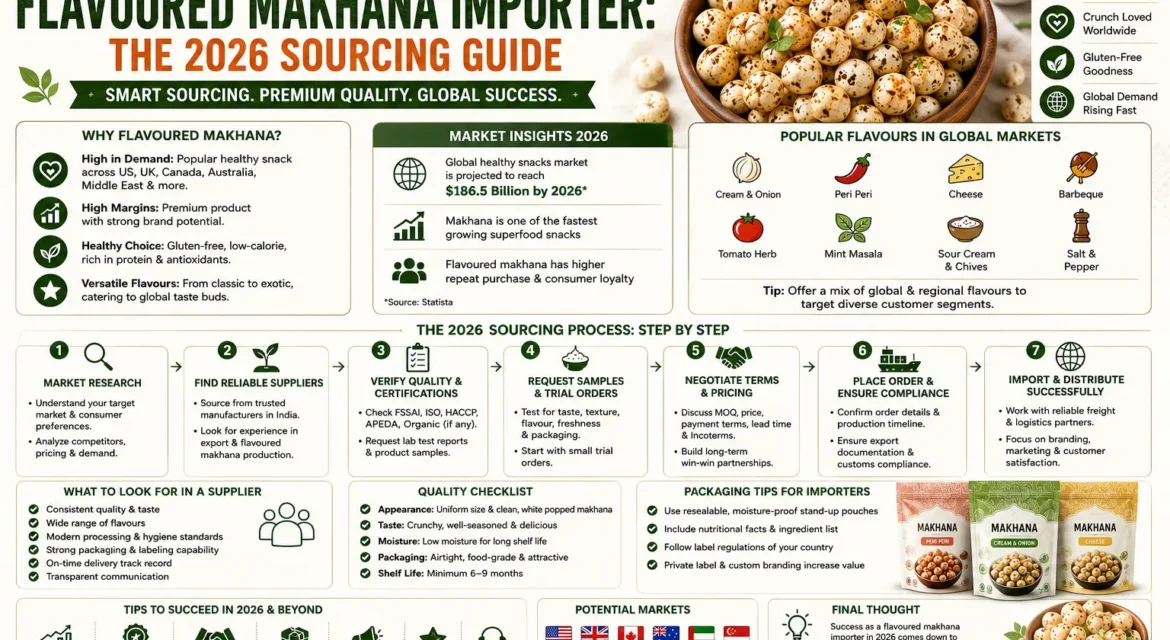
This comprehensive guide covers everything you need to know about sourcing, importing, and commercializing flavoured makhana in 2026.
Table of Contents
- 1. The State of the Global Makhana Market in 2026
- 2. Why Importers Are Shifting to Flavoured Makhana
- 3. HS Codes and Customs Classification (Updated for 2026)
- 4. International Food Safety and Quality Regulations
- 5. 7 Common Traps for Makhana Importers (and How to Avoid Them)
- 6. How to Find and Vet Reliable Indian Makhana Suppliers
- 7. Private Label vs. Bulk Import for Flavoured Makhana
- 8. The Logistics of Shipping Puffed Makhana
- 9. Marketing and Distribution Strategies Post-Import
- 10. Frequently Asked Questions (FAQs)
1. The State of the Global Makhana Market in 2026
Makhana, also known as fox nuts, gorgon nuts, or puffed lotus seeds, is harvested from the Euryale ferox plant. Historically confined to regional consumption in India (specifically the state of Bihar, which produces roughly 90% of the world’s supply), makhana has officially achieved global “superfood” status.
Market Dynamics and Regional Growth
The Indian makhana market itself is projected to hit USD 2.23 Billion by 2030, growing at an impressive CAGR of 8.8%. Globally, the demand is driven by a massive consumer shift toward gluten-free, vegan, paleo-friendly, and low-calorie snacking alternatives.
- North America: The leading importer by volume outside of Asia. The market here is driven by specialty grocery chains (like Whole Foods and Trader Joe’s) seeking alternatives to popcorn and potato chips.
- European Union: A fast-growing market, though heavily regulated. UK and German consumers are driving demand for clean-label, sustainably sourced, and organically flavoured makhana.
- Middle East (GCC): Rapidly adopting premium flavoured makhana, especially in the UAE and Saudi Arabia, heavily influenced by the large South Asian diaspora and an increasing focus on diabetes-friendly snacks.
The Shift from Commodity to CPG
Until recently, makhana was traded primarily as a raw commodity. Today, it is a Consumer Packaged Good (CPG). This shift requires importers to think less like agricultural traders and more like brand managers and food scientists. You are no longer just importing a seed; you are importing a complex recipe of oils, spices, binding agents, and customized packaging.
2. Why Importers Are Shifting to Flavoured Makhana
For years, the standard model was to import raw, unbranded makhana in bulk and process (roast and flavour) it domestically in the US, UK, or Australia. In 2026, the trend has heavily skewed toward importing pre-roasted, flavoured makhana directly from the source.
The Economic Advantage
The unit economics of importing finished goods from India are highly compelling. Let us look at why importers are making the switch:
- Higher Retail Margins: Flavoured makhana retails at a 300% to 500% premium over raw makhana. Consumers are willing to pay for convenience and gourmet flavour profiles.
- Reduced Domestic Processing Costs: Roasting and flavouring in India takes advantage of lower labor, machinery, and manufacturing overhead costs, significantly reducing your landed Cost of Goods Sold (COGS).
- Authentic and Complex Flavour Profiles: Indian manufacturers excel at complex spice blends like Tikka Masala, Mint (Pudina), and regional curries, which are difficult and expensive to replicate overseas using third-party co-packers.
- Ready-to-Market Supply Chains: With the rise of private labeling, importers can receive shelf-ready retail pouches directly off the shipping container, bypassing the need for a domestic warehouse processing step.
Unit Economics Comparison
| Metric | Importing Raw Makhana (Domestic Processing) | Importing Flavoured Makhana (Source Processing) |
|---|---|---|
| Purchasing Cost | Low | Medium |
| Domestic Co-packing Cost | Very High | Zero |
| Time to Market | 3 – 5 Months | 1 – 2 Months |
| Supply Chain Complexity | High (Multiple domestic partners) | Low (Single source partner) |
| Final Net Margin | 15% – 25% | 35% – 50% |
3. HS Codes and Customs Classification (Updated for 2026)
The most critical operational update for any flavoured makhana importer in 2026 is the Harmonized System (HS) code classification. Misclassification is the number one cause of customs delays, demurrage charges, and unexpected tariffs.
Historically, makhana exports faced massive customs ambiguity. Exporters often used generic codes like 19041090 (prepared foods) or 08109090 (fresh/dried fruit). However, effective late 2025, the Agricultural and Processed Food Products Export Development Authority (APEDA) and Indian Customs introduced dedicated codes to streamline trade and track the industry’s growth accurately.
The New 2026 HS Code Breakdown
| Product Category | 2026 HS Code | Description | Customs Treatment |
|---|---|---|---|
| Raw Makhana (Loose) | 08109090 | Dried lotus seeds (fox nuts), unbranded, raw. | Treated as agricultural commodity. |
| Popped Makhana | 20081921 | Makhana Popped (fox nuts, puffed lotus seeds), unflavoured. | Treated as processed food. |
| Makhana Flour | 20081922 | Makhana Flour and Powder. | Treated as milled ingredient. |
| Flavoured Makhana | 20081990 | Roasted and processed with additives, spices, and oils. | Highest scrutiny for food safety. |
Why This Matters for Importers
Ensure your Indian supplier uses HS Code 20081990 on all commercial invoices, packing lists, and Bills of Lading for flavoured makhana. Using the old, generic codes in 2026 will trigger automated red flags in customs systems like the US ACE (Automated Commercial Environment) or the EU’s TRACES system, resulting in mandatory physical inspections.
4. International Food Safety and Quality Regulations
Importing a flavoured, processed food product invites much stricter regulatory scrutiny than importing raw agricultural commodities. A flavoured makhana importer must ensure the Indian manufacturer complies with the destination country’s specific food safety laws. Relying solely on Indian FSSAI (Food Safety and Standards Authority of India) certification is a recipe for disaster.
United States: FDA and FSMA Compliance
If you are importing flavoured makhana into the US, your product must comply with the FDA’s Food Safety Modernization Act (FSMA).
- Foreign Supplier Verification Program (FSVP): As the importer, you are legally responsible for ensuring your Indian supplier meets US safety standards. You must have an FSVP plan on file that documents hazard analysis and supplier vetting.
- Facility Registration: The Indian processing facility must be actively FDA-registered, and you must include their registration number on your Prior Notice filings.
- Nutrition Facts: The packaging must feature the updated US Nutrition Facts panel, specifically highlighting “Added Sugars” (which are often present in sweet, BBQ, or sriracha flavourings).
- Pesticide Tolerances: The FDA enforces US EPA pesticide tolerance limits. Makhana must pass pesticide residue testing before export.
European Union: EFSA Standards
The EU has some of the strictest food import regulations globally, focusing heavily on chemical residues and mycotoxins.
- Aflatoxin Limits (EC 1881/2006): Makhana is highly susceptible to aflatoxin B1 contamination if stored in humid conditions before processing. The EU limit is an incredibly strict 4 μg/kg for total aflatoxins.
- Pesticide MRLs (EC 396/2005): The EU applies a default Maximum Residue Level (MRL) of 0.01 mg/kg for any pesticide not specifically listed. This is a common failure point for Indian exporters whose domestic MRLs are far more permissive.
- Novel Food Status: While makhana has a history of consumption, certain novel flavouring agents or functional additives (like added vitamins or adaptogens) might trigger Novel Food regulations, requiring pre-market authorization.
Middle East (UAE & GCC)
- Halal Certification: Mandatory for all flavoured products. Flavourings can sometimes contain alcohol-based carriers (like ethanol used in spice extractions) or animal-derived additives (like non-halal dairy enzymes in cheese flavours). The certification must come from an ESMA-approved Islamic body.
- Arabic Labelling: Labels must be dual-language (English and Arabic) and comply strictly with GSO conformity standards regarding font size, expiry date formats, and allergen warnings.
5. 7 Common Traps for Makhana Importers (and How to Avoid Them)
Even experienced food importers can stumble when dealing with a unique product like makhana. Here are the seven most common traps and exactly how to navigate them.
Trap 1: Aflatoxin Exceedances During the Monsoon
Makhana is highly hygroscopic (it rapidly absorbs moisture from the air). If it is processed, flavoured, or shipped during the Indian monsoon season (June to September) without proper climate control, aflatoxin molds can bloom rapidly.
The Fix: Mandate that suppliers maintain product moisture below 10%. Insist on the use of high-grade silica-gel desiccant packaging inside the master shipping cartons, and request a pre-shipment Certificate of Analysis (CoA) specifically testing for Aflatoxin B1.
Trap 2: Undeclared Allergens in Complex Flavourings
While makhana itself is a seed and generally hypoallergenic, the facilities that produce flavoured makhana often process peanuts, tree nuts, and dairy (cheese/butter flavours) on the same lines.
The Fix: Require a strict allergen management and line-clearing plan from your supplier. Ensure your packaging contains clear “May contain traces of nuts and dairy” warnings that comply with your local market’s specific allergen declaration laws.
Trap 3: Lapsed APEDA or RCMC Certificates
Indian exporters must be registered with APEDA and hold a valid Registration-cum-Membership Certificate (RCMC). These must be renewed annually. If an exporter’s certificate lapses while your container is on the water, you will face severe clearance delays and inability to claim export benefits.
The Fix: Request a copy of the supplier’s APEDA certificate during onboarding and calendar the expiration date to ensure it covers your shipping window.
Trap 4: Flavour Loss and “Dust” Over Time
Puffed makhana has a high surface area but is relatively smooth, meaning dry seasoning can easily fall off, leaving flavourless puffs at the top of the bag and a pile of salty dust at the bottom.
The Fix: Ensure your manufacturer uses an appropriate binding agent—usually a light, even spray of high-quality edible oil (like olive, sunflower, or avocado oil)—before applying the seasoning in a continuous tumbler to ensure 360-degree adherence.
Trap 5: Dimensional Weight Shipping Costs
Because makhana is 90% air, it is incredibly lightweight but takes up massive volume. You will almost always “cube out” (run out of physical space) in a shipping container long before you “weigh out” (hit the maximum weight limit).
The Fix: Optimize your packaging dimensions meticulously. Work with your supplier and a structural packaging engineer to ensure retail pouches fit perfectly into master cartons with zero wasted space, maximizing your container yield. Always ship in 40ft High Cube (HC) containers.
Trap 6: Rancidity from Poor Barrier Films
Flavoured makhana contains oils from the roasting/binding process. If oxygen and UV light penetrate the retail packaging, these oils will oxidize and turn rancid long before the 9-to-12-month shelf life expires.
The Fix: Never use cheap, single-layer plastics. Mandate three-ply packaging (e.g., PET/MET PET/PE) which includes a metalized layer acting as an absolute barrier to light and oxygen.
Trap 7: Missing Nitrogen Flushing
Even with excellent barrier films, the oxygen trapped inside the bag at the time of sealing will degrade the product.
The Fix: Nitrogen flushing is absolutely non-negotiable for flavoured makhana. This process replaces ambient air in the bag with food-grade nitrogen just before sealing, preserving crispness and preventing oil oxidation.
6. How to Find and Vet Reliable Indian Makhana Suppliers
To succeed as a flavoured makhana importer, your relationship with your supplier is everything. The state of Bihar is where the great bulk of makhana produced worldwide is grown and processed.
The Role of the Makhana Board
In 2025, the Government of India established a dedicated Makhana Board in Bihar with a massive initial allocation of INR 100 crore. This board actively regulates production, improves quality standards, and provides training to modern processing units. When sourcing, look for suppliers who are affiliated with or recognized by the Makhana Board. This affiliation guarantees a baseline of modern processing infrastructure, moving away from traditional, unhygienic roasting methods.
The GI Tag Advantage
Mithila Makhana received a Geographical Indication (GI) designation in 2022. Sourcing authentic GI-tagged makhana ensures quality and allows you to market the product with a premium, traceable origin story. This transparency is a massive selling point for health-conscious Western consumers who care about provenance.
A Step-by-Step Supplier Vetting Checklist
Avoid sourcing only from generic trade portals or Alibaba without thorough screening. Before signing a contract or wiring an advance, verify the following:
- Central FSSAI License: The supplier must have a Central (not State) FSSAI license, which is mandatory for export operations in India.
- GFSI-Recognized Certifications: Look for BRCGS, SQF, or FSSC 22000. These certifications prove the facility meets global food safety standards and significantly eases your FSVP compliance in the US.
- In-House Roasting and Flavouring: Avoid trading companies and middlemen. Ensure the supplier has their own continuous roasting and seasoning tumblers on-site. Outsourced flavouring introduces massive quality control risks.
- Farm-Level Traceability: Can they trace a contaminated batch back to the specific farm or pond? Ask to see a mock recall report.
- Independent Third-Party Testing: Do they partner with internationally accredited labs (like SGS, Eurofins, or TÜV SÜD) for pre-shipment pesticide, heavy metal, and microbiological testing? Never accept an in-house lab report at face value.
7. Private Label vs. Bulk Import for Flavoured Makhana
Importers generally have two strategic paths when bringing flavoured makhana to market: Bulk Import for B2B distribution, or Private Label (Retail Ready) for B2C sales.
Bulk Import (B2B Distribution)
You import flavoured makhana in large 5kg to 10kg foil-lined, nitrogen-flushed bags, packed tightly into master cartons.
- Pros: Lower initial packaging costs; lower Minimum Order Quantities (MOQs) from the Indian supplier; flexibility to repackage domestically into various sizes, create trail mixes, or supply food service companies (cafes, airlines, hotels).
- Cons: Requires access to certified domestic repacking facilities; exposure to ambient air and humidity during the repacking process can severely degrade crispness; higher domestic labor costs.
Private Label / Retail Ready (B2C)
The Indian manufacturer roasts, flavours, and packages the makhana directly into your branded retail pouches (e.g., 50g, 100g, or 150g bags), ready for supermarket shelves immediately upon arrival.
- Pros: Highly scalable; completely eliminates domestic manufacturing and repacking costs; faster time to market; significantly better quality control as the product is sealed immediately after roasting.
- Cons: Higher MOQs for custom printed packaging (often 10,000 to 20,000 bags per flavour); if there is a labelling error (e.g., a typo in the nutrition facts or a missing allergen warning), the entire shipment is non-compliant and essentially ruined.
8. The Logistics of Shipping Puffed Makhana
Logistics can make or break your margins. Because makhana is a puffed product, you are paying for volume, not weight. Mastering ocean freight logistics is a core competency of a successful flavoured makhana importer.
Choosing the Right Container
- Standard 20ft vs. 40ft High Cube: A standard 20ft container will hold so little weight of makhana that your per-unit freight cost will destroy your margin. Always opt for 40ft High Cube (HC) containers. An HC container provides an extra foot of height, which is crucial for lightweight, bulky items.
- LCL vs. FCL: Less than Container Load (LCL) shipments are dangerous for food products. Your makhana might share a container with strong-smelling chemicals or industrial goods that can cause odor taint. Always ship Full Container Load (FCL).
Climate Control and Stowage
- Reefer Containers: While refrigerated (reefer) containers are generally not necessary for dry makhana, you must ensure standard dry containers are in excellent condition (no holes).
- Below Deck Stowage: Request that your freight forwarder books “below deck” stowage. Containers stored on the top deck are exposed to direct sun, creating wild temperature swings that can cause condensation (container rain) inside the box, ruining the cardboard cartons and potentially breaching the packaging seals.
- Desiccants: Always mandate that the supplier hangs at least 6 to 8 heavy-duty desiccant poles inside the container before sealing the doors.
Incoterms to Use
For maximum control over your supply chain and costs, buy FOB (Free on Board) Nhava Sheva or Mundra. This means the Indian supplier is responsible for all costs and risks until the container is loaded onto the ship. From there, you control the ocean freight and destination customs through your own trusted freight forwarder. Avoid CIF (Cost, Insurance, and Freight), as suppliers often mark up the freight costs or use subpar shipping lines with massive delays.
9. Marketing and Distribution Strategies Post-Import
Once your container clears customs, the real work begins. The snack market is fiercely competitive worldwide. How you position your flavoured makhana will determine your sell-through rate.
Positioning and Messaging
Makhana sits at the intersection of several massive consumer trends. Ensure your marketing highlights these attributes:
- Plant-Based and Vegan: (Ensure your flavours do not contain hidden dairy if making this claim).
- Grain-free and gluten-free: Suitable for those with celiac disease and those who follow keto or paleo.
- Low GI (Glycemic Index): Excellent for diabetic-friendly snacking.
- Sustainable: Lotus seeds are cultivated in aquatic environments, often without the need for intense synthetic fertilizers or deforestation.
Distribution Channels
- DTC E-commerce: Launching via Shopify and Amazon provides immediate cash flow and helps you gather consumer data on which flavours perform best before pitching to physical retailers.
- Specialty Health Stores: Superfoods are typically first introduced by independent health food stores. They have lower barriers to entry than massive grocery chains.
- Corporate Snacking & Airlines: Single-serve (20g-30g) pouches of flavoured makhana are increasingly popular in corporate pantry programs and domestic airline snack boxes as a premium alternative to pretzels.
10. Frequently Asked Questions (FAQs)
Don’t risk your brand’s reputation on unverified suppliers. Partner with Civize for FDA/FSSAI-compliant, nitrogen-flushed, and expertly flavoured private label Makhana ready for global distribution.