

 27 July 2026
Benefits of Eating Makhana: Diabetes, Obesity, and Gut Issues
The primary benefits of eating makhana (fox nuts) include stabilizing blood sugar for diabetics due to their low glycemic index, promoting weight loss through high protein and fiber content, and improving gut health via resistant starches. Regular consumption of this gluten-free seed reduces inflammation, supports heart health with high magnesium, and offers a low-calorie alternative to processed snacks.
Table of Contents
- What is Makhana?
- The Nutritional Profile of a Superfood
- Makhana for Diabetes: Mechanisms and Proof
- Makhana for Weight Loss & Obesity Management
- Makhana for Gut Health: A Prebiotic Powerhouse
- Other Hidden Fox Nut Benefits
- How to Eat Makhana: Best Practices & Mistakes
- Edge Cases & Potential Side Effects
- Frequently Asked Questions (FAQs)
What is Makhana?
Makhana, scientifically known as Euryale ferox, is an aquatic crop cultivated primarily in stagnant wetlands. While commonly referred to as “fox nuts” or “lotus seeds,” they are actually the seeds of the prickly water lily. Native to Eastern Asia, particularly the Bihar region of India, makhana has been a staple in Ayurvedic and Traditional Chinese Medicine for over 3,000 years.
Today, makhana is experiencing a global resurgence. As consumers pivot away from ultra-processed snacks, the makhana benefits profile positions it as a premier functional food. It is naturally gluten-free, vegan, non-GMO, and free of trans fats.
The Nutritional Profile of a Superfood
To understand why makhana is so effective for chronic condition management, we must look at its macronutrient and micronutrient density. It is uniquely balanced to provide sustained energy without the metabolic spikes associated with other carbohydrates.
Here is the nutritional breakdown of 100 grams of plain, unroasted makhana:
| Nutrient | Amount (approx.) | Primary Function |
|---|---|---|
| Calories | 347 kcal | Sustained, slow-release energy |
| Protein | 9.7 g | Muscle repair and satiety |
| Dietary Fiber | 14.5 g | Digestion and glucose regulation |
| Carbohydrates | 76.9 g | Complex carbs for brain function |
| Fat | 0.1 g | Virtually fat-free baseline |
| Magnesium | 68 mg | Nerve function and heart health |
| Potassium | 500 mg | Blood pressure regulation |
The Original Insight:
Unlike traditional nuts (like almonds or walnuts) which are heavily fat-dense, makhana is uniquely carbohydrate-heavy but features a high resistant-starch-to-protein ratio. This makes it a “volume eating” dream—you can eat a physically large bowl of makhana for a fraction of the calories found in a handful of peanuts.
Makhana for Diabetes: Mechanisms and Proof
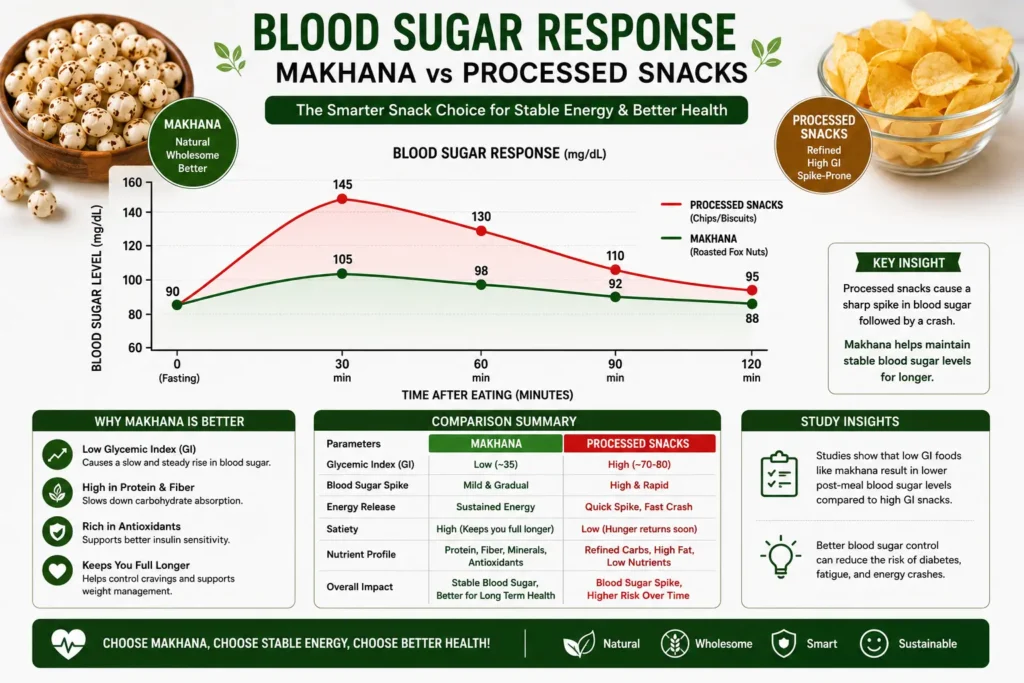
A frequent question in clinical nutrition is: Is makhana good for diabetes? In a nutshell, the answer is definitely yes. One of the best snacking strategies for those with insulin resistance and Type 2 diabetes is makhana.
The Glycemic Index (GI) Advantage
Makhana is categorized as a low-GI food because its Glycemic Index (GI) is less than 55. When you consume makhana, the complex carbohydrates break down slowly in the digestive tract. This prevents the rapid spike in blood glucose that typically follows the consumption of refined grains or processed chips.
Magnesium and Insulin Sensitivity
Its high magnesium concentration is one of the most important makhana for diabetes processes. Magnesium is a cofactor in over 300 enzymatic reactions in the body, including glucose metabolism.
Studies show that intracellular magnesium plays a direct role in regulating insulin action.
Adequate magnesium intake helps cellular receptors respond more efficiently to insulin, actively pulling glucose out of the bloodstream.
Kaempferol: The Anti-Inflammatory Flavonoid
Diabetic pathology is closely linked to chronic inflammation. Makhana contains a specific natural flavonoid called kaempferol. This compound is scientifically proven to scavenge free radicals, reduce systemic inflammation, and protect pancreatic beta cells (the cells responsible for producing insulin).
Makhana for Weight Loss & Obesity Management
Tackling obesity requires a multifaceted approach, but dietary adherence is often the hardest part. Finding a healthy snack for obesity that satisfies the psychological need to “crunch” without derailing a caloric deficit is rare.
The Protein-to-Fiber Satiety Matrix
Makhana for weight loss works primarily through satiation. The combination of nearly 10 grams of protein and 14.5 grams of fiber per 100 grams triggers the release of cholecystokinin (CCK) and Peptide YY (PYY). These are gut chemicals that let the brain know when you’re full.
Caloric Density and Volume Eating
You need to be in a calorie deficit in order to lose weight. Makhana is exceptionally light and airy.
A standard 30-gram serving yields about 100 calories.
That same 30 grams fills an entire cereal bowl, providing a prolonged eating experience.
Compare this to 30 grams of potato chips, which yields roughly 160 calories but vanishes in a handful, leaving the eater unsatisfied.
Inhibiting Adipogenesis
Emerging in-vitro studies suggest that the specific alkaloids found in Euryale ferox may inhibit adipogenesis (the formation of new fat cells). While more human trials are needed, the preliminary data indicates that makhana might not just prevent weight gain via calorie control, but actually influence how the body stores lipids.
Makhana for Gut Health: A Prebiotic Powerhouse
Gut health dictates everything from our immune response to our mood. Using makhana for gut health is an ancient practice now validated by modern gastroenterology.
Rich in Resistant Starch
The small intestine does not break down all carbs. Makhana contains significant levels of resistant starch. This type of starch “resists” digestion and travels intact to the colon. It functions as a prebiotic once there.
Feeding the Microbiome
In the colon, beneficial bacteria ferment the resistant starch from makhana. Short-chain fatty acids (SCFAs), especially butyrate, are produced by this fermentation process.
The main energy source for colonocytes, or the cells that line your colon, is butyrate.
It reduces inflammation in the gut lining, making makhana an excellent dietary addition for those managing Irritable Bowel Syndrome (IBS) or leaky gut syndrome.
Astringent Properties
In Ayurveda, makhana is known for its astringent properties. It helps absorb excess water in the digestive tract, making it a traditional remedy for treating chronic diarrhea and stabilizing irregular bowel movements.
Other Hidden Fox Nut Benefits
Beyond diabetes, obesity, and gut issues, the holistic fox nut benefits extend to several other physiological systems:
1. Cardiovascular Support
Makhana has a high potassium content and a very low sodium content. This precise ratio is the cornerstone of the DASH (Dietary Approaches to Stop Hypertension) diet. The potassium helps relax blood vessel walls, reducing blood pressure and easing the workload on the cardiovascular system.
2. Anti-Aging and Skin Health
The antioxidants in makhana, alongside a specific enzyme called L-isoaspartyl methyltransferase, help repair damaged proteins in the body. This mechanism supports skin elasticity, slows down the formation of wrinkles, and promotes cellular longevity.
3. Cognitive Function
Fox nuts contain thiamine, or vitamin B1, which is necessary for cognitive function. Frequent ingestion promotes the synthesis of neurotransmitters, which may enhance concentration and memory.
How to Eat Makhana: Best Practices & Mistakes
To reap the full benefits of eating makhana, preparation is key. Eaten raw, they are unpleasantly chewy. Properly roasted, they are crisp and flavorful.
The Ideal Roasting Method
- Heat the Pan: Use a heavy-bottomed skillet or cast-iron pan on low-medium heat.
- Dry Roast First: Add raw makhana and dry roast for 5–7 minutes until they lose their moisture.
- Add Healthy Fats: Add exactly one teaspoon of ghee (clarified butter) or cold-pressed coconut oil per 50 grams of makhana.
- Season Wisely: Remove from heat and immediately toss with turmeric, black pepper, and a pinch of pink Himalayan salt.
The Biggest Mistake: Ruining the Nutritional Profile
Many commercial “healthy snacks” ruin makhana by deep-frying them in inflammatory seed oils (like palm or refined sunflower oil) or coating them in refined sugar and artificial caramel. Always read the ingredient label. If the fat content per 100g exceeds 12g, you are likely holding a highly processed, oil-soaked version that nullifies the weight loss and diabetes benefits.
Edge Cases & Potential Side Effects
As an authoritative resource, we must address edge cases where makhana might not be suitable.
Because makhana is highly astringent and fiber-rich, eating massive quantities (e.g., over 100 grams in one sitting) without adequate water intake can lead to severe constipation and bloating.Always eat meals high in fiber and stay hydrated.
Euryale ferox grows in aquatic environments. If cultivated in polluted waters, the roots and seeds can absorb heavy metals like arsenic or lead. Always purchase makhana from reputable, certified organic brands that test for heavy metals.
For Type 1 Diabetics or Type 2 Diabetics on heavy insulin regimens, the low-GI nature of makhana means blood sugar won’t spike as expected. If you dose rapid-acting insulin assuming a traditional carbohydrate spike, eating makhana instead could lead to mild hypoglycemia. Consult your endocrinologist.
Source Premium, Export-Grade Makhana
Don’t risk your brand’s reputation on unverified suppliers. Partner with Civize for FDA/FSSAI-compliant, nitrogen-flushed, and expertly flavoured private label Makhana ready for global distribution.