
 09 May 2026
Top 7 Dry Fruits in Global Demand (And Where Buyers Are Paying Premium in 2026)
Quick Summary:
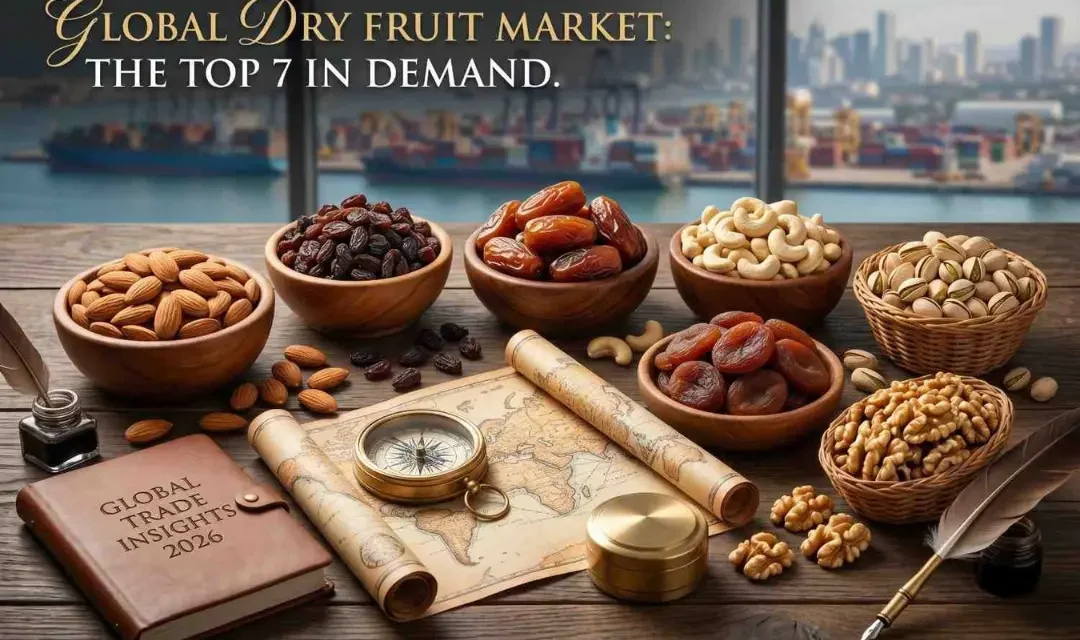
In 2026, the global dry fruit market reached a valuation of $12.41 Billion, growing at a 7.62% CAGR. The Top 7 dry fruits driving global demand are Almonds, Raisins, Dates, Cashews, Apricots, Pistachios, and Walnuts. The most lucrative premium markets are the United States, Germany, the UK, Japan, and the UAE. Buyers in these regions are paying a 20-40% premium for organic certification, single-origin traceability, and advanced pasteurization (chemical-free) processes.
Table of Contents
1. The 2026 Market Landscape: A Macro View
If you’ve been watching the commodities board lately, you know that the dried fruit and edible nut sector isn’t just a snack industry anymore—it’s a functional food powerhouse. In my 15 years of navigating customs borders and quality control labs, I’ve never seen the market shift quite like it is heading into 2026.
According to recent industry forecasts, the global Dry Fruit Market is anticipated to be worth $12.41 Billion in 2026, on track to hit $24.04 Billion by 2035. That’s a steady compound annual growth rate (CAGR) of 7.62%. But where is this growth coming from?
It boils down to two massive consumer shifts:
- The Clean-Label Movement: Consumers are aggressively rejecting processed sugars. Household purchases of dry fruits have jumped 52% over the last four years simply because people want nutrient-packed, natural alternatives.
- The Plant-Based Boom: The dairy, bakery, and snack industries are heavily substituting artificial ingredients with dried fruits and nuts to capture the booming vegan and health-conscious demographics.
Where is the Volume Going?
Geographically, Asia Pacific leads global consumption with a massive 39% share, driven heavily by India and China’s growing middle class. However, if you’re looking for premium buyers—the ones who don’t flinch at top-tier pricing—you need to look at North America (27% market share) and Europe. Specifically, the US market is projected to hit $3.95 billion this year, with Germany and the UK right behind them.
Let’s cut to the chase and break down the “Big 7” commodities that are moving the needle.
2. The Top 7 Dry Fruits Dominating Global Trade
1. Almonds: The Undisputed King of Nuts
Almonds currently hold a staggering 28% market share in the edible nut category. They aren’t just a snack; they are a vital industrial ingredient used for almond milk, gluten-free baking flour, and protein bars.
- Global Need Dynamics: The demand for almonds has increased along with the surge in demand for plant-based milks. The U.S. (specifically California) produces roughly 39% of global tree nuts, heavily weighted toward almonds.
- Where Buyers Pay Premium: Japan and the EU (Germany, UK). Japanese buyers are notoriously strict about quality. They will pay top dollar for “Nonpareil” almonds with zero chipping and perfect color grading.
- The Author’s Take: I remember a deal in 2024 where a German buyer rejected a container of almonds over a 1% moisture discrepancy. The premium market is ruthless, but if you can provide steam-pasteurized, perfectly sized almonds, European confectioners will write blank checks.
2. Raisins: The Volume Leader
Holding 31% of the dried fruit market segment, dried grapes (raisins) are the unsung heroes of the baking and foodservice industries.
- Global Need Dynamics: As the bakery sector pivots to naturally derived sweet goods, raisins are flying off the shelves. They are cheap to transport due to high density and long shelf life.
- Where Buyers Pay Premium: Northern Europe and the United States.
- Quality Markers: Premium buyers want “Thompson Seedless” or golden raisins that are sun-dried rather than chemically treated. Organic certification here pushes the price up by almost 30%.
3. Dates: The Natural Sweetener
Dates account for 25% of the dried fruit market. They have evolved from a seasonal delicacy (often tied to Ramadan) to a year-round staple in the Western diet.
- Energy Bars: Dates are the ultimate binder in healthy energy bars. The rise of “no added sugar” products relies entirely on date paste.
- Where Buyers Pay Premium: The UK, France, and North America.
- Quality Markers: Medjool dates are the crown jewels. Buyers look for large size, intact skin (no separation or “puffing”), and a soft, caramel-like texture. In my experience, if you can offer organic Medjools with verifiable traceability to specific farms in Jordan, Morocco, or California, you bypass the wholesale race to the bottom entirely.
4. Cashews: The Creamy Vegan Staple
Capturing 19% of the nut market, cashews have seen a meteoric rise due to their creamy texture, making them the base for vegan cheeses, sauces, and milk.
- Global Demand Dynamics: Processing is labor-intensive, often routed through Vietnam or India, even if the raw nuts come from West Africa.
- Where Buyers Pay Premium: The US and the UAE. The UAE is a big re-export hub yet local premium retail is booming.
- Quality Markers: The “W180” and “W210” grades (White Whole) command the highest prices. Any scorching or discoloration plummets the value immediately.
5. Pistachios: The High-Margin Snack
At 13% market share, pistachios are a highly profitable crop. They require very specific climates (hot summers, cold winters), limiting global production primarily to the US (California), Iran, and Turkey.
- Global Demand Dynamics: Plant-based snacking has boosted pistachio consumption by 19% recently. They are perceived as a luxury, heart-healthy nut.
- Where Buyers Pay Premium: China and Western Europe. China is a massive buyer of pistachios, particularly during the Lunar New Year.
- Quality Markers: The premium is in the “naturally open” shells. Mechanically opened pistachios are considered inferior. Bright green kernels (like the Turkish Antep) fetch a massive premium in the European gelato and confectionery markets.
6. Apricots: The Clean-Label Favorite
Holding roughly 18% of the dried fruit market, apricots are a cornerstone of the breakfast cereal and trail mix industries.
- Global Demand Dynamics: Turkey completely dominates the supply chain here.
- Where Buyers Pay Premium: Australia, Germany, and the US.
- Quality Markers: Here is where the industry is seeing a massive split. Conventional bright-orange apricots are treated with sulfur dioxide to maintain color. However, the premium market is entirely shifting toward unsulfured, organic apricots (which are dark brown). Health-conscious buyers will pay a 40% markup to avoid sulfites.
7. Walnuts: The Brain-Boosting Powerhouse
Holding a 9% share, walnuts are heavily marketed for their high Omega-3 fatty acid content.
- Global Demand Dynamics: Despite a recent 13% dip in global output due to climate disruptions, demand remains fierce in the functional food sector.
- Where Buyers Pay Premium: South Korea, Japan, and Spain.
- Quality Markers: Oxidation is the enemy of walnuts. Buyers pay absolute top tier for “light” or “extra light” halves. If a walnut turns amber, its value drops because the taste becomes bitter. Cold-chain logistics are mandatory to preserve quality, and buyers will pay a premium for guaranteed fresh-crop deliveries.
3. The “Premium Factor”: Why Buyers Pay More
Why does a buyer in Munich pay $12/kg for almonds when the commodity price sits at $6/kg? It’s not just about the fruit; it’s about risk mitigation and brand protection.
- Advanced Pasteurization: Chemical fumigation is dying. Premium markets demand Radio Frequency (RF) heating and steam pasteurization. This ensures safety without compromising the oil profile of the nuts.
- Clean Label & Organic: Organic variants have grown by 44% recently. If a consumer can’t pronounce an ingredient, they won’t buy it. Dried fruits act as “clean” preservatives and sweeteners.
- Traceability & ESG: European buyers, under new supply chain laws, must prove their supply chains are free from child labor and excessive carbon footprints. Premium contracts are awarded to sellers who can demonstrate traceability at the blockchain level.
4. Expert Insights
To round out this analysis, I reached out to a few of my most trusted contacts in the industry to get their take on the 2026 landscape.
“Europe’s cheap, untraceable bulk nuts heyday is over. If you are an exporter and you are not investing in organic certification and steam pasteurisation, you are basically cutting yourself out of the top 30% of global profit margins.”
— Maria Gonzales, Head of Procurement at EuroNut S.A.
“What we’re seeing with Dates is unprecedented. They’re no longer a niche ethnic food. These are the backbone of the $15 billion global energy bar market. Currently, the supply of date paste and chopped dates is premium and less than the demand.”
— Dr. Aris Thorne, Agronomist and Lead Researcher at Arid Agri-Tech
“Climate volatility is our biggest nightmare right now. We saw walnut yields drop 13% globally due to erratic weather. Buyers are willing to pay a massive premium to lock in multi-year contracts just to guarantee supply security.”
— David Chen, Chief Supply Chain Officer, Asia-Pac Foods
5. Frequently Asked Questions (FAQs)
A: The organic and unsweetened dry fruit segment is the fastest-growing, surging by 44% in 2026. Regionally, the Asia Pacific market is expanding the fastest due to rising middle-class incomes in India and China, while North America remains a dominant premium buyer.
A: Cashews are expensive due to a highly labor-intensive extraction process. Each cashew apple produces only one nut, which is encased in a toxic, caustic shell (anacardic acid) that must be carefully roasted and hand-cracked to avoid damaging the creamy white kernel inside.
A: Premium pistachios open naturally on the tree, not by mechanical force. Buyers also look for large sizes, intact shells without staining, and a vibrant green kernel, which indicates high oil content and superior flavor.
A: Climate volatility has severely impacted the market by causing seasonal production drops. For example, recent unpredictable weather patterns caused a 13% drop in global walnut output and an 11% fall in almond yields, driving up wholesale prices and forcing buyers to pay premiums for supply security.
A: Conventional dried apricots are treated with sulfur dioxide gas to preserve their bright orange color and extend shelf life. Organic dried apricots are unsulfured and dried naturally in the sun, resulting in a dark brown color and a sweeter, more caramel-like flavor. Premium markets prefer the organic, unsulfured variant.
A: Traditionally the largest importer of dried fruit in terms of value is the United States with more than $247 million imported yearly. They are closely followed by Germany, the United Kingdom, and China, all of which are massive markets for baking, snacking, and confectionery applications.
Ready to Scale Your Premium Supply Chain?
Partner with a trusted global exporter for certified, traceable, and high-quality agro commodities.