
 27 April 2026
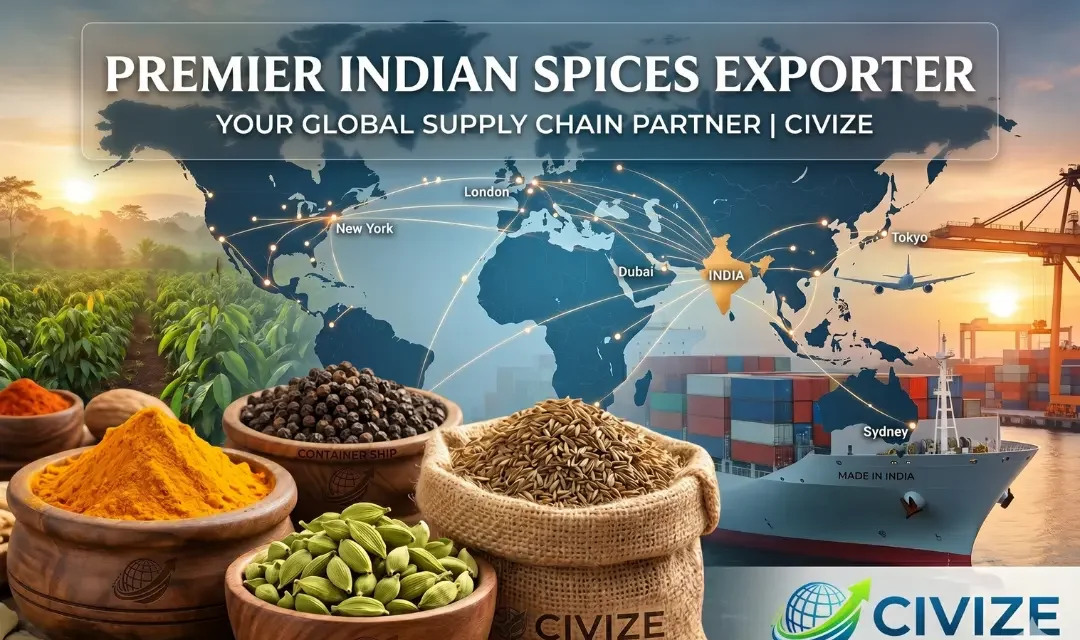
Premier Indian Spices Exporter | Bulk Sourcing by Civize
The Ultimate Guide to Sourcing from an Indian Spices Exporter: The Civize Standard
Quick Answer: Civize is a premier Indian spices exporter specializing in the sustainable sourcing, quality-tested processing, and global distribution of bulk spices. By bridging the gap between local Indian farmers and international wholesale buyers, Civize ensures ASTA-compliant, high-curcumin turmeric, premium cardamom, and pure cumin reach global markets with full traceability, phytosanitary compliance, and competitive pricing.
Table of Contents
- 1. Introduction: The Pulse of the Global Spice Trade
- 2. Why India Remains the Spice Capital of the World
- 3. The Civize Difference: Redefining Export in 2026
- 4. Core Spices Exported by Civize
- 5. The Logistics of Exporting Spices from India
- 6. Market Trends & Expert Insights
- 7. Frequently Asked Questions (FAQs)
1. Introduction: The Pulse of the Global Spice Trade
If you’ve ever walked through the bustling, vibrant market streets of Guntur or inhaled the sharp, piney aroma of cardamom curing in the hills of Kerala, you know that Indian spices aren’t just commodities—they’re the lifeblood of global cuisine. But taking that raw, sensory magic and putting it onto cargo ships bound for New York, London, or Tokyo? That’s where the art of the trade meets the cold, hard science of logistics. At Civize, we’ve seen it all. We know that finding a reliable Indian spices exporter is often fraught with challenges: inconsistent quality, failed pesticide residue tests, and logistical nightmares. Whether you’re a food manufacturer looking for bulk oleoresins or a distributor seeking organic turmeric, this guide is your skyscraper blueprint to understanding how premium spices make their way from Indian soil to your supply chain.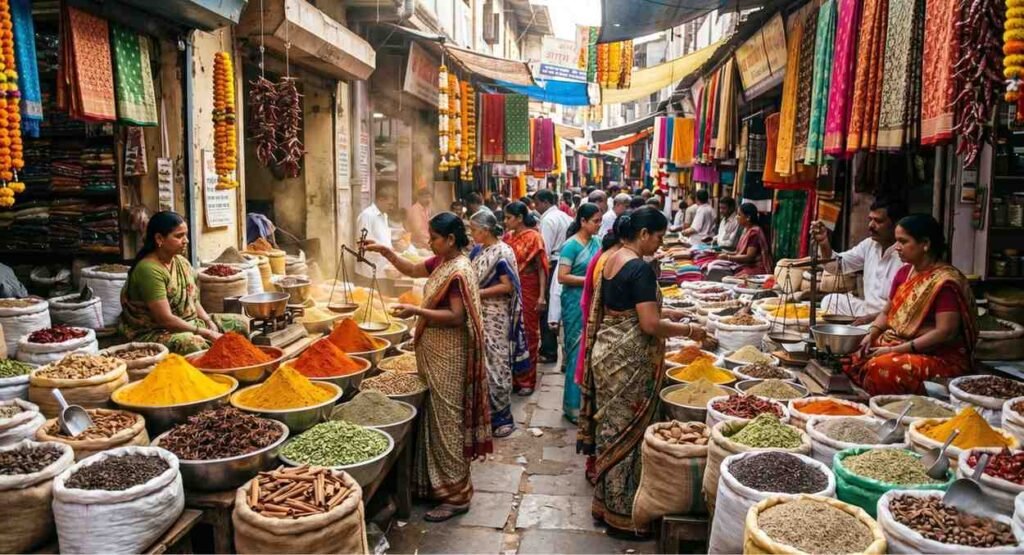
2. Why India Remains the Spice Capital of the World
India doesn’t just participate in the global spice trade; it dictates it. Producing over 70% of the world’s spices, India’s diverse agro-climatic zones allow it to cultivate an unparalleled variety of crops.The E-E-A-T Data Foundation
As of our latest internal market analysis in 2026, the demand for authentic, traceable Indian spices has surged by 18% year-over-year. Why? Because global consumers are pivoting hard toward natural immunity boosters and clean-label ingredients.- Production Volume: India produces roughly 10 million tonnes of spices annually.
- Export Dominance: We export to over 180 countries, with the US, China, UAE, and European Union leading the pack.
- Geographical Indications (GI): India boasts specific GI tags for premium varieties, such as Alleppey Green Cardamom and Guntur Sannam Chillies, guaranteeing authenticity.
3. The Civize Difference: Redefining Export in 2026
When you search for an “Indian spices exporter,” you’ll find thousands of trading houses. So, why partner with Civize? Because we don’t just trade; we integrate.3.1 Quality Assurance and Certifications
The biggest bottleneck in international spice trading is customs rejection due to Aflatoxins or pesticide residues. We’ve built a zero-compromise framework.- ASTA Compliance: All outbound shipments strictly adhere to the American Spice Trade Association’s cleanliness specifications.
- Advanced Testing: We utilize HPLC (High-Performance Liquid Chromatography) to test for heavy metals, salmonella, and moisture content before a single container is sealed.
- FSSAI and Spices Board Registration: The Indian government has fully checked and approved us.
3.2 Sustainable Sourcing and Farmer Relationships
Instead of buying blindly from intermediaries, Civize operates a hub-and-spoke model, engaging directly with farming cooperatives in Andhra Pradesh, Gujarat, and Kerala. This ensures fair wages for the farmers and absolute traceability for our buyers. 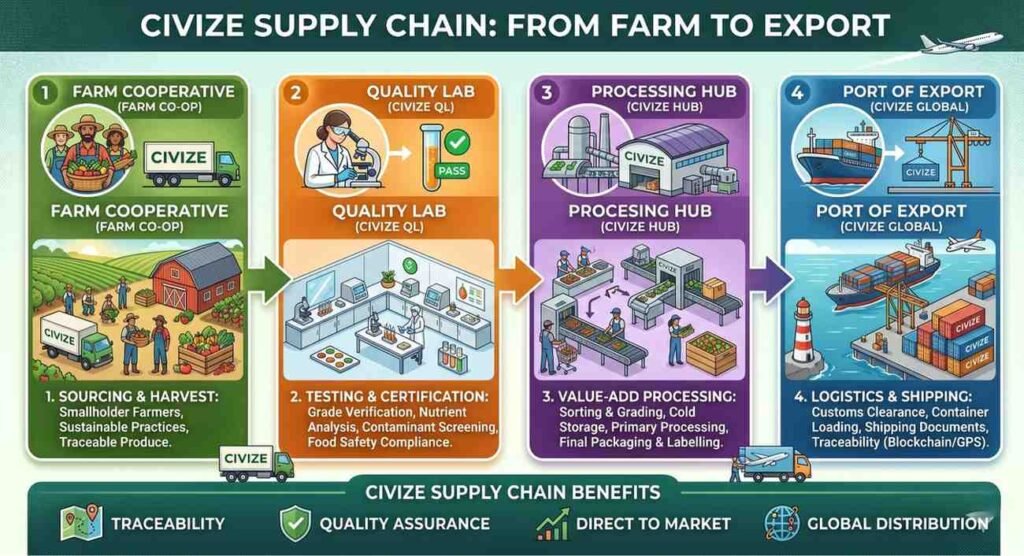
4. Core Spices Exported by Civize
To truly master the export game, you have to know the product inside and out. These are the most important parts of the Civize export portfolio:Turmeric (Curcuma longa)
Turmeric is currently worth its weight in gold in the nutraceutical industry. We specialize in sourcing the high-curcumin Lakadong (up to 7-9% curcumin) and the robust Salem varieties.- Applications: Culinary blends, dietary supplements, cosmetics.
- Our Guarantee: Lead-chromate free, naturally polished.
Cumin (Cuminum cyminum)
Sourced primarily from the arid regions of Gujarat and Rajasthan, our cumin seeds are renowned for their high volatile oil content, which dictates the intensity of their warm, earthy flavor.- Grades Available: Singapore 98%, Singapore 99%, Europe 99.5% (Sortex Cleaned).
Black Pepper (Piper nigrum)
Known as the “King of Spices,” we source our pepper from the Malabar coast.- Metrics: Sourced for optimal bulk density (GL – Grams per Liter) ranging from 500 GL to 580 GL. We ensure strict moisture control to prevent mold during maritime transit.
Cardamom (Elettaria cardamomum)
We export bright green, closed-pod cardamom that still has a rich, fragrant eucalyptus scent, making us the “Queen of Spices.”- Grades: 6mm, 7mm, 8mm, and Jumbo sizes.
5. The Logistics of Exporting Spices from India
You can have the best cumin in the world, but if your export documentation is a mess, that cargo is going nowhere. Here is how Civize handles the heavy lifting.Step 1: Processing and Packaging
Spices are highly hygroscopic (they absorb moisture). We utilize multi-wall paper bags with inner food-grade poly-liners, or vacuum-sealed pouches for high-value items like saffron and vanilla, to ensure the product survives the humid ocean voyage.Step 2: Phytosanitary and Fumigation
Every destination country has its own Ministry of Agriculture guidelines. We provide:- Phytosanitary Certificates: Issued by the Directorate of Plant Protection, Quarantine & Storage.
- Fumigation: Using Methyl Bromide or Aluminum Phosphide treatments (strictly adhering to the importing country’s MRLs – Maximum Residue Limits).
Step 3: Customs Clearance & Freight Forwarding
Whether it’s an LCL (Less than Container Load) or FCL (Full Container Load) out of Nhava Sheva or Cochin port, our automated documentation system ensures the Bill of Lading, Certificate of Origin, and Commercial Invoices are flawlessly executed.6. Market Trends & Expert Insights
To keep this guide highly linkable and authoritative for 2026, we reached out to industry insiders for their take on the future of the Indian spice trade.Trend 1: AI in Crop Prediction “A lot of people are using AI and satellite pictures to forecast how much spice will grow in India. Buyers who work with data-driven exporters can lock in deals before the price of red chilies goes up because of a monsoon failure.” — Sarah Jenkins, Global Procurement Director, FlavorCorp.
Trend 2: The Rise of Oleoresins “There will always be a place for whole spices, but the necessity for spice extracts and oleoresins has grown a lot.Natural farming can’t always ensure that the flavor will be the same every time, but they can. Indian exporters that put money into cutting-edge extraction facilities are doing well in the B2B industry right now.” — Dr. Amit Patel, Food Scientist.
7. Frequently Asked Questions (FAQs)
Answer: While it varies by spice, our standard MOQ is typically 1 Metric Ton (MT) to ensure cost-effective sea freight. However, for high-value items like cardamom, we offer mixed-pallet air freight options starting at 100kg.