
 13 August 2026
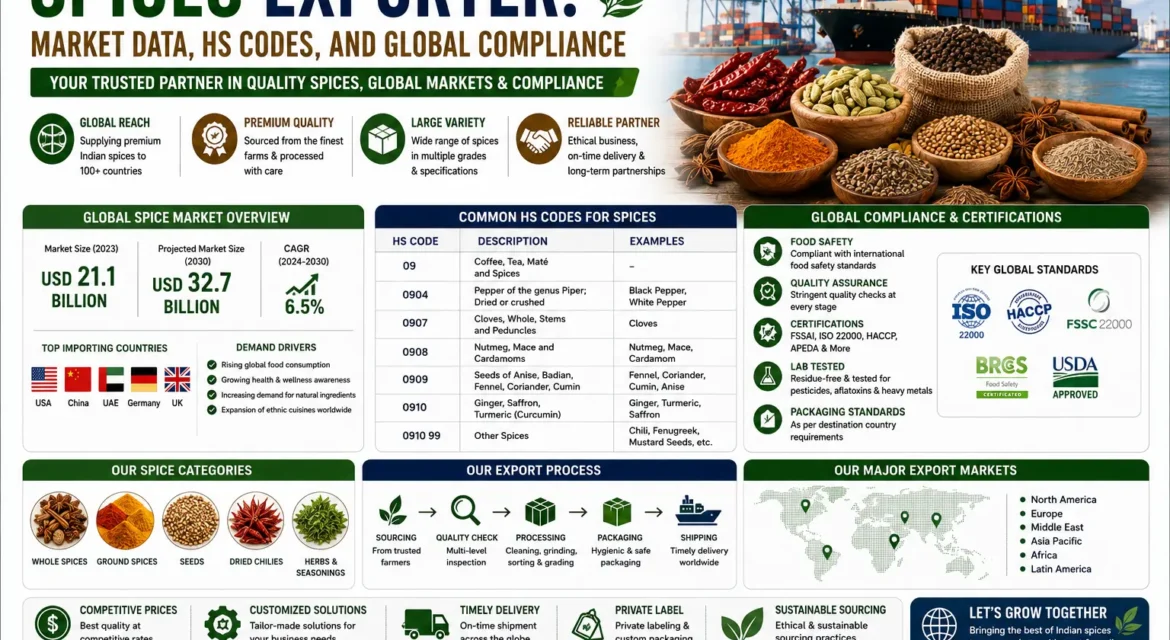
The Ultimate Guide to Becoming a High-Volume Spices Exporter: Market Data, HS Codes, and Global Compliance
For centuries, the global spice trade has been the backbone of international commerce. Today, stepping into the role of a spices exporter offers immense commercial potential, but it requires deep technical knowledge. If you are looking for the definitive roadmap on india spices export, navigating customs, or understanding the exact spices hs code for your products, you have found it.
India remains the undisputed king of the spice trade. In FY 2025-26, India exported an incredible 17.34 lakh tons of spices and spice products, valued at $4.43 billion. But scaling a spice export business requires more than just sourcing high-quality raw materials. Successful Indian spice exporters must master complex regulatory landscapes, stringent quality standards (like ASTA and EU MRLs), and optimized supply chain logistics.
This guide covers everything you need to know about the India spice export market—from initial licensing to navigating global phytosanitary regulations.
Request a Wholesale Quote Today
1. Why Indian Spice Exporters Dominate the Global Market
India is fondly known as the “Spice Bowl of the World,” benefiting from a geographic diversity that allows for the cultivation of over 50 different spices.
The Numbers Behind India Spice Export
Recent data from the Spices Board of India highlights the sheer scale of the industry. During 2025-2026, the india spices export basket saw massive contributions from:
- Chilli: 27% of total export value.
- Cumin: 12% of total export value.
- Spice Oils & Oleoresins: 12%.
- Small Cardamom: 9%.
- Turmeric and Mint Products: 7% and 8% respectively.
“Indian exporters of spices are robust because of both volume and value addition. We are seeing a massive shift from bulk raw spice exports to high-margin extracted oleoresins and sterilized blended powders.” — Rajesh Nair
Major Export Destinations
The world relies heavily on Indian spices. The top destinations contributing to over 85% of export earnings include:
- USA: 14% market share.
- China: 12% market share.
- UAE & Bangladesh: 9% and 8% respectively.
Understanding these regional demands is step one for any aspiring spices exporter. The US market prioritizes organic and ASTA-cleanliness grade spices, while the Middle East demands high volumes of bulk whole spices like cardamom and cumin.
2. Essential Spices HS Code Classification (Chapter 09)
Before you can ship a single container, you must correctly classify your goods. The spices hs code is a standardized numerical method of classifying traded products. Incorrect HS codes lead to customs delays, heavy fines, and the loss of critical export incentives.
Spices fall broadly under Chapter 09 (Coffee, tea, mate, and spices) of the Harmonized System of Nomenclature.
Complete Spices HS Code Directory
| Spice Type | State/Form | HS Code | GST Status (India) |
|---|---|---|---|
| Black Pepper | Whole | 090411 | 0% (Loose) / 5% (Packaged) |
| Black Pepper | Crushed/Ground | 090412 | 0% (Loose) / 5% (Packaged) |
| Dry Red Chilli | Whole | 090411 | 0% (Loose) / 5% (Packaged) |
| Chilli Powder | Powder | 090422 | 0% (Loose) / 5% (Packaged) |
| Coriander | Whole | 090921 | 0% (Loose) / 5% (Packaged) |
| Coriander | Crushed/Ground | 090922 | 0% (Loose) / 5% (Packaged) |
| Cumin (Jeera) | Whole | 090931 | 0% (Loose) / 5% (Packaged) |
| Cumin (Jeera) | Crushed/Ground | 090932 | 0% (Loose) / 5% (Packaged) |
| Turmeric | Whole | 09103010 | 0% (Loose) / 5% (Packaged) |
| Turmeric | Powder | 09103020 | 0% (Loose) / 5% (Packaged) |
| Mixed Spices | Blend | 091099 | 5% / 12% (Based on composition) |
“It is imperative to use the exact spice HS code. Exporters often confuse the codes for whole versus ground spices. For example, whole turmeric is 09103010, but turmeric powder is 09103020. That one-digit difference dictates your customs duty and RoDTEP eligibility.”
Export Incentives Linked to HS Codes
By correctly classifying your exports, Indian spice exporters can claim government benefits like the RoDTEP (Remission of Duties and Taxes on Exported Products) scheme. This provides refunds on embedded central, state, and local taxes, directly padding your profit margins.
3. Step-by-Step Guide for Exporters of Spices from India
Starting an export business requires navigating a web of domestic and international regulations. Here is the exact roadmap to establishing a compliant spice export firm.
1.Legal Entity and IEC Registration: Foundation of export identity.
You must first register your business (LLP, Private Limited, or Proprietorship). Following that, obtain an Import Export Code (IEC) from the Directorate General of Foreign Trade (DGFT). This 10-digit code is strictly required for any commercial cross-border shipment.
2.Obtain CRES Certification: Spices Board India Mandate.
The Spices Board of India mandates that all spice exporters possess a Certificate of Registration as Exporter of Spices (CRES). Operating without this is illegal and will result in customs seizing your shipment at the port.
3.FSSAI and Phytosanitary Clearance:Food safety protocols.
Since spices are food products, you must hold a central FSSAI license. Additionally, every shipment leaving India requires a Phytosanitary Certificate issued by the Plant Quarantine Organization of India, certifying that the goods are free from pests and agricultural diseases.
4.Rigorous Product Testing:Meeting buyer standards.
Global markets will not accept blind shipments. Your spices must undergo laboratory testing at NABL-accredited labs for Aflatoxins, Pesticide MRLs (Maximum Residue Limits), Salmonella, and Ethylene Oxide (EtO) residues.
5.Finding Global Buyers:Moving beyond B2B portals.
Successful india spice export businesses attend international trade fairs like Anuga, SIAL, and Gulfood. Building direct relationships with food manufacturers, flavor houses, and large-scale distributors yields the best long-term margins.
6.Shipping and Logistics:Preventing transit damage.
Select a reliable freight forwarder experienced in agricultural commodities. Ensure your packaging prevents moisture ingress, as condensation during 30-day ocean voyages can lead to mold growth and total shipment rejection.
4. International Quality Standards: The Make-or-Break for Exporters
The biggest hurdle for exporters of spices from India is not finding buyers; it is clearing international quality hurdles. Rejections at foreign ports destroy margins.
The United States: FDA and ASTA
The US is the largest buyer of Indian spices. The American Spice Trade Association (ASTA) enforces strict Cleanliness Specifications. Spices are visually and chemically inspected for dead insects, mammalian excreta, mold, and foreign matter. Furthermore, under the FDA’s FSMA (Food Safety Modernization Act), foreign suppliers must undergo rigorous verification.
The European Union: ESA and MRLs
The European Spice Association (ESA) mandates some of the strictest standards globally. The EU’s primary focus is on Maximum Residue Limits (MRLs) for pesticides. Recently, the EU has aggressively rejected shipments showing traces of Ethylene Oxide (a sterilizing agent) and Chlorpyrifos. To succeed in Europe, Indian spice exporters must partner directly with farmers to monitor pesticide application at the farm level.
5. Most Profitable Categories for India Spices Export
If you are entering the market, focusing on high-demand, high-margin categories is crucial to outpace the competition.
- Value-Added Spices (Oils and Oleoresins): India commands over 70% of the world market for spice oleoresins. These concentrated liquid extracts are used extensively by the global processed food and beverage industry. The barrier to entry is high, but the profit margins are astronomical compared to raw spices.
- Organic Spices: Consumers in the West are hyper-conscious about chemical residues. Organic spices (certified under NPOP, USDA Organic, and EU Organic) fetch premiums of 30% to 50% over conventional spices.
- Turmeric and Curcumin Extracts: Driven by the health and wellness boom, turmeric is a nutraceutical powerhouse. Exporters providing high-curcumin Lakadong or Alleppey turmeric (curcumin levels exceeding 5%) see massive demand from pharmaceutical companies.
- Speciality Chillies: India exports massive volumes of Teja (S17) chillies. Known for their extreme pungency (high capsaicin content), they are heavily imported by China for extracting capsaicin used in pharmaceuticals.
6. Overcoming Challenges and Edge Cases
Even seasoned spices exporters make mistakes. Here are the edge cases competitors often ignore:
- Ignoring Moisture Content: Shipping spices with moisture levels above 10-12% is a recipe for disaster. During an ocean transit, temperature fluctuations cause “container sweat,” leading to mold. Always use desiccant bags in shipping containers.
- Adulteration Scandals: Mixing spent spices (spices that have had their volatile oils extracted) with fresh spices to increase bulk weight is a fraudulent practice that will get you permanently blacklisted by international buyers.
- Packaging Failures: Jute bags are traditional but prone to contamination. Moving to multi-layered, hermetically sealed bags or vacuum packing for high-value items preserves volatile oils and prevents pest infestation.
Secure Your Premium Spice Export Supply Chain
Ready to scale your commercial spice business? Partner with our export trade specialists for guaranteed ASTA-compliant quality, accurate HS Code classification, and seamless global logistics.
Frequently Asked Questions (FAQs)
Yes. In addition to a standard business registration, IEC, and FSSAI license, you must obtain a Certificate of Registration as Exporter of Spices (CRES) from the Spices Board of India.
Whole turmeric is classified under HS Code 09103010, while turmeric powder falls under 09103020.
Exports are generally considered “zero-rated” supplies under GST. Under a Letter of Undertaking (LUT), you can export without paying IGST or pay IGST and then request a refund.
The United States is the top destination (14% share), followed closely by China (12%), the UAE (9%), and Bangladesh (8%).
You must adhere to ASTA cleanliness guidelines for the US and ESA MRL (Maximum Residue Limits) for Europe. This requires testing your batches at NABL-accredited laboratories for pesticide residues, aflatoxins, and microbial contamination before shipping.