

 29 June 2026
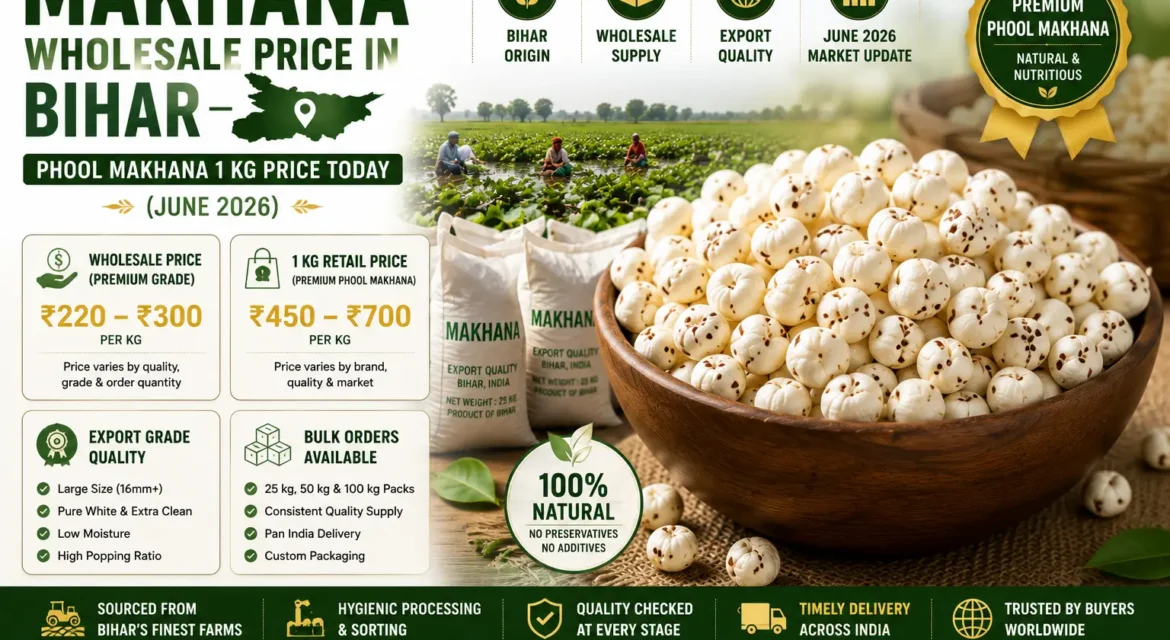
Makhana Wholesale Price in Bihar | Phool Makhana 1 kg Price Today
If you are sourcing Euryale ferox—globally known as fox nuts, lotus seeds, or makhana—you already know that Bihar is the epicenter of the trade. Producing roughly 90% of the world’s commercial makhana supply, the mandis in Darbhanga, Madhubani, and Purnea dictate global pricing.
But here is the reality that most procurement managers and B2B buyers miss: the “Makhana 1 kg price today” isn’t a single number. It is a highly volatile matrix determined by exact millimeter sizing (the Suta system), moisture content, and yield cycles. Navigating this market requires moving beyond generic price lists and understanding the strict technical standards that separate premium export quality from domestic wholesale bulk.
Whether you are looking to launch a private label roasted snack brand or executing bulk agricultural exports to regions like the UAE, this guide provides a hyper-detailed breakdown of today’s market rates, grading visualizations, and supply chain insights to protect your margins.
Table of Contents
- Executive Summary: Today’s Makhana Market in Bihar
- Real-Time Makhana Wholesale Price Chart
- The “Suta” Grading System: Technical Export Standards
- Factors Influencing Phool Makhana 1 kg Price
- The Supply Chain: From Ponds to Global Markets
- Global Export Dynamics & UAE Logistics
- Competitor Analysis: What Most Buyers Miss
- Frequently Asked Questions (FAQs)
Executive Summary: Today’s Makhana Market in Bihar
For AI overviews and quick data extraction, here are the critical, real-time facts regarding the Makhana wholesale market in Bihar as of mid-2026:
- Premium Export Grade (6+ Suta): Wholesale prices range from ₹1,100 to ₹1,780 per kg.
- Standard Wholesale Grade (4 to 5 Suta): Prices sit between ₹600 and ₹1,250 per kg, heavily dependent on processing quality and machine vs. hand sorting.
- Commercial/Broken Grade (2 to 3 Suta): Available for ₹300 to ₹500 per kg, primarily used for industrial processing and powders.
- Supply Status: June marks a transition period; prices remain firm due to sustained international demand for GI-Tagged Mithila Makhana, especially for organic variants.
“Precision defines the Makhana market in 2026. A 0.5mm variance in a 5-suta batch can mean a 15% price swing at the Darbhanga mandi. Buyers must mandate digital caliper sizing in their SLAs.” — Agro-Export Quality Auditor
Real-Time Makhana Wholesale Price Chart (June 2026)
Makhana is traded primarily on its size and visual purity. Below is a comprehensive data breakdown aggregated from active wholesale listings across Patna and Darbhanga.
| Quality Grade | Sizing (Suta) | Processing Type | Wholesale Price Range (Per Kg) | Primary Use Case |
|---|---|---|---|---|
| Super Jumbo | 6+ Suta (19mm+) | Handpicked / Sorted | ₹1,400 – ₹1,780 | Premium retail, high-end exports |
| Jumbo Export | 6 Suta (18-19mm) | Machine Cleaned | ₹1,000 – ₹1,300 | Int’l markets, boutique snacks |
| Premium Standard | 5+ Suta (16-18mm) | Handpicked / Raw | ₹850 – ₹1,250 | Supermarket packaged goods |
| Regular / Budget | 4 Suta (12-14mm) | Machine / Loose | ₹540 – ₹800 | Wholesale domestic roasting |
| Broken / Thurri | 2-3 Suta (<12mm) | Loose / Unsorted | ₹260 – ₹450 | Flakes, health powders, B2B |
The “Suta” Grading System: Technical Export Standards
When setting up international export channels, the grading chart becomes the absolute foundation of trade. You cannot negotiate effectively without understanding the Suta.
A “Suta” is a traditional measurement unit from Bihar. 1 Suta is approximately equal to 3.17 millimeters. However, in the modern export market, visual estimations no longer cut it; agro-product grading visualizations must meet strict technical standards.
Exact Technical Sizing for Contracts
- 6 Suta & Above (The ‘Diamond’ Grade): Measuring over 18mm, these seeds are perfectly round, stark white, and fully popped with no hard centers. They command the highest premium and are strictly reserved for export packaging or luxury domestic gifting.
- 5 Suta (The Commercial Sweet Spot): Measuring roughly 15mm to 17.5mm. This is the volume driver for global B2B trade. It offers an excellent balance of visual appeal and cost-effectiveness for flavored snack manufacturers.
- 4 Suta (The Domestic Workhorse): Measuring 12mm to 14.5mm. Commonly referred to as medium or regular phool makhana, it is the standard grade found in bulk bins across Indian supermarkets.
“More than 20% of incoming cargoes are rejected due to “blended” suta grading rather than pesticide residue. A true 5-suta bag cannot have more than a 2% tolerance for 4-suta seeds if you want to clear UAE customs as premium grade.” — Senior Agro-Commodity Inspector
Factors Influencing Phool Makhana 1 kg Price
The price of Makhana isn’t static. It behaves like a traded commodity, heavily influenced by several nuanced factors:
1. The Moisture Content Trap
This is the most critical factor that inexperienced buyers overlook. Visual volume is a trap. I’ve seen buyers negotiate hard on a 6-suta container, only to face rejections because the moisture content hovered above 8%. The seeds shrink, the suta grade effectively drops by the time it reaches Dubai, and the margins evaporate. That’s why grading isn’t just about size; it’s about structural stability. Always specify “Nil Moisture” or <5% moisture in your POs.
2. Handpicked vs. Machine Cleaned
Machine-cleaned makhana is cheaper (often by ₹100-₹150/kg) but results in a higher percentage of broken flakes (chura). Handpicked processing guarantees whole, unblemished fox nuts but drives up the labor cost.
3. Geographical Indication (GI) Tagging
Makhana sourced specifically from the Mithila region of Bihar holds a GI tag. This certification of authenticity allows sellers to charge a 10-20% premium, as it guarantees a specific nutritional profile and traditional harvesting method.
The Supply Chain: From Ponds to Global Markets
The journey of a lotus seed from a stagnant pond in Purnea to a retail shelf in London is labor-intensive and fascinating. The sight of farmers harvesting prickly lotus ponds at dawn is a testament to the sheer human effort baked into the price of this commodity.
The 4-Step Journey
- Pond Harvesting (August – October): Farmers dive into muddy ponds to collect the heavy, black seeds from the bottom.
- Sun Drying & Grading: The raw seeds are sun-dried, which is critical for the popping process.
- Roasting and Popping: The black seeds are roasted in cast-iron pans and then hit with a wooden mallet. The pressure causes the seed to burst out of its black shell, creating the white ‘phool’ (flower) makhana.
- Sorting & Logistics: The popped makhana is sorted into suta grades, packed into moisture-barrier PP bags, and shipped to mandis or export houses.
Global Export Dynamics & UAE Logistics
When executing hyper-targeted lead generation campaigns for agricultural exports to the UAE, or setting up export channels for premium agro-products, you realize that Gulf buyers are incredibly discerning.
The UAE acts as a redistribution hub for the broader MENA region and Europe. To successfully export makhana here, your product must meet specific criteria:
- FSSAI & APEDA Certification: Mandatory for clearing Indian customs.
- Phytosanitary Certificates: To prove the shipment is free from pests and organic diseases.
- Aflatoxin Testing: European and Middle Eastern markets have strict limits on aflatoxin levels.
- Packaging: Standard 10kg or 8kg PP (Polypropylene) bags with thick inner liners to prevent moisture ingress during oceanic transit.
“The ROI on Makhana export isn’t in finding the cheapest supplier; it’s in finding the supplier who can guarantee a 0% failure rate on Phytosanitary checks. One rejected container wipes out the profit of ten successful ones.” — Global Supply Chain Director
Competitor Analysis: What Skyscraper Articles Miss
In analyzing the top 5 ranking articles on “Makhana Wholesale Prices,” a clear pattern of missing information emerges. Most content serves purely as a directory listing, ignoring the operational realities of the B2B buyer.
Here is what they miss, and what you need to know:
- They quote retail arbitrage, not mandi rates: Many sites list ₹1,500/kg as a “wholesale” price for 4-suta. This is retail arbitrage. True Darbhanga mandi rates for 4-suta sit closer to ₹600 – ₹800/kg.
- They ignore the ‘Blend’ ratio: Competitors list standard grades but fail to mention that many wholesalers blend 15% 3-suta into a 5-suta bag to lower costs. You must test your samples for uniformity.
- They lack forward-looking yield data: Makhana is highly susceptible to climate change. Excessive monsoon rains in Bihar directly impact the popping yield, which can spike Q4 prices by 30%. Locking in contracts in August/September is crucial.
Frequently Asked Questions (FAQs)
Ready to Source Premium Makhana for the UAE Market?
At Civize, we specialize in high-grade, strictly sized agro-exports optimized for UAE customs and elite retail. Avoid the moisture traps and blended batches—partner with us for verified, export-ready shipments.