
 03 August 2026
Fox Nut Distributor Alabama: Sourcing Premium Makhana for the US Market
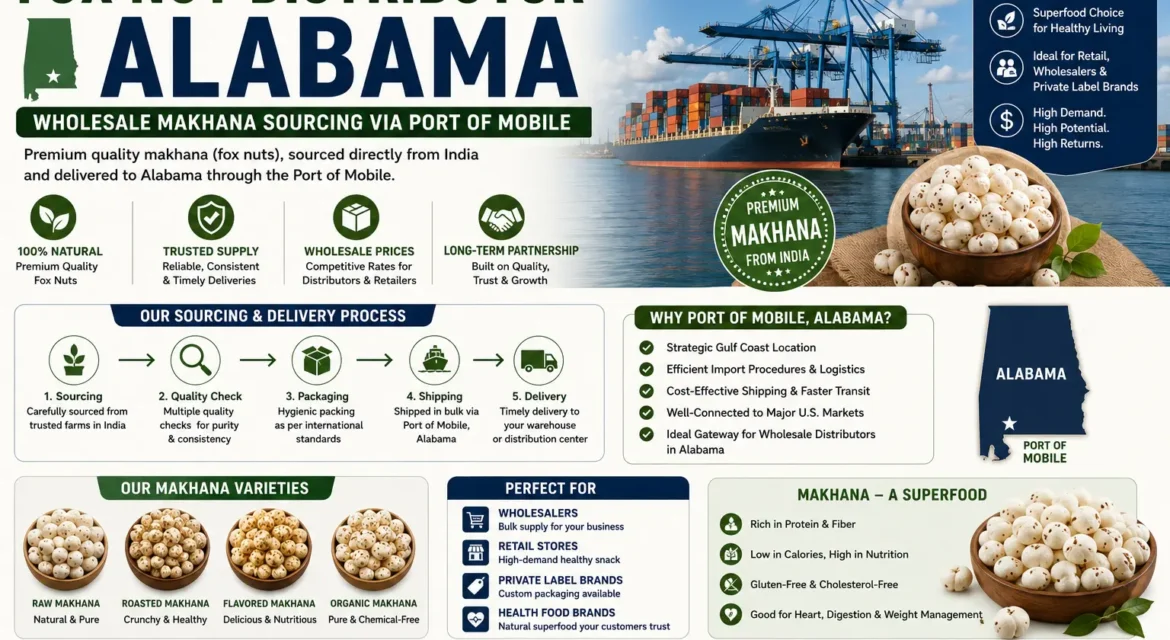
If you are a snack brand, retailer, or wholesale buyer searching for a fox nut distributor in Alabama, the most critical factors for your supply chain are FDA compliance, precise grading, and efficient port logistics. Alabama is rapidly becoming a strategic entry point for agricultural imports due to the high-velocity operations at the Port of Mobile. Sourcing wholesale makhana (fox nuts) directly through established B2B export partners like Civize ensures you receive export-grade quality while avoiding common customs bottlenecks.
Request a Wholesale Quote Today
Table of Contents
- The Rise of Fox Nuts (Makhana) in the US Snack Market
- Why Alabama? The Port of Mobile as a Logistics Hub
- Sourcing Premium Fox Nuts: Grading Standards for US Export
- Navigating US FDA and Customs Compliance for Makhana Imports
- Why Partner with Civize as Your Wholesale Fox Nut Supplier?
- B2B Distribution Strategies for Alabama Retailers & Brands
- Overcoming Common Supply Chain Bottlenecks
- Frequently Asked Questions (FAQs)
The Rise of Fox Nuts (Makhana) in the US Snack Market
With an annual import of around 2,000 metric tons, the United States has emerged as the biggest market for Indian makhana exports. This accounts for over 17% of India’s total makhana exports. But why the sudden surge?
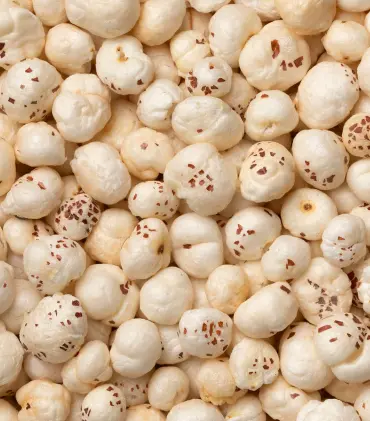
Fox nuts are perfectly positioned at the intersection of several massive consumer dietary trends: they are naturally gluten-free, vegan, paleo-friendly, and boast a low glycemic index. As a highly adaptable ingredient, makhana serves as a nutrient-dense alternative to traditional popcorn or potato chips.
Key Market Drivers for Makhana in the US:
- Plant-Based Snacking: Consumers are aggressively seeking plant-based proteins. Fox nuts deliver a satisfying crunch with a superior amino acid profile compared to traditional corn snacks.
- Allergen-Free Properties: Being free from the top nine major allergens (including nuts, soy, and dairy), makhana is a highly sought-after commodity for school-safe snack brands.
- Versatility in Flavoring: The neutral, slightly earthy taste of raw fox nuts makes them a perfect canvas for both savory (Himalayan pink salt, jalapeño, truffle) and sweet (caramel, dark chocolate) flavor profiles.
Why Alabama? The Port of Mobile as a Logistics Hub
When discussing a fox nut distributor in Alabama, the conversation must center on logistics. Alabama offers one of the most direct and cost-effective global access points in the United States through the Port of Mobile.
Governed by the Alabama Port Authority, the Port of Mobile is one of the nation’s fastest-growing deep-water seaports. For agricultural imports like bulk fox nuts, avoiding the notorious congestion of ports like Los Angeles or New York/Newark is a massive competitive advantage.
The Mobile America Express (MAX) Advantage
The Alabama Port Authority operates the MAX (Mobile America Express) service line. This high-velocity freight corridor connects global trade directly to inland US markets.
| Logistics Feature | Benefit for Makhana Importers |
|---|---|
| Deep-Water Berths | Accommodates massive post-Panamax container vessels, reducing transshipment times from India. |
| Class I Rail Access | Direct integration with major rail networks (CSX, Norfolk Southern, BNSF) for immediate inland distribution. |
| Interstate Highways | Immediate access to I-10 and I-65, facilitating rapid trucking to distribution centers across the Southeast and Midwest. |
| Reduced Dwell Time | Significantly lower container dwell times compared to West Coast ports, protecting the shelf-life of agricultural commodities. |
For a wholesale distributor, importing through Mobile means lower drayage costs, faster customs clearance, and a more resilient supply chain.
Sourcing Premium Fox Nuts: Grading Standards for US Export
In the global B2B trade of agricultural commodities, visual and structural consistency is everything. US buyers and private-label brands demand exact specifications. If you are a fox nut distributor in Alabama, your supplier must adhere strictly to established sizing and grading metrics.
Visualizations and grading charts for agro-products must meet exact technical standards to align with export market expectations. Makhana is graded by diameter (measured in suta or millimeters) and the percentage of acceptable breakage.
Export-Grade Makhana Sizing Chart
To meet US retail and wholesale expectations, Civize adheres to the following strict grading standards:
| Grade Designation | Size (Diameter) | Breakage Tolerance | Best Commercial Application |
|---|---|---|---|
| 7+ Suta (Jumbo Premium) | > 18 mm | < 10% | Premium retail snacking, gourmet roasted/flavored whole nuts. |
| 6 Suta (Standard Export) | 16 mm – 18 mm | < 12% | Standard private label snacks, bulk wholesale distribution. |
| 5 Suta (Economy/Industrial) | 14 mm – 16 mm | < 15% | Industrial processing, flavored product blends, trail mixes. |
| Makhana Flakes/Powder | Custom Milled | N/A | Confectionery blends, gluten-free baking flour, infant food bases. |
Crucial Insight: Size isn’t the only metric. Moisture content is the silent killer of agricultural imports. Export-grade makhana must be dried to a strict moisture level (typically below 8%) and packed in vacuum-sealed bags to prevent mold and preserve the signature crunch during ocean transit.
Navigating US FDA and Customs Compliance for Makhana Imports
Importing food products into the United States requires meticulous documentation. A single missing document can result in a shipment being detained at the Port of Mobile, leading to demurrage charges and spoiled inventory.
When evaluating a fox nut distributor in Alabama or an overseas supplier, ensure they are fully compliant with the US Food and Drug Administration (FDA) and the Food Safety Modernization Act (FSMA).
1. FDA Facility Registration and DUNS Number
Any foreign facility that manufactures, processes, packs, or holds food for consumption in the US must register with the FDA. As of 2020, this requires a Data Universal Numbering System (DUNS) number issued by Dun & Bradstreet. Your supplier must maintain active registration.
2. Foreign Supplier Verification Program (FSVP)
According to FSMA, US importers are legally obligated to confirm that the food produced by their foreign suppliers offers the same degree of public health protection as facilities located in the United States. This requires documented hazard analysis and preventive controls.
3. Prior Notice Requirements
Before a shipment of makhana arrives at a US port, the FDA must receive Prior Notice. For ocean freight arriving at the Port of Mobile, this electronic filing must be submitted at least 8 hours before arrival.
4. Mandatory Labeling and Commercial Documentation
US Customs and Border Protection (CBP) and the FDA will inspect shipments for strict labeling compliance. Rejected shipments are frequently the result of non-compliant labels.
- Nutrition Facts: Must follow the updated FDA 2020 format.
- Allergen Declarations: Clear statements, even if the facility processes allergen-free goods.
- Country of Origin: Must prominently state “Product of India.”
- Net Weight: Dual declaration required (e.g., ounces/pounds and grams/kilograms).
Makhana HS Code Classification
Proper Harmonized System (HS) code classification prevents customs delays and penalty assessments.
- Raw/Dried Makhana (unsalted): HS Code 0810.90.90 (Typically 2.7% duty, medium FDA scrutiny).
- Roasted/Flavored Fox Nuts: HS Code 2008.19.90 (Typically 6.6% duty, medium-high FDA scrutiny).
- Makhana Flour: HS Code 1106.30.90.
Why Partner with Civize as Your Wholesale Fox Nut Supplier?
Sourcing agricultural commodities from overseas involves significant risk. Civize eliminates this friction for Alabama distributors by acting as a highly optimized, fully compliant B2B export partner.
The Civize Advantage in Agricultural Commodities
- Direct Farm-to-Port Sourcing: Civize bypasses multiple layers of local aggregators and regional wholesalers. We source directly from the cultivation hubs in Bihar, India, which controls costs and ensures full traceability of the product.
- Strict Adherence to Grading Visualizations: We understand that the US B2B market requires exact technical standards. Whether you need 7+ Suta Jumbo or standard 6 Suta, our shipments match the precise grading charts expected by US buyers, ensuring zero surprises upon container unsealing.
- Comprehensive Compliance Support: Civize provides robust support for FDA Prior Notice filings, FSVP documentation packages, and complete Certificates of Analysis (COA) for pesticide residues, heavy metals, and microbiological contamination.
- Optimized Container Utilization: Through advanced vacuum-sealing techniques, we optimize volumetric weight, allowing buyers to maximize the yield of 20-foot (approx. 8,000–10,000 kg) and 40-foot containers.
“A successful B2B agricultural trade relies on predictability. At Civize, we don’t just ship products; we deliver compliance, precise grading, and logistical peace of mind for our US distribution partners.”
B2B Distribution Strategies for Alabama Retailers & Brands
Once your container of premium Civize makhana clears the Port of Mobile, how do you maximize its value in the local and national market?
1. Private Label Manufacturing
Private labeling is the most lucrative choice for a lot of distributors. Wholesale sourcing provides the raw material base for brands to roast, flavor, and package makhana under their own branding. By importing raw 7+ Suta makhana, Alabama businesses can control the flavoring process locally, adapting quickly to regional taste preferences (e.g., Southern BBQ or Cajun spice profiles).
2. Supplying the Food Service Industry
Beyond retail snacking, there is a growing B2B market for makhana in the food service sector. High-end restaurants, vegan cafes, and corporate cafeterias are incorporating makhana as a salad topping, soup garnish, or premium bar snack. Distributors can capture this market by offering smaller, manageable bulk sizes (e.g., 5 lb or 10 lb vacuum bags) rather than full pallets.
3. Margin Control Through Volume
By purchasing in 40-foot container loads, distributors achieve massive economies of scale. Wholesale sourcing allows brands to control their margins tightly. Instead of investing heavy capital into primary processing in India, Alabama distributors leverage established supply networks like Civize to handle the heavy lifting, focusing their capital on localized marketing and distribution.
Overcoming Common Supply Chain Bottlenecks
Even with the best planning, global logistics can present challenges. Here is how top-tier distributors mitigate risks when importing fox nuts.
The Moisture Challenge
Makhana is highly hygroscopic—it absorbs moisture from the air rapidly. If shipped in standard poly bags during a 30+ day ocean transit, the product will arrive soggy and prone to fungal growth.
The Fix: Always specify multi-layer, moisture-barrier vacuum packaging. This preserves the crunch and extends the shelf life up to 12-18 months.
The Pesticide Residue Trap
The US FDA strictly enforces EPA pesticide tolerance limits. Shipments that fail laboratory testing will be destroyed or returned at the importer’s expense.
The Fix: Require your supplier to provide an independent, third-party Certificate of Analysis (COA) from an ISO-certified laboratory before the container leaves the port of origin.
Transshipment Delays
Relying on heavily congested ports can add weeks to transit times, tying up working capital and delaying product launches.
The Fix: Route shipments strategically. Utilizing the Port of Mobile instead of West Coast alternatives often results in faster rail and truck deployment to the Southeast and Midwest US markets.
Secure Your Alabama Makhana Supply Chain
Ready to scale your snacking brand? Partner with Civize for FDA-compliant, perfectly graded bulk makhana shipped securely to the Port of Mobile.