

 03 July 2026
5+ Suta Makhana: Wholesale Rates, Grading & Buying
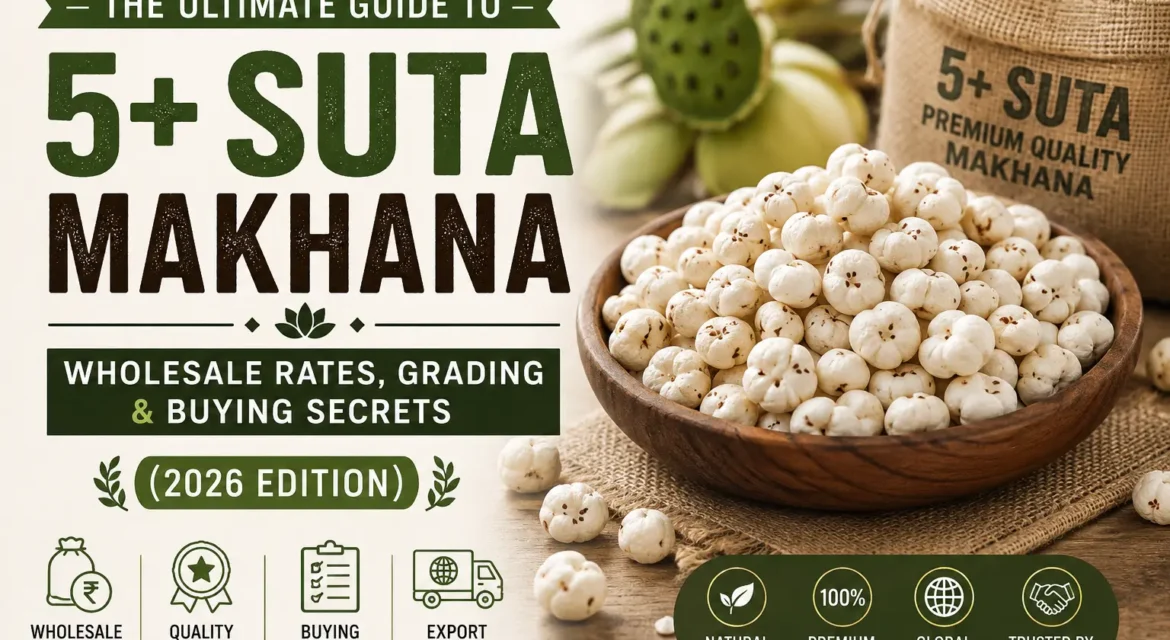
The Ultimate Guide to 5+ Suta Makhana: Wholesale Rates, Grading & Buying Secrets (2026 Edition)
The global snack market is undergoing a massive transformation, and at the center of this healthy snacking revolution is premium quality makhana (fox nuts or lotus seeds). But if you are a wholesale buyer, a retail packer, or a snack brand manufacturer, you know that buying makhana isn’t as simple as picking up a bag from the farm. The industry operates on a highly specific grading metric known as the “Suta” system.
If you are searching for a “Buy 5+ Suta Makhana Pack of 1 KG – Wholesale Rate” or trying to decode the makhana price per kg, you have landed in the right place. In this comprehensive, data-backed guide, we will break down exactly what the Suta grading system is, why the 5+ Suta Makhana grade is the ultimate sweet spot for wholesale and retail, the real-time pricing dynamics in hubs like Delhi and Bihar, and the essential quality checks you must perform before your next bulk purchase.
Table of Contents
- 1. What is Suta Makhana? Decoding the Industry Grading System
- 2. Why 5+ Suta Makhana is the Gold Standard for Buyers
- 3. Today’s Makhana Price: Understanding the 1 KG Wholesale Rate
- 4. How to Source the Best Quality Makhana: A B2B Buyer’s Checklist
- 5. Structuring Your Supply Chain: Export and Retail Preparations
- 6. Voices from the Industry
- 7. The Makhana Market’s Future (2026 and Beyond)
- 8. Frequently Asked Questions (FAQs)
1. What is Suta Makhana? Decoding the Industry Grading System
To the untrained eye, a bag of makhana looks like a uniform batch of white, puffy kernels. However, in traditional trade markets—especially in Katihar, Purnea, and Darbhanga (Bihar)—makhana quality is strictly evaluated by diameter using a unit of measurement called the Suta.
The Mathematics of Suta
In the Indian agricultural trade, 1 Suta is exactly equal to 3.175 mm.
When farmers harvest and process raw gorgon nuts into popped makhana, the expansion of the kernel dictates its final grade. The sorting process (often done through mechanized sieves or rigorous hand-picking) separates these pops into distinct categories. This size calibration is critical because it dictates not only the visual appeal of the product but also its roasting behavior, texture, and commercial value.
The Standard Suta Makhana Size Chart
Understanding these grades is essential for negotiating the best makhana rate. Here is how the industry classifies them:
| Suta Grade | Size in Millimeters (mm) | Trade Name | Core Characteristics & Best Uses |
|---|---|---|---|
| 3 Suta | 9.5 mm to 12.7 mm | Murrah / Economy | Small, dense pops. Used for industrial grinding, gravies, and budget chakhna (bar snacks). |
| 4 Suta | 12.7 mm to 14.5 mm | Ulwa | Consistent small pops. Excellent for value-added mixes, baby foods, and Kheer. |
| 5 Suta | 15.8 mm to 17.5 mm | Premium Commercial | The workhorse grade. Balanced size for flavoring, roasting, and standard retail pouches. |
| 5.5+ / 5+ Suta | 17.5 mm to 19.0 mm | Super Premium | Large, uniform pops with brilliant white color. The top choice for high-end retail packing and export. |
| 6+ Suta | 19.0 mm to 25.0 mm | Rasgulla / Rajbhog | Jumbo export-grade. Handpicked, visually stunning, highest price point. Used for luxury gifting. |
Expert Insight: “Nutrition-wise, a 3 Sutta and a 6 Sutta makhana are identical. You get the same protein and minerals regardless of size. However, the roasting experience and visual presentation for the end-consumer are totally different.” – Manish Kushwaha, Founder, Chahak Foods International.
2. Why 5+ Suta Makhana is the Gold Standard for Buyers
If you are analyzing the makhana 1kg price across various suppliers, you will notice a massive spike in cost when moving from 5 Suta to 6+ Suta. This is why the 5+ Suta Makhana grade has emerged as the most practical and profitable choice for wholesale buyers, snack brands, and regional distributors.
A. The “Kitchen Physics” of Even Roasting
One of the biggest mistakes new snack brands make is buying “mixed grade” (a blend of 3, 4, and 5 suta) to save money. Because makhana has a delicate cellular structure, mixed sizes roast at vastly different speeds. The smaller 3 Suta kernels will burn and turn bitter long before the larger 5 Suta pieces achieve their signature crunch. Premium 5+ Suta Makhana guarantees a uniform diameter (15.8mm – 19mm), meaning every kernel in your commercial roaster reaches the perfect crunch simultaneously.
B. The Perfect Balance of Volume and Price
While 6+ Suta (Rajbhog) looks majestic, it often commands prices exceeding ₹1,450 to ₹1,575 per kg. For a consumer snack brand looking to sell a 100g flavored packet at a competitive MRP, using 6 Suta ruins the profit margin. 5+ Suta sits exactly in the middle of the grading ladder: it provides a stunning, premium aesthetic without the exorbitant luxury markup.
C. Superior Coating Surface Area
For manufacturers creating peri-peri, cheese, or caramel-coated makhana, the surface area is everything. 5+ Suta offers the ideal expansion ratio. The kernels are robust enough to handle the tumbling action of flavor-coating machines without experiencing high breakage (which plummets to less than 2% in this grade).
3. Today’s Makhana Price: Understanding the 1 KG Wholesale Rate
Tracking the makhana price 1kg requires understanding that this is a highly localized, weather-dependent cash crop. Over 85% of the world’s makhana is produced in the Mithila region of Bihar. Therefore, the today makhana price is dictated at the farm-gate level in mandis like Katihar, Purnea, and Darbhanga.
Estimated Wholesale Makhana Rate Per Kg (2026 Projections)
Please note: Prices fluctuate based on seasonal yields, global export demand, and moisture content (drying costs).
| Grade Type | Wholesale Rate (Per KG in Bihar) | Wholesale Rate (Per KG in Delhi / Metro) | Target Buyer |
|---|---|---|---|
| 3 Suta (Murrah) | ₹400 – ₹550 | ₹480 – ₹620 | Powder manufacturers, feed |
| 4 Suta | ₹650 – ₹800 | ₹750 – ₹900 | Budget snack brands, caterers |
| 5 Suta Standard | ₹850 – ₹1,050 | ₹950 – ₹1,150 | General retail packaging |
| 5+ Suta Premium | ₹1,150 – ₹1,350 | ₹1,250 – ₹1,450 | Premium brands, Exporters |
| 6+ Suta (Handpicked) | ₹1,450 – ₹1,700 | ₹1,550 – ₹1,850 | Luxury gifting, Gourmet labels |
Why is the Makhana Price 1kg in Delhi Higher Than in Bihar?
When searching for makhana price 1kg in delhi, you will notice a ₹100 to ₹150 premium over the Bihar rates. This delta is driven by:
- The Bora (Bag) System Inefficiency: Traditionally, makhana is packed in large volumetric jute bags (Boras) measuring 28×46 inches rather than by strict weight. Because popped makhana is both light and voluminous, transportation expenses (freight by volume) are extremely expensive.
- Moisture Loss: Raw pops hold moisture. They lose water weight as they move to drier regions like Delhi, which forces distributors to raise the price per kilogram in order to preserve profits.
- Multi-layer Intermediation: From the Katihar mandi to a Delhi distributor, the product changes hands 3 to 4 times, with each intermediary adding a 5-8% markup.
4. How to Source the Best Quality Makhana: A B2B Buyer’s Checklist
Not all Suta Makhana Packs are created equal. Fraud is common in the bulk market, where suppliers might mix 4 Suta into a 5+ Suta batch to inflate profits. If you are seeking an exclusive wholesale rate for premium quality makhana, use this 5-point evaluation checklist before signing a purchase order.
1. Caliper Validation (Size Consistency)
Do not rely on naked-eye estimates. Request a sample from best makhana supplier civizeexim and use a digital caliper. In a real 5+ Suta Makhana packet, at least 90% of the kernels should measure between 15.8 mm and 19.0 mm.
2. The Squeeze Test for Moisture
Optimal export-grade makhana should have a moisture content between 9% and 14%. If you squeeze a popped kernel and it feels spongy or compresses easily without breaking, the moisture is too high. This reduces shelf life, invites fungal growth, and means you are paying for water weight instead of product. A perfectly dried makhana will offer firm resistance.
3. Visual Purity (Color & Spotting)
Best quality makhana should be a radiant, creamy white. Beware of:
- Red/Brown spots: Indicates improper roasting before the popping phase, where the black seed coat fused with the white kernel.
- Yellowing: Suggests old stock or poor storage conditions exposed to high humidity.
4. Breakage Tolerance
In a premium 10kg wholesale bag of 5 or more Suta, breakage (crushed pieces or dust) should be kept to a minimum. Excessive breakage indicates poor supply chain handling or the use of sub-standard popping methods.
5. Packaging Standards
Never buy premium makhana in open gunny bags. Ensure the wholesaler uses food-grade, moisture-barrier liner bags (usually hermetically sealed) inside the master carton or woven sack. This preserves the crunch and prevents ambient moisture absorption during transit.
5. Structuring Your Supply Chain: Export and Retail Preparations
For brands looking to take their premium makhana global, the stakes are even higher. Makhana is regarded as a high-end superfood in the global market, particularly in the US, UK, and UAE, where it faces off against macadamia nuts and premium almonds.
Export Readiness for 5+ Suta
If you are exporting, 5+ Suta Handpicked is the minimum acceptable grade.
- Phytosanitary Certification: Mandatory for international shipping, proving the batch is free from pests.
- Aflatoxin Testing: Given the pond-based cultivation of gorgon nuts, stringent lab testing for aflatoxins and heavy metals is required.
- Vacuum Packaging: To ensure the product survives a 30-day ocean freight journey without losing its crunch, exporters must use nitrogen-flushed or vacuum-sealed 5kg/10kg bulk packs.
Topic Read Also:
Are you a brand owner looking to expand your healthy snack portfolio? Check out our related guides on:
- How to Launch a Flavored Makhana Brand,
- Understanding the Nutritional Profile of Fox Nuts,
- Top 10 Export Markets for Indian Makhana in 2026.
6. Voices from the Industry
To provide an authoritative perspective on the evolving rate of makhana per kg, we spoke to leading figures in the Indian agribusiness sector.
“Five years ago, grading was done using the subjective eye estimations of local traders. The institutionalization of the Suta measuring system has made the playing field level today. A customer in Europe is aware of the precise millimeter measurements they would receive when they place an order for a 5.5 Suta pack. It removes information asymmetry and guarantees price transparency. “
— Dr. Anjali Verma, Supply Chain Researcher, National Institute of Agricultural Economics
“Volume vs. Weight discrepancies are the hidden cost.”
“The “makhana rate today” per kilogram is often the attention of new buyers, who completely forget that makhana is a volumetric nightmare. A 10kg batch won’t fill your typical retail pouches if the expansion is inadequate, even if you manage to obtain a low per-kilo charge.You aren’t just buying weight; you are buying volume and visual real estate in a snack bag.”
— Vikram Sahni, Procurement Head, Leading Indian FMCG Snack Brand
7. The Makhana Market’s Future (2026 and Beyond)
As we move deeper into the decade, the demand for makhana 1 kg packs for direct-to-consumer online sales is skyrocketing. What was once a fasting food (Vrat ka khana) in North India is now a staple vegan, gluten-free, keto-friendly snack worldwide.
We anticipate the following trends:
- Precision Agriculture in Cultivation: Yields in Bihar are being optimized using aquatic weed management and controlled pond environments, potentially stabilizing the highly volatile makhana cost.
- Hyper-Local Processing: Instead of shipping raw pops to Delhi or Gujarat for flavoring, processing hubs are being set up directly in Darbhanga and Purnea, reducing freight costs and minimizing carbon footprints.
- Rise of Organic Certification: As global buyers become more stringent, USDA Organic and EU Organic certified 5+ Suta makhana will command a 30-40% premium over standard conventional rates.
8. Frequently Asked Questions (FAQs)
Ready to Source Verified 5+ Suta Premium Makhana?
Stop compromising on quality with mixed-grade suppliers. Partner with Civize for strictly calibrated, 5+ Suta Makhana. Get uniform sizes, optimal moisture control, and scalable B2B export supply.