
 04 August 2026
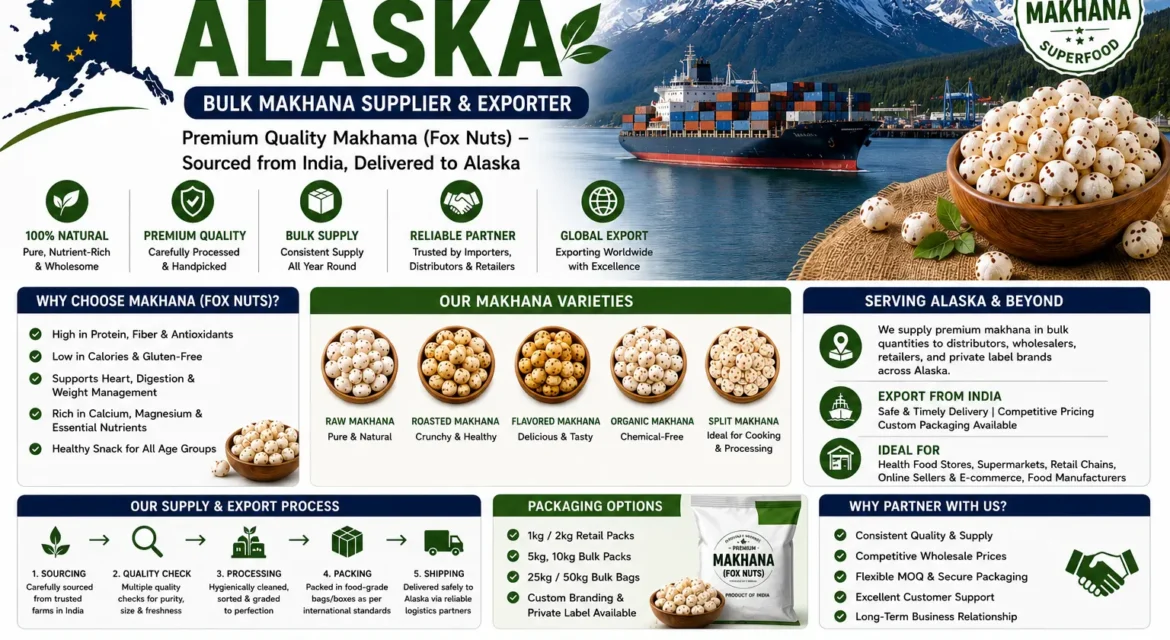
Fox Nut Distributor Alaska: Complete Guide to Bulk Sourcing with Civize
Securing a reliable fox nut distributor in Alaska requires more than just finding a supplier with the lowest price per kilo. The Last Frontier presents unique logistical challenges—from navigating the Jones Act for Seattle-to-Anchorage sea freight to preventing moisture-induced crop loss in transit.
For Alaskan food distributors, health food retailers, and snack manufacturers, the global shift toward plant-based, gluten-free snacking has made Euryale ferox (fox nuts or makhana) a highly lucrative commodity. However, importing this lightweight, high-volume superfood into Alaska demands strict adherence to FDA regulations, precise volumetric shipping strategies, and a rigorous grading system.
As a leading global fox nut exporter, Civize bridges the gap between the aquatic farms of Bihar, India (where 90% of the world’s supply originates) and distribution centers across Alaska. This comprehensive guide breaks down export grades, logistics, and how to source premium wholesale makhana profitably.
Request a Wholesale Quote Today
Table of Contents
Why Alaska’s Food Distributors Are Stocking Up on Fox Nuts
The Alaskan food market relies heavily on shelf-stable, nutrient-dense products that can withstand long supply chains. Fox nuts fit this profile perfectly while catering to modern dietary trends.
Consumers are pivoting away from seed-oil-drenched potato chips toward snacks that offer clean nutrition. Fox nuts are naturally gluten-free, vegan, and boast a low glycemic index, making them a safe, high-protein alternative for diabetic and health-conscious demographics.
“The demand for functional snacks in the Pacific Northwest and Alaska has surged. Distributors aren’t just looking for bulk calories; they are sourcing premium, minimally processed commodities that align with Keto and Paleo dietary frameworks.”
For an Alaskan fox nut wholesaler, the profit margins on premium 6-Suta roasted and flavored makhana are significantly higher than traditional bulk grains or imported tree nuts.
The Civize Standard: Makhana Export Grades and Suta Sizing
In the B2B commodity market, “premium” is not just a marketing term—it is a mathematically measurable standard. To meet export market expectations, bulk buyers must understand the traditional grading visualizations used at the source.
Fox nuts are graded using the “Suta” system, a highly specific sizing matrix where one Suta equals approximately 3.175 mm.
The B2B Suta Sizing Matrix
| Grade | Size (mm) | Quality Characteristics | Best Use Case |
|---|---|---|---|
| 4-Suta | 12.0 mm – 15.0 mm | High density, moderate popping yield, off-white. | Commercial grinding, traditional cooking. |
| 5-Suta | 15.0 mm – 18.0 mm | Uniform size, excellent crunch, low breakage. | Flavored retail snack manufacturing. |
| 6-Suta / 7-Suta | 18.0 mm+ | Maximum expansion, bright white, zero unpopped seeds. | Premium gourmet retail, export standard. |
When acting as your fox nut supplier in Alaska, Civize strictly adheres to these technical standards. For the Alaskan retail market, we highly recommend focusing on 5-Suta and 6-Suta grades. These grades guarantee less than 2% broken kernels and a bright white color profile that appeals to Western consumers.
Logistics: Shipping High-Volume Fox Nuts to Alaska
Moving agricultural commodities to Alaska is uniquely complex. Because of the Jones Act, most goods bound for Alaska must first arrive at a U.S. port (typically Seattle or Tacoma) before being loaded onto domestic barges or vessels heading to the Port of Anchorage.
Managing Volumetric Weight
Makhana is incredibly light but highly voluminous. This drastically impacts shipping economics. A standard 40ft High Cube (HC) container maxes out at roughly 8 to 9.5 Metric Tons, depending on the Suta size. Larger 6-Suta nuts leave more empty space in the bag, lowering the total weight per container.
To maintain profitability as a fox nut wholesaler in Alaska, buyers must optimize their container loads and work with suppliers who utilize high-compression, moisture-barrier packaging.
The Moisture Threat
One of the greatest bottlenecks in the global fox nut supply chain is post-harvest moisture control.
- Target Moisture: Must be strictly maintained below 8% to 10%.
- The Risk: Sea freight from India to Seattle, followed by the transit across the Gulf of Alaska, exposes cargo to severe temperature fluctuations. If moisture levels exceed 10%, condensation within the bags can lead to mold and complete loss of crispness.
- The Solution: Civize utilizes thermal-lined containers and specialized moisture-barrier gunny bags to ensure the product arrives at Alaskan distribution centers exactly as it left the roasting facility.
FDA Compliance and Import Documentation for Alaska
International borders do not care about the size of your makhana if it fails health screening. As an experienced fox nut exporter to Alaska, Civize ensures seamless customs clearance through meticulous documentation and quality assurance.
To avoid delays at the Port of Seattle or Anchorage, your shipments must meet the following technical labeling and certification requirements:
- Strict Labeling Compliance: Retail and wholesale packaging must adhere to the updated FDA 2020 format for Nutrition Facts. It is also mandatory to include clear allergen warnings and a highly visible “Product of India” label to comply with U.S. Customs and Border Protection (CBP) rules.
- HS Code Classification: Proper tariff classification is essential. Raw makhana falls under different codes than processed snacks. For roasted and flavored varieties, utilizing the correct HS code (such as 20081990) prevents costly customs holds.
- Phytosanitary Certificates: Issued by the Plant Quarantine Organization of India, certifying the shipment is free from weevil infestations or agricultural pests.
- Residue and Lot-Level Testing: Strict lot-level documentation and certificates of analysis regarding pesticide residues and heavy metals must accompany every commercial invoice.
Raw vs. Roasted: What Should You Import?
Depending on your place in the supply chain, you have two primary sourcing models when partnering with Civize:
1. Bulk Raw Phool Makhana
Ideal for Alaskan snack manufacturers who possess their own commercial roasting and flavoring facilities. Buying raw 5-Suta or 6-Suta makhana in bulk polypropylene (PP) bags offers the lowest cost per kilogram. It allows you to control the end-to-end flavoring process locally, responding instantly to regional taste trends.
2. Private Label (Roasted & Flavored)
For retail brands, grocery chains, or distributors looking for a turnkey solution, Civize offers end-to-end white labeling. We utilize commercial hot-air continuous roasters and pack the makhana into nitrogen-flushed, branded stand-up pouches. Popular flavor profiles for the U.S. market include Himalayan Pink Salt, Vegan White Cheddar, and Truffle Oil.
Secure Your Alaskan Makhana Supply Chain
Ready to scale your snacking brand? Partner with Civize for FDA-compliant, perfectly graded bulk makhana shipped securely to the Pacific Northwest and Alaska.