
 21 July 2026
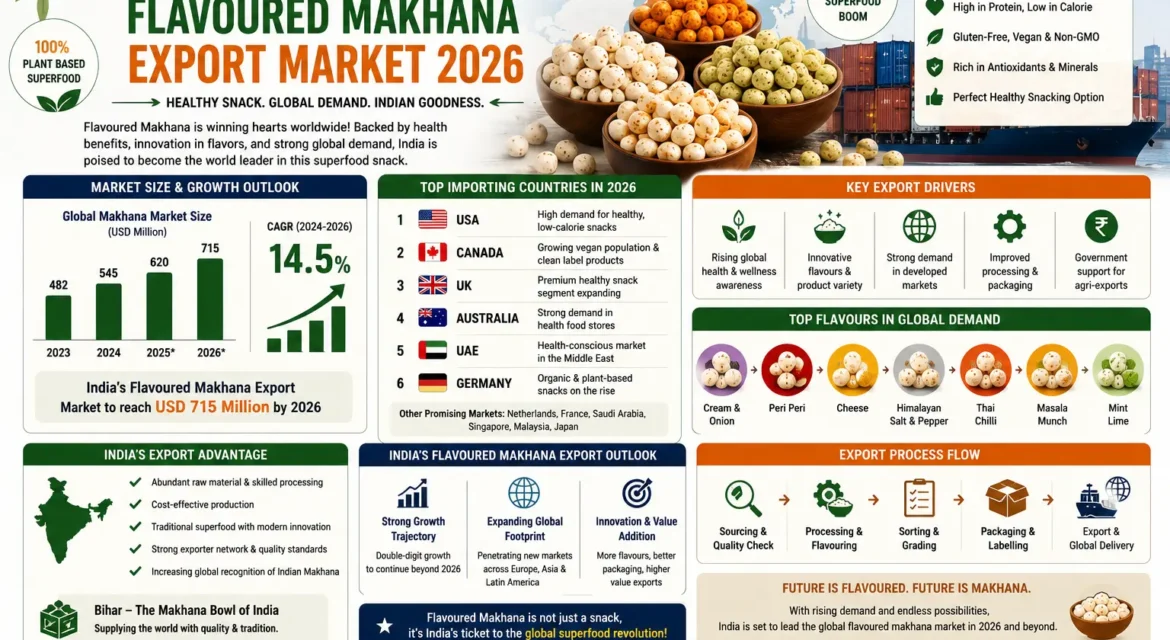
India’s Flavoured Makhana Export Market 2026
The global snacking industry is undergoing a seismic shift, and at the center of this transformation is a humble aquatic seed from the wetlands of Bihar, India. The demand for plant-based, gluten-free, and nutrient-dense snacks has catapulted fox nuts (makhana) from a regional Indian staple into a global superfood phenomenon.
Whether you are looking to become a flavoured makhana exporter in India, seeking makhana contract manufacturing for your private brand, or simply trying to understand the makhana export rate from India, navigating this booming supply chain requires precise, data-backed insights.
Here is a deep dive into the business of makhana exportation, processing, pricing, and market dominance in 2026.
Table of Contents
- The Flavoured Makhana Market in India: 2026 and Beyond
- From Pond to Packet: How to Make Makhana from Lotus Seeds
- The Art of Value Addition: How to Flavour Makhana
- Economics: Makhana Export Rate from India
- The Landscape: Top Flavoured Makhana Manufacturers in India
- Strategy for Buyers and Exporters
- Frequently Asked Questions
The Flavoured Makhana Market in India: 2026 and Beyond
The numbers paint a clear picture: the world is hungry for healthy snacks. The India Makhana Market was valued at USD 1.46 billion in 2025 and is projected to reach USD 2.23 billion by 2030, growing at an impressive 8.80% CAGR. India currently accounts for roughly 88–90% of the global makhana supply, with the state of Bihar producing the vast majority of it.
For a flavoured makhana exporter, the value addition is where the real margin lies. The roasted and flavored segment now holds roughly 67% of the total market share. Consumers are moving away from traditional potato chips, prompting the rise of dedicated makhana chips manufacturers who roast these seeds and coat them in global flavors like peri-peri, truffle, and sour cream & onion.
Why the Export Market is Exploding
Makhana export from India saw roughly 25,130 metric tons shipped in 2023–2024, bringing in $30.5 million. The Middle East (particularly the UAE), the UK, Germany, and the US are the primary buyers. Health-conscious buyers in these regions are willing to pay a premium for organic, non-GMO, clean-label snacks, making the flavoured makhana exporter price incredibly lucrative on the international stage.
From Pond to Packet: How to Make Makhana from Lotus Seeds
Before any flavour is added, the raw seed must undergo a highly specialized, labor-intensive transformation. If you’ve ever wondered how to make makhana from lotus seeds, it’s a process that has remained largely traditional, demanding immense skill.
1.Harvesting the Seeds:Wetland labor. Farmers manually collect the seeds of the Euryale ferox (prickly water lily) plant from the bottom of stagnant ponds and wetlands, usually covered in mud.
2.Cleaning and Washing: The harvested seeds undergo multiple rounds of rigorous washing to remove all pond dirt, residues, and impurities, ensuring only premium seeds move forward.
3.Sun Drying:Moisture reduction. The cleaned seeds are spread out under direct sunlight. Reducing the moisture content is critical for the seeds to survive the high-temperature roasting phase without turning to mush.
4.Roasting: Seeds are roasted in heavy iron pans. This prepares the hard outer shell and creates the internal pressure necessary for the crucial next step.
5.Popping:Manual precision required. Skilled workers take the hot, roasted seeds and strike them gently with a wooden mallet. The heat trapped inside causes the black shell to break and the white kernel to aggressively expand—popping into the fluffy makhana we recognize.
6.Grading and Sorting: The popped nuts are sorted by size (measured in “Suta”). The most expensive flavored makhana in the world is a premium 7-Suta (extra-large) makhana.
The Art of Value Addition: How to Flavour Makhana
Any top-tier flavoured makhana manufacturer will tell you that the secret lies in the roasting and coating process. Unlike standard frying, makhana is dry-roasted or tossed in minimal cold-pressed oils (like olive or ghee) to act as a binding agent for spices.
Industrial Production vs. Home Recipes
If you are wondering how to add flavour to makhana at scale, makhana chips manufacturers use large industrial tumbling machines. The popped seeds are sprayed with a fine mist of oil and then tossed with powdered seasonings to ensure an even coat without making the snack soggy.
For those testing products or wanting to know how to make flavoured makhana at home, the flavoured makhana recipe is simple:
- Dry roast the makhana in a heavy-bottomed pan for 5-7 minutes until they snap when crushed.
- In a separate small pan, heat 1 tablespoon of ghee or coconut oil.
- Add your spices (e.g., turmeric, black pepper, sea salt, or peri-peri powder) to the warm oil.
- Coat the roasted makhana fully by pouring the spicy oil over it and tossing.
The Nutritional Trade-off
While raw makhana is a near-perfect diet food, aggressive commercial flavoring can alter its health profile, spiking sodium and fat content.
Interactive Nutrition Breakdown
Makhana Nutrition Calculator
Estimated Macros
Economics: Makhana Export Rate from India
Understanding the financial architecture of the trade is crucial. The makhana export rate from India fluctuates based on the raw seed yield in Bihar and global supply chain logistics.
Pricing Tiers (2025/2026 Estimates)
Whether you are buying from flavoured makhana suppliers in India or dealing directly with a makhana manufacturer in India, prices are dictated by the “Suta” (size) of the pop.
| Makhana Grade | Size | Domestic Wholesale (INR/kg) | Export FOB Price (USD/kg) |
|---|---|---|---|
| 4 Suta (Standard) | Small | ₹500 – ₹700 | $10 – $13 |
| 5 Suta (Medium) | Medium | ₹700 – ₹900 | $13 – $16 |
| 6 Suta (Bold) | Large | ₹900 – ₹1,100 | $16 – $20 |
| 7 Suta (Premium) | Extra-Large | ₹1,200 – ₹1,700 | $20 – $26 |
Note: These are baseline prices for raw/roasted unflavored makhana. As a flavoured makhana exporter, value addition (flavoring and retail packaging) pushes the final B2B CIF price up by another 30-40%.
Profitability: Export vs. Domestic
Why go through the hassle of customs and international freight? The margins. While domestic sales might yield a standard wholesale margin, the export market (especially to the USA, EU, and UAE) offers significantly higher profitability. An exporter shipping 1 Metric Ton (1,000 kg) of premium 6-Suta makhana to the US can clear an estimated net profit margin of ~36% after freight, FSSAI compliance, packaging, and CHA fees.
The Landscape: Top Flavoured Makhana Manufacturers in India
The flavoured makhana market in India is hyper-competitive. Brands are battling for shelf space in domestic modern trade while simultaneously locking down international distribution.
If you are a global buyer searching for flavoured makhana suppliers, you generally have two routes:
- Branded Distribution: Importing established Indian FMCG brands.
- Makhana Contract Manufacturing: Partnering with a facility for a makhana white label arrangement, allowing you to sell the product under your own brand in your home country.
Leading Players
- Farmley: A massive player with a farm-to-consumer supply chain. They are a go-to for mid-premium, highly standardized export quality.
- Tata Sampann: Leveraging the massive trust of the Tata name, they command significant shelf space for quality-assured FMCG goods.
- Happilo and Open Secret: These brands dominate the premium wellness segment, focusing on clean labels and transparency.
- B2B Specialists (TradeIndia & IndiaMART): For bulk buyers looking for a flavoured makhana exporter in Bangalore, Delhi, or Pune, platforms like IndiaMART list highly-rated suppliers like Super Healthyfox Food India, Yash Originals, and Nehashi International Exporter offering bulk rates ranging from ₹125/pack to ₹1,600/kg depending on the flavor complexity and packaging.
When sourcing from flavoured makhana tradeindia or IndiaMART directories, always request a sample for moisture testing. Improperly packaged flavoured makhana will quickly lose its crunch—the ultimate kiss of death for this snack.
Strategy for Buyers and Exporters
If you are setting up an operation to become a flavoured makhana exporter in India, your success hinges on three pillars:
- Source directly from Bihar: Bypass middlemen to secure the best raw material prices.
- Invest in Nitrogen-flushed packaging: Flavoured makhana is highly hygroscopic (it absorbs moisture from the air). Without high-barrier, nitrogen-flushed pouches, your product will be stale before the shipping container reaches Dubai or New York.
- Master compliance: Ensure your facility meets FSSAI standards domestically, and has FDA (USA) or CE (Europe) certifications if you are engaging in makhana contract manufacturing for global clients.
Frequently Asked Questions
Scale Your Flavoured Makhana Export Operations with Civize
Looking for certified, nitrogen-flushed, and premium-graded Flavoured Makhana for global distribution or private label contract manufacturing? Partner with Civize for reliable, direct-from-origin export supply.